As Medicare’s open enrollment period for 2027 officially gets underway, millions of beneficiaries across the United States are facing critical decisions regarding their healthcare coverage. With the annual enrollment window open, beneficiaries have a vital opportunity to examine their current coverage options, compare costs, and make necessary adjustments to their plans for the upcoming year. For prescription drug coverage under Medicare Part D, the average beneficiary finds themselves weighing a substantial number of alternatives, featuring dozens of choices designed to accommodate varying medical and financial needs.
According to a comprehensive new analysis of plan landscape and benefits data from the Centers for Medicare & Medicaid Services (CMS), the average Medicare beneficiary has access to 28 Medicare Advantage prescription drug plans alongside 9 stand-alone prescription drug plans. However, these options come with widely divergent costs associated with premiums, deductibles, and cost-sharing requirements. Understanding how these financial obligations have shifted over time is increasingly important for enrollees striving to manage their healthcare expenses in an evolving insurance market.
The Average Monthly Premium for Medicare Part D Stand-Alone PDPs Is Projected to Be $51 in 2027, a 50% Increase From $34 in 2026
One of the most significant developments for the 2027 plan year involves the trajectory of stand-alone prescription drug plan premiums. If current stand-alone prescription drug plan enrollees simply maintain their existing coverage without making any changes, the average monthly premium for these plans is projected to jump from $34 in 2026 to $51 in 2027. This represents a striking 50% increase year-over-year.
While CMS initially projected a much more modest $1 increase in the national average premium—moving from $35 to $36 based on September 2026 enrollment data—agency officials did not explicitly detail the underlying methodology used in that calculation. Analysts note that it is possible CMS assumed widespread consumer switching to lower-cost plans, which would naturally produce a lower enrollment-weighted average premium than the $51 projection. Once new enrollees make their plan selections and current enrollees actively shop around during the open enrollment period, the actual average premium realized across the board is likely to settle somewhat below the $51 mark.
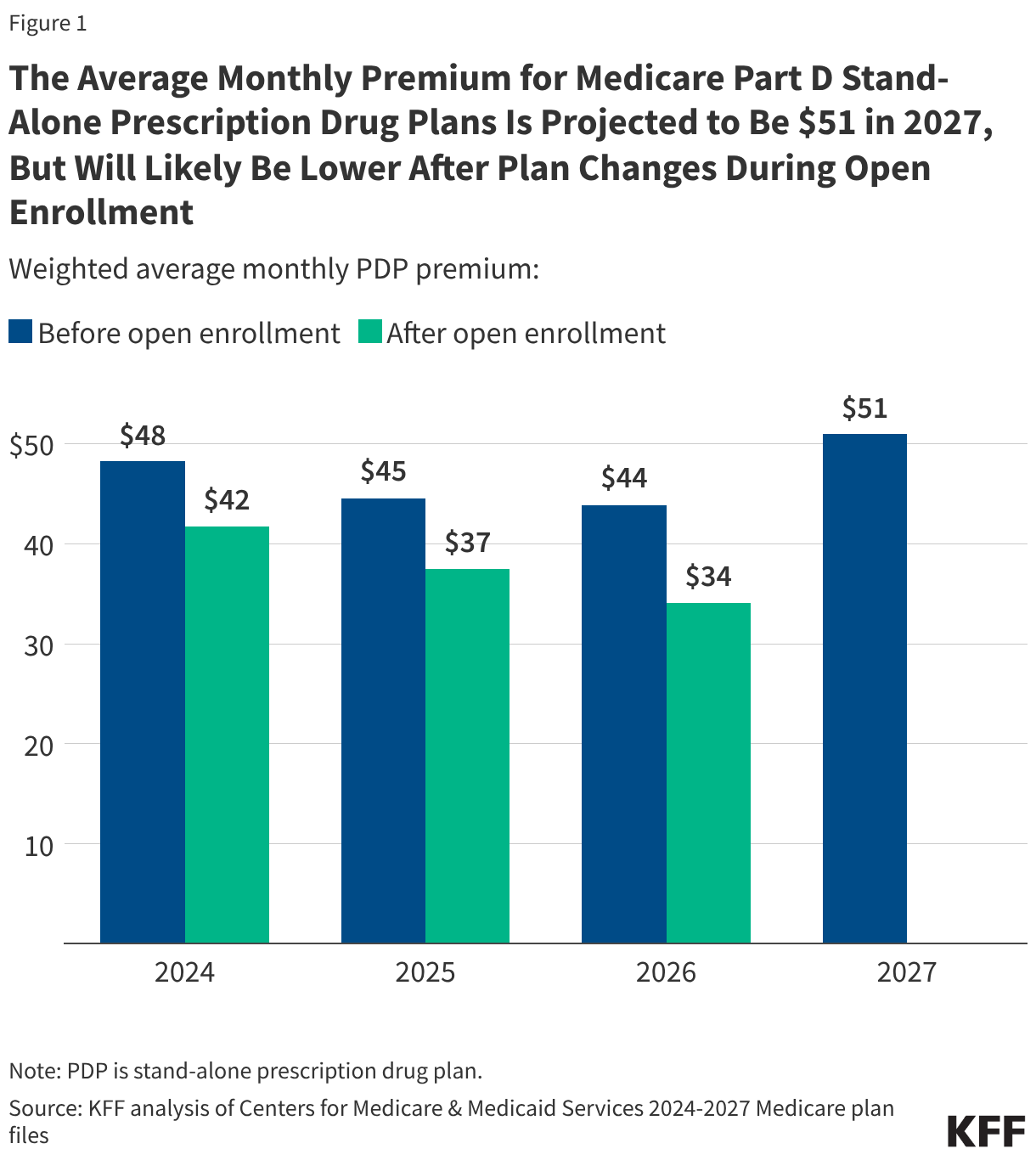
A similar trend occurred during the previous enrollment cycle. At the start of open enrollment in October 2025, the average monthly premium for stand-alone coverage was initially estimated to rise from $37 up to $44 for 2026 based on preliminary enrollment at that time. However, after accounting for active switching by existing enrollees and the choices made by new participants, the actual weighted average premium for 2026 ultimately landed at $34 as consumers migrated toward lower-premium alternatives.
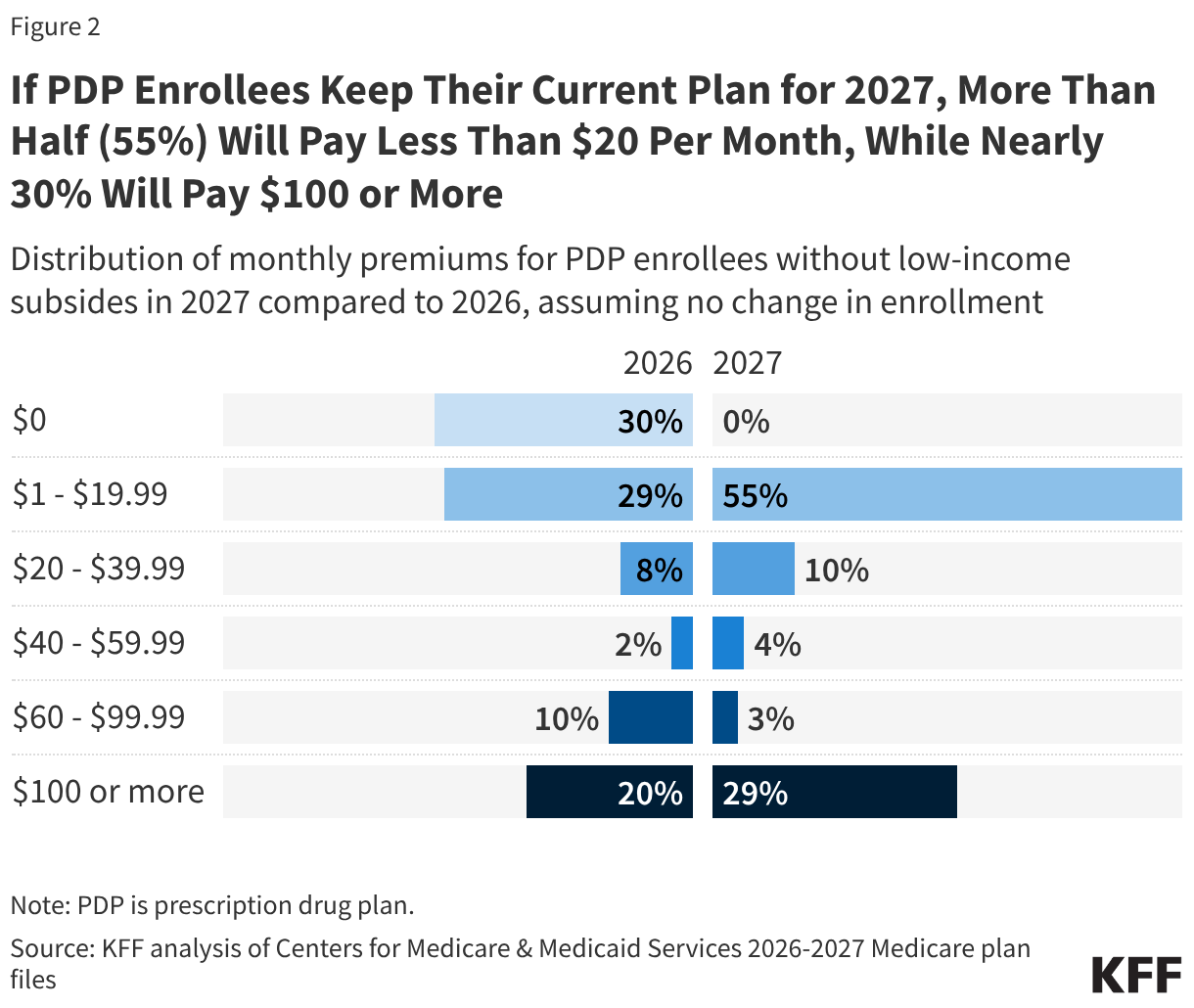
For the 13.6 million stand-alone prescription drug plan enrollees who do not receive Low-Income Subsidies, the financial landscape remains diverse. If these individuals retain their current plans for 2027, more than half, or approximately 55% totaling 7.5 million people, will pay monthly premiums of less than $20. At the same time, however, not a single enrollee will enjoy a zero-dollar monthly premium, and nearly 30%, amounting to 3.9 million beneficiaries, will face monthly costs of $100 or more. By comparison, in 2026, roughly 30% of these non-subsidized enrollees enjoyed zero monthly premiums, while only 20% paid $100 or more per month.
PDP Enrollees Will Pay Higher Monthly Premiums Than MA-PD Enrollees in 2027
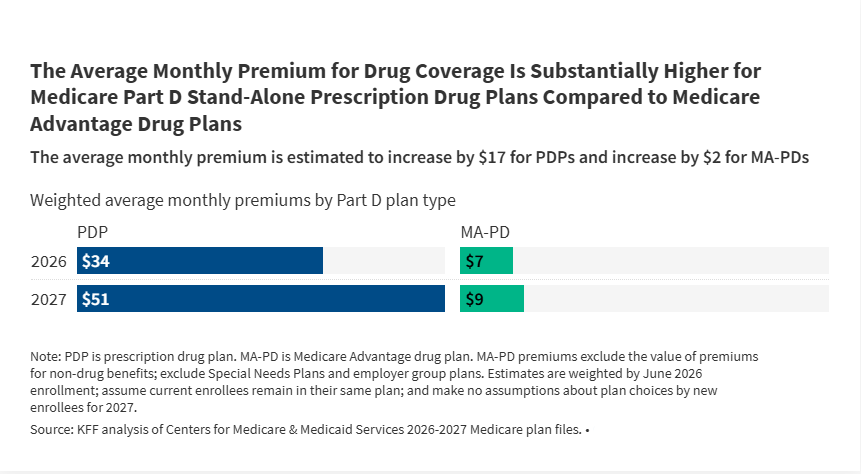
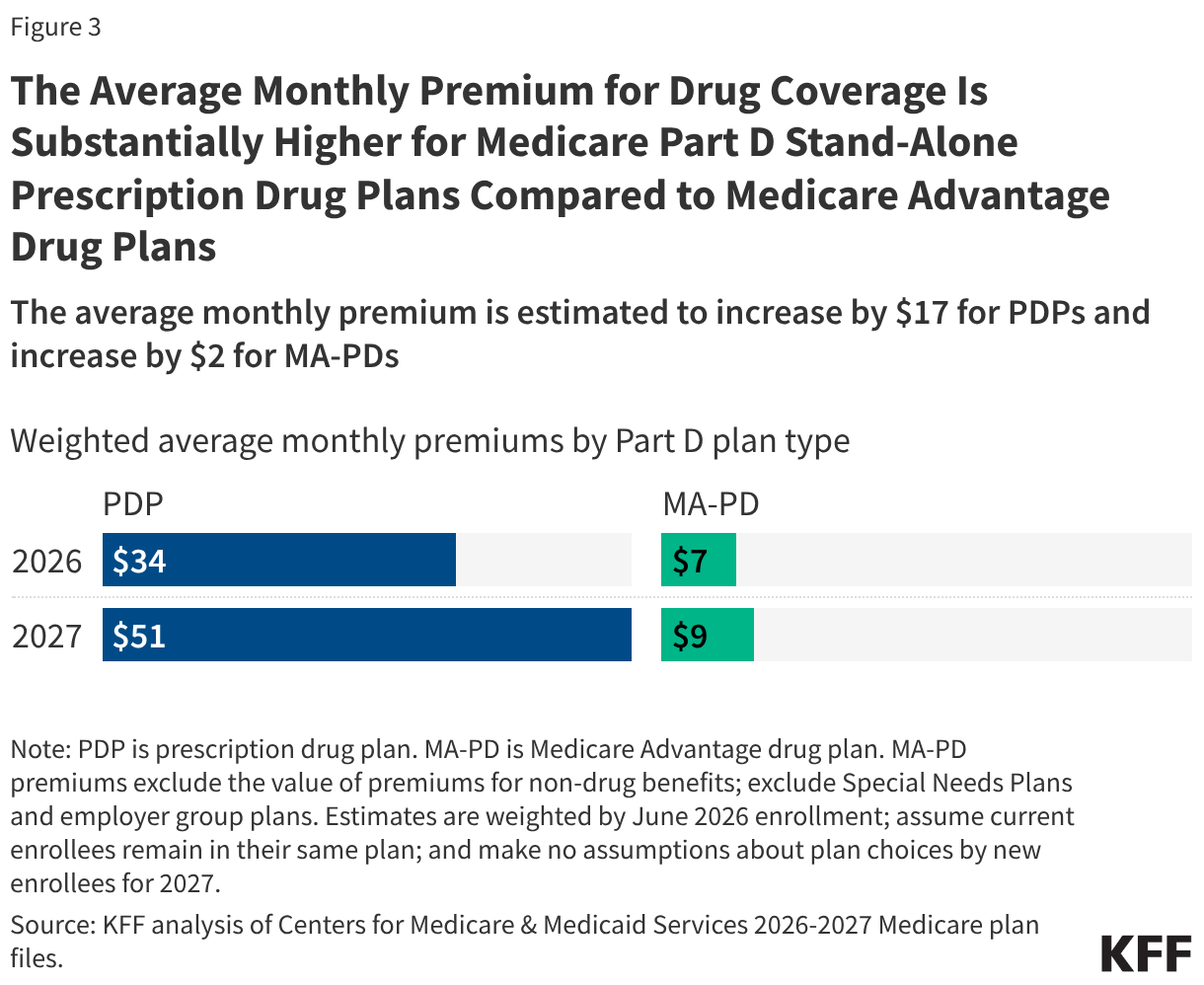
A persistent divide continues to characterize the two primary avenues for obtaining Medicare prescription drug coverage. Beneficiaries enrolled in stand-alone prescription drug plans will face substantially higher monthly financial burdens than those enrolled in Medicare Advantage prescription drug plans in 2027, with estimated averages of $51 versus $9, respectively.
The gap between these two models is widening. Between 2026 and 2027, the average monthly premium is increasing by $17, or 50%, for stand-alone plans, compared to a mere $2 increase, or 20%, for Medicare Advantage drug plans. The underlying mechanics of the Medicare program explain much of this disparity. Medicare Advantage plan sponsors are permitted to utilize rebate dollars generated from federal Medicare payments to lower or completely eliminate their Part D drug premiums while simultaneously offering supplemental benefits.
Conversely, no equivalent rebate system exists to subsidize stand-alone prescription drug plans. According to findings from the Medicare Payment Advisory Commission, monthly rebates per enrollee in Medicare Advantage have more than doubled since 2018, climbing from $95 to $199 in 2026. Of that $199 total monthly rebate amount in 2026, $51 was specifically deployed to reduce Medicare Advantage prescription drug plan premiums. Consequently, the Medicare Advantage premium structure is heavily skewed by zero-premium options, with nearly 8 in 10 enrollees without low-income assistance paying nothing out-of-pocket each month for their drug coverage.
Three-Fourths of PDP Enrollees Without Low-Income Subsidies Face Premium Increases
The expiration of federal temporary relief measures has compounded the financial pressure on stand-alone plan participants. Out of the 13.6 million stand-alone prescription drug plan enrollees without low-income subsidies in 2026, an overwhelming 10.4 million beneficiaries—representing 76% of this population—will see their monthly premiums rise in 2027 if they do not change plans.
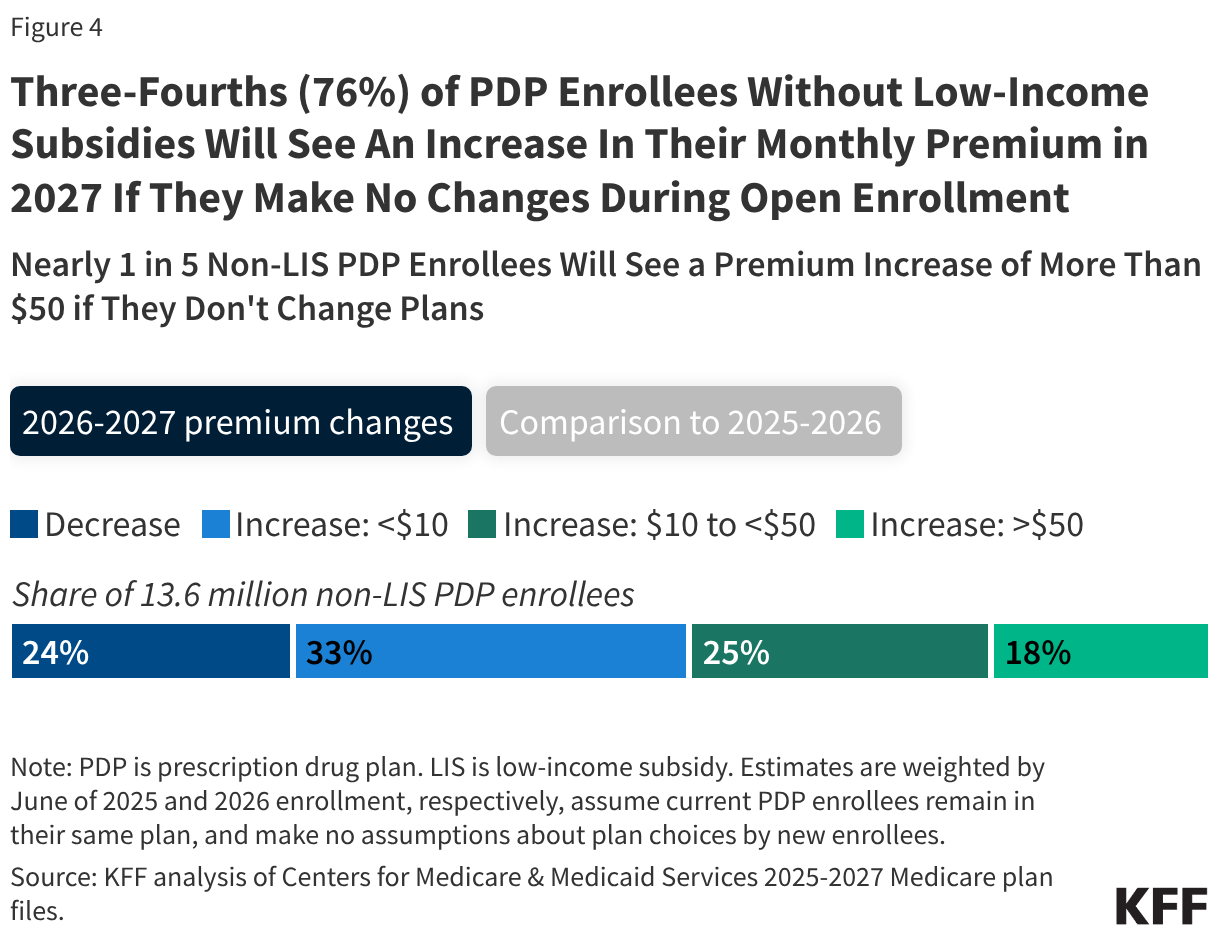
This broad increase includes 4.1 million enrollees who currently enjoy zero-monthly-premium plans in 2026. Because zero-premium stand-alone plans have been entirely phased out for the 2027 plan year, these individuals will inevitably transition to paying higher monthly costs. Among all non-subsidized enrollees facing higher rates, 2.4 million will see their monthly bills jump by more than $50 if they stay put. Conversely, for the 24% of enrollees who might experience a premium reduction, the vast majority—some 2.6 million people—will see savings of $5 or less.
This sharp upward trend contrasts starkly with the previous year. For 2026, about 56% of stand-alone enrollees faced potential premium increases, but fewer than 1%—roughly 38,000 individuals—faced hikes exceeding $50 per month. The Trump administration’s decision to discontinue the Part D Premium Stabilization Demonstration after the 2026 cycle officially ended the additional federal subsidies previously funneled to stand-alone plan sponsors. It also removed the regulatory cap that had limited the maximum allowable monthly premium increase to $50 for participating plans.
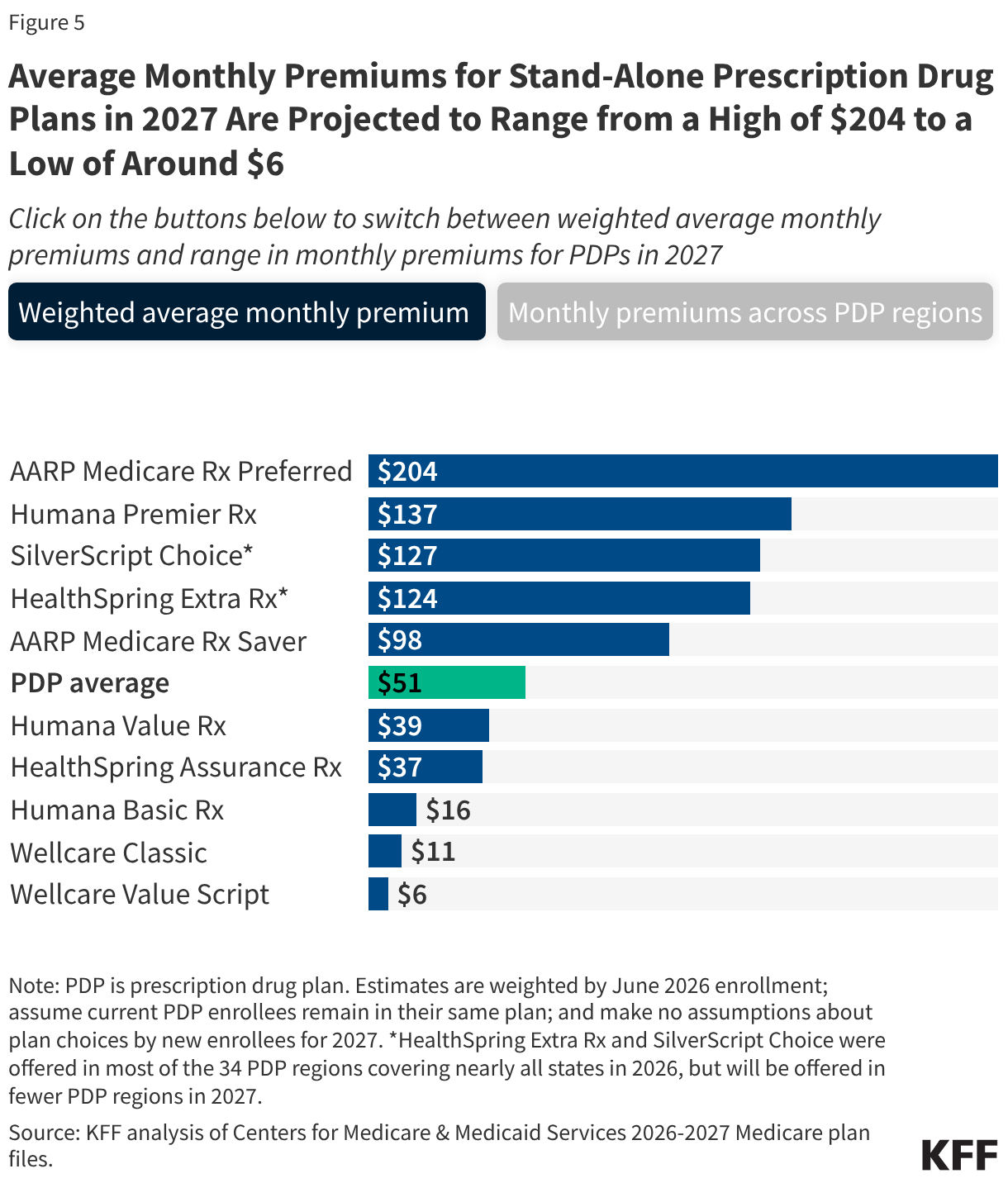
Average Monthly Premiums for National PDPs Vary Widely
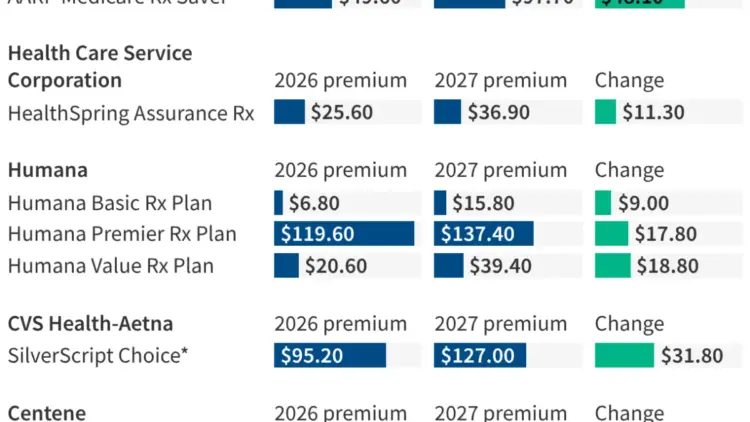
For beneficiaries navigating the market, Part D premiums for 2027 exhibit dramatic variation both across different insurance providers and across geographic regions for the exact same plan. Among the eight stand-alone prescription drug plans operating nationally across all 34 pricing regions in 2027, the lowest-priced offerings stem from Centene. The company’s Wellcare Value Script, an enhanced drug plan, features an average premium of $6.50, while its basic plan, Wellcare Classic, averages $10.90 per month. While both of these plans were accessible for zero monthly premium across numerous geographic areas in 2026, the complete absence of zero-premium options for 2027 pushes these averages into positive territory.
At the upper end of the pricing spectrum, some of the most expensive national stand-alone plans include UnitedHealthcare’s AARP Medicare Rx Preferred and the Humana Premier Rx Plan, which carry projected average monthly premiums of $204.50 and $137.40, respectively.
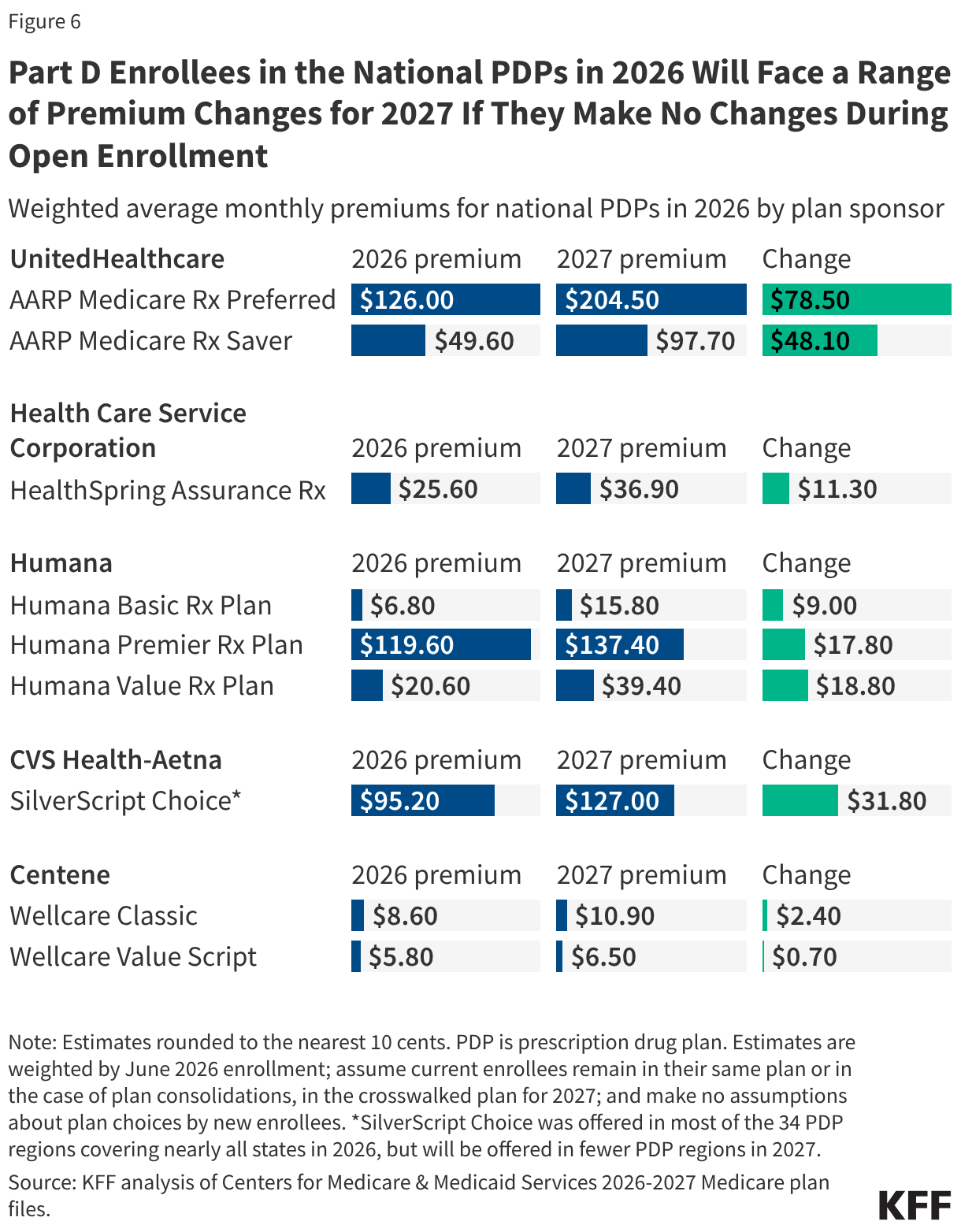
Geographic discrepancies further complicate the picture for consumers. For six of the eight national stand-alone plans, the price difference between the highest-cost and lowest-cost regions exceeds $90. For instance, while the average monthly premium for AARP Medicare Rx Preferred sits at $204, regional pricing spans from a low of $136.70 to a high of $264.50. Similarly, the AARP Medicare Rx Saver averages $98 per month nationally, yet ranges wildly from $10.30 to $235.30 depending on where the enrollee lives. Consequently, enrollees remaining in these national plans without evaluating alternatives could encounter steep financial surprises.
Deductibles and Cost Sharing
Financial obligations for Medicare beneficiaries extend well beyond monthly premiums, encompassing annual deductibles and per-prescription cost-sharing structures that are also shifting upward for 2027.
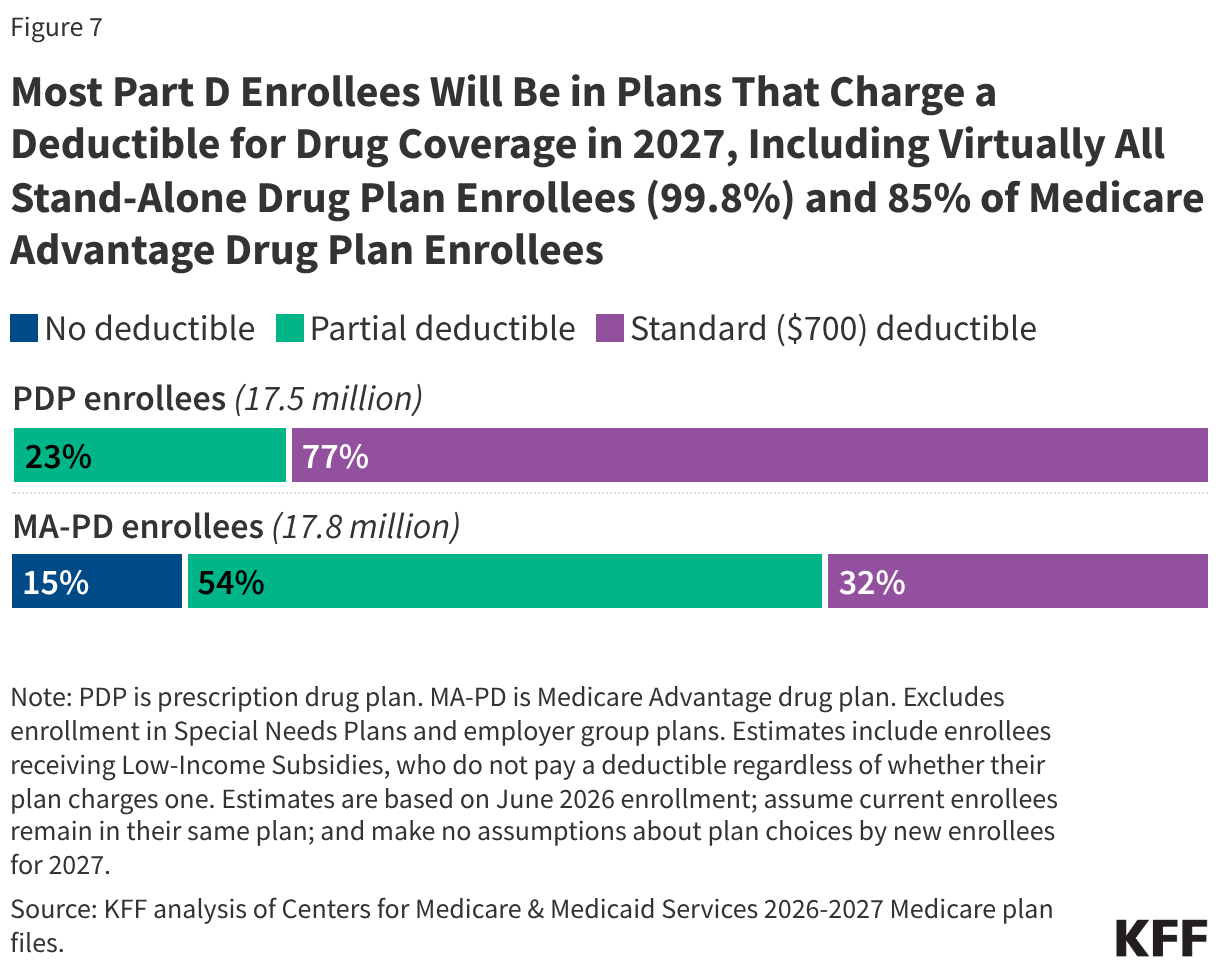
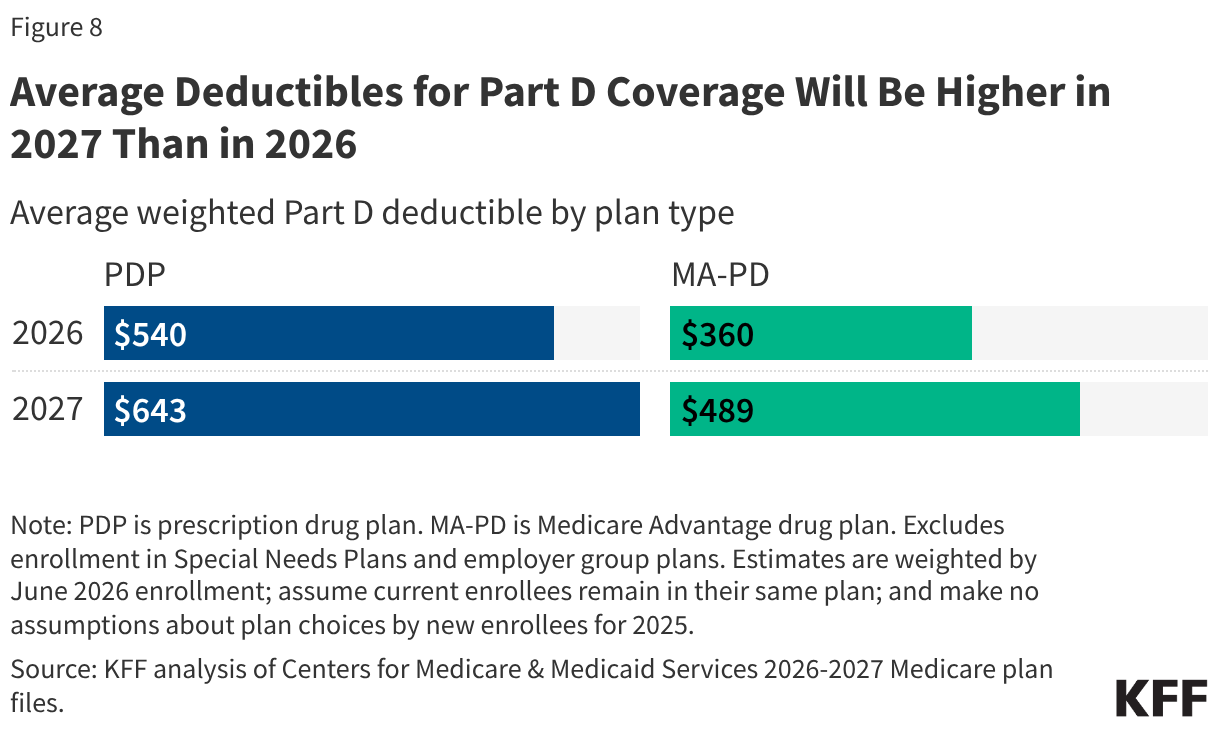
The proportion of Medicare Advantage drug plan enrollees subjected to a deductible for their coverage will climb from 80% in 2026 to 85% in 2027 for those who maintain their current policies. Meanwhile, virtually all stand-alone prescription drug plan enrollees—99.8%—will find themselves in plans that charge an annual deductible, marking a slight increase from 96% the previous year. While low-income subsidies cover these deductible costs for qualifying individuals, the baseline structure affects millions of standard participants.
The weighted average Part D deductible for 2027 is projected to reach $643 for stand-alone plan enrollees and $489 for Medicare Advantage drug plan enrollees, tracking alongside an increase in the standard Part D deductible from $615 up to $700. Although stand-alone enrollees continue to face higher overall average deductibles, Medicare Advantage enrollees are experiencing a sharper rate of increase. Between 2026 and 2027, the average deductible for Medicare Advantage drug plans is jumping by $128, or 36%, compared to a $103 increase, or 19%, for stand-alone plans.
Beyond deductibles, cost-sharing designs heavily favor coinsurance over fixed copayments for brand-name and non-preferred medications. Coinsurance, which calculates patient responsibility as a percentage of a drug’s total cost rather than a flat dollar amount, often introduces greater unpredictability into out-of-pocket spending.
Under the typical five-tier formulary design utilized across Part D, tiers generally include preferred generics, standard generics, preferred brands, non-preferred drugs, and specialty pharmaceuticals. For preferred brands and non-preferred drugs, the vast majority of enrollees now face coinsurance rather than traditional copayments. The share of Medicare Advantage drug plan enrollees facing coinsurance for preferred brands is jumping from 54% in 2026 to 83% in 2027, while nearly 90% face coinsurance for non-preferred medications. Among stand-alone plan participants, nearly all face coinsurance for these non-generic tiers.
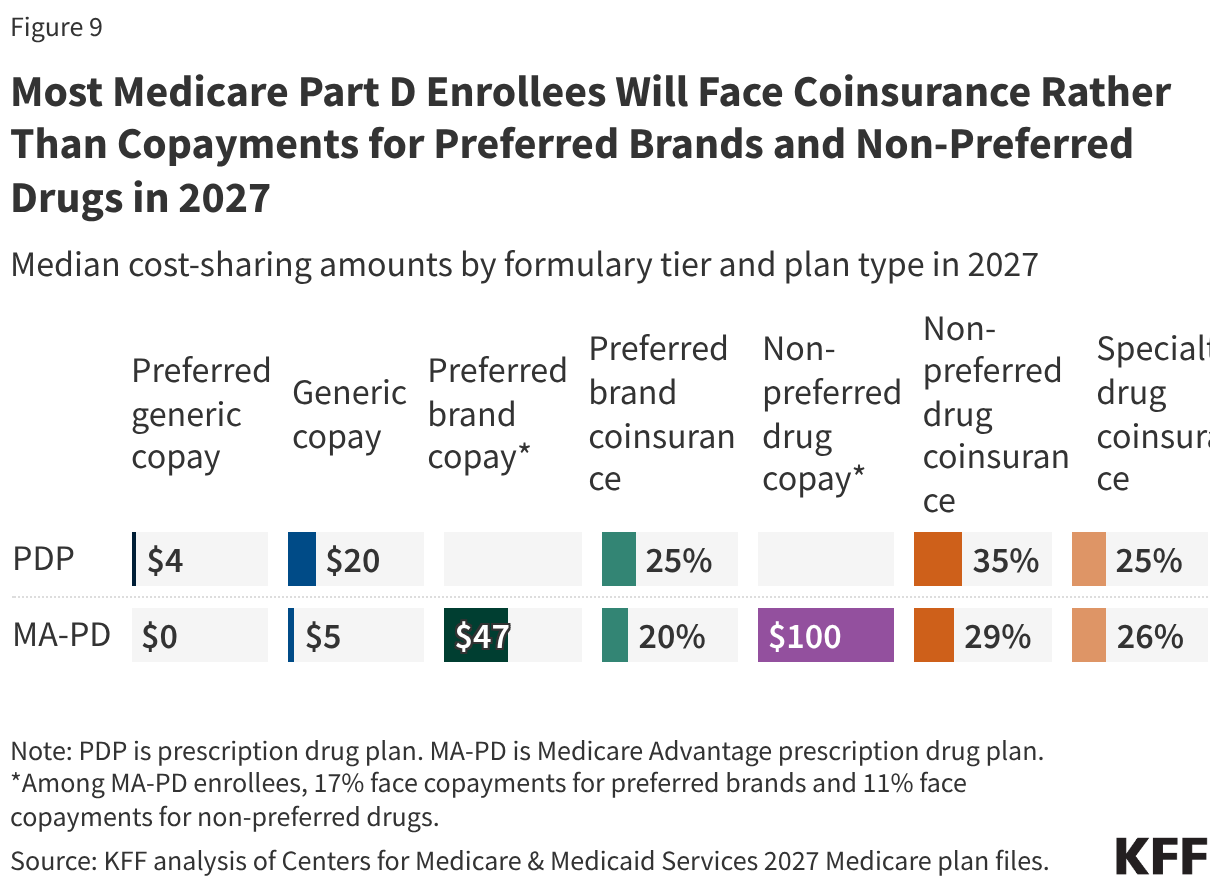
Median standard cost sharing across all Part D plans for 2027 reflects these distinct tier categories. Enrollees in national stand-alone plans typically encounter median copayments ranging from $0 to $5 for preferred generics, and $1 to $20 for standard generics. For preferred brands, median coinsurance spans from 16% to 25%, while non-preferred drugs carry median coinsurance rates between 30% and 50%, and specialty drugs range from 25% to 30%. Plan adjustments for the new year also introduce structural shifts, such as Centene’s addition of a dedicated injectable drug tier featuring a 15% coinsurance rate and the consolidation of its generic tiers into a unified structure within its Wellcare offerings.