WASHINGTON — In a significant legislative development on November 16, 2026, the Senate Appropriations Committee officially released its final batch of fiscal year 2027 appropriations bills and accompanying reports. This major legislative package includes the measures for State, Foreign Operations, and Related Programs—which is alternatively referred to in the final fiscal year 2026 legislation and the House fiscal year 2027 appropriations bills as National Security, Department of State and Related Programs, or NSRP. Alongside the foreign affairs measure, the committee released the comprehensive appropriations bill for Labor, Health and Human Services, Education, and Related Agencies, commonly known as LHHS.
Together, these two cornerstone appropriations bills provide the vital funding machinery for the vast majority of United States global health activities. Beyond raw financial allocations, the newly released legislative texts and their accompanying explanatory statements incorporate crucial policy provisions. These directives either directly impact how federal dollars are spent or provide explicit programmatic guidance and direction on the administration of global health funding across international and domestic agencies.

The release of the Senate measures marks a critical milestone in the ongoing federal budget process, setting up subsequent legislative negotiations and offering a clear window into congressional priorities for international diplomacy, foreign assistance, domestic health infrastructure, and educational initiatives. Analysts, public health advocates, and policymakers are currently examining the fine print of both bills to understand how the Senate’s proposed funding levels compare to previous fiscal years and to competing proposals originating in the House of Representatives.
The State, Foreign Operations, and Related Programs bill and its corresponding explanatory statement outline specific funding amounts and policy directives tailored for international U.S. global health programs managed primarily through the Department of State and the United States Agency for International Development. These programs traditionally encompass a wide array of bilateral and multilateral initiatives designed to combat infectious diseases, strengthen fragile healthcare systems in developing nations, support maternal and child survival, and address critical humanitarian needs across the globe.
Simultaneously, the Labor, Health and Human Services, Education, and Related Agencies bill addresses domestic programs that often intersect with global health security, research, and multilateral health coordination. While the primary focus of the LHHS measure centers on domestic public health institutions, education systems, and labor programs, its provisions frequently ripple outward to affect global health research, biomedical innovation, and international health surveillance executed by agencies such as the Centers for Disease Control and Prevention and the National Institutes of Health.
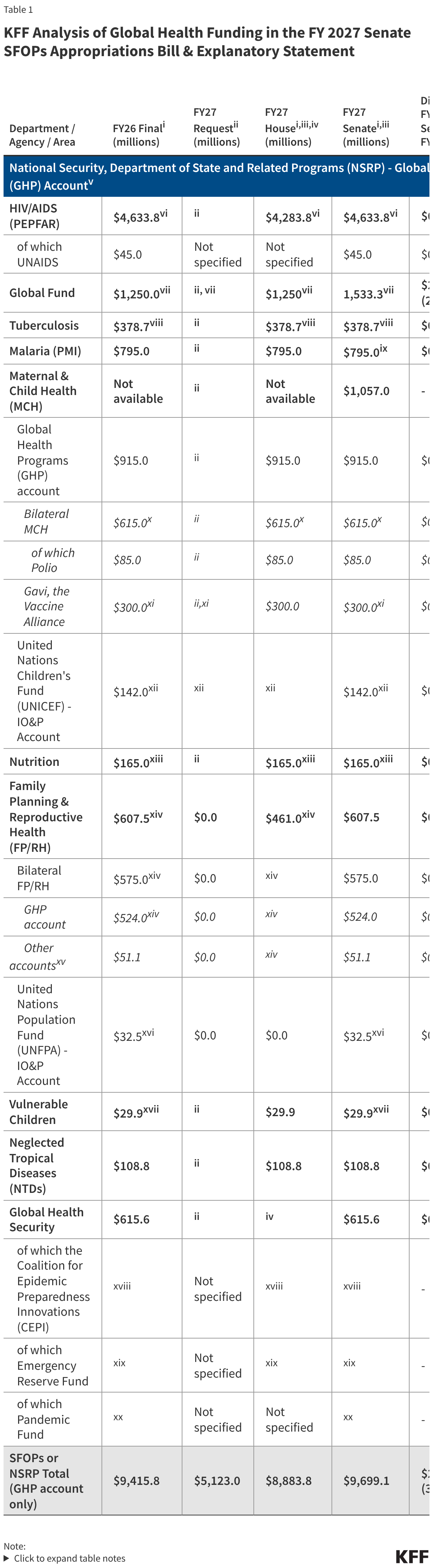
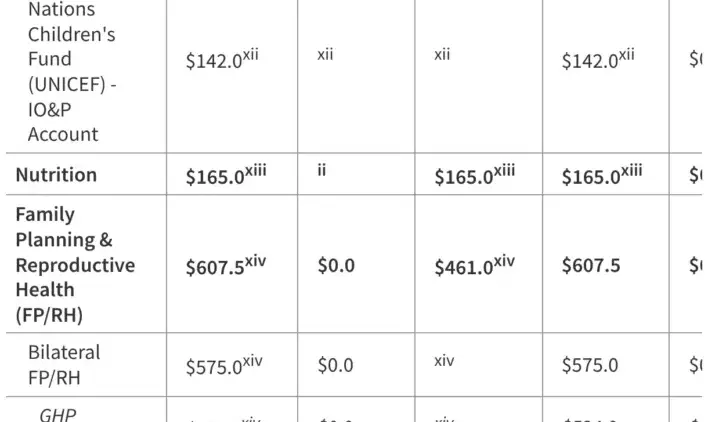
The unveiling of these documents allows budget experts and public health stakeholders to conduct detailed comparative analyses. For instance, a review of broader legislative trajectories indicates that the House fiscal year 2027 bill and its explanatory statement previously proposed an allocation of $8.8 billion specifically to the Global Health Programs account. While that House framework provided explicit, itemized funding amounts for several key areas—including HIV and AIDS programs, contributions to the Global Fund to Fight AIDS, Tuberculosis and Malaria, bilateral tuberculosis programs, malaria mitigation efforts, maternal and child health initiatives, nutrition programs, support for vulnerable children, and neglected tropical diseases—it notably omitted specific funding breakdowns for global health security as well as family planning and reproductive health programs. The newly released Senate package provides the upper chamber’s distinct perspective on these allocations, offering a comprehensive basis for comparison between the two chambers of Congress as the legislative process moves forward.
To assist researchers, policymakers, and the public in navigating these complex budgetary shifts, specialized tracking organizations have made detailed resources publicly available. Comprehensive budget summaries and interactive tracking tools, such as those maintained by KFF, offer deep dives into the historical context of annual appropriations for global health programs. These tools allow observers to place the fiscal year 2027 Senate proposals into a broader historical perspective, charting trends in funding levels over successive congressional sessions and presidential administrations.
As the legislative session progresses, the details contained within the Senate Appropriations Committee’s latest release will serve as an essential baseline for lawmakers attempting to reconcile differences between the House and Senate versions of the appropriations bills. The ultimate outcome of these negotiations will dictate the operational capacity of U.S. global health agencies, determining the level of resources available to address persistent health challenges, emerging infectious disease threats, and foundational healthcare needs worldwide throughout fiscal year 2027.