Introduction
In the wake of sweeping changes to U.S. foreign aid initiated early in President Trump’s second administration, the landscape of international public health has
undergone a fundamental transformation. The structural overhaul included a significant reduction in supported projects and organizations, the dissolution of the U.S. Agency for International Development (USAID), and the transition of remaining global health responsibilities to the Department of State. Following months of uncertainty, the State Department officially launched the America First Global Health Strategy (AFGHS) in September 2025. This comprehensive strategy outlines a paradigm shift in how the United States plans to execute its global health initiatives moving forward.
At the core of this new approach are bilateral agreements negotiated directly between the United States and partner nations receiving U.S. global health assistance. To date, 36 of these bilateral agreements have been established through Memoranda of Understanding (MOUs), totaling $26.7 billion in pledged commitments, though detailed information regarding the current operational status of many agreements remains limited. These MOUs identify and prioritize localized health needs to be financed jointly by the U.S. government and participating partner countries. Out of the total committed funds, the U.S. has pledged $15.9 billion, while partner nations have committed to co-invest $10.3 billion.
While the State Department intends to implement these MOUs primarily through government-to-government funding agreements, these mechanisms are still in their infancy and are expected to take considerable time to develop fully. To bridge this gap and provide immediate support, the State Department established an open-ended competitive funding mechanism known as an Annual Program Statement (APS). Entitled the "Advancing Global Health APS" (AGH/APS), this supplemental framework was designed to solicit applications from eligible organizations to directly support the overarching goals of the AFGHS.
Announced in March 2026, the State Department anticipates utilizing the AGH/APS to distribute up to $4.5 billion—subject to the annual availability of funds—across four distinct funding windows running from March 2026 through February 2027. Individual awards under this mechanism range from $500,000 to $250 million over a five-year period. While some of this capital will be integrated directly into a country’s overall MOU funding envelope, other allocations may sit outside those pre-established envelopes. Eligible applicants encompass a diverse group of entities, including U.S. and foreign private for-profit enterprises, public and private institutions of higher education, faith-based organizations, Public International Organizations, and governmental institutions.
To provide greater transparency into U.S. global health efforts under the post-USAID framework, a new policy brief analyzes the AGH/APS award opportunities, known as addenda, announced to date. By examining how financial resources are directed across various countries and targeted areas of public health programming, observers can paint a clearer picture of how future U.S. global health investments will take shape in this new era.
Analysis of Funding Addenda and Windows
As of November 2026, the State Department has released 12 distinct addenda encompassing up to 122 possible awards across three funding rounds, totaling an estimated $1.43 billion. This figure represents nearly one-third, or approximately 32 percent, of the $4.5 billion in total anticipated funding. The released addenda are divided between country-specific solicitations and broad, area-specific global health priorities.
The rollout of these funds has been structured across multiple sequential windows. Window 1, which ran from March 5 to May 31, 2026, accounted for up to $542.65 million distributed across 21 potential awards. Window 2A followed between June 2 and July 31, 2026, offering up to $295 million across 39 awards. Window 2B overlapped slightly, running from July 1 to September 15, 2026, providing up to $315.4 million for 25 awards. Window 3 opened on August 15 and closed on October 30, 2026, featuring up to $277 million across 37 awards. A final funding window, Window 4, was expected to launch in mid-November 2026 and run through late January 2027.
An analysis of the 12 addenda reveals a nearly even split between geographic and programmatic focuses. Country-specific addenda account for up to $730 million, or 51 percent of the announced funding, while area-specific addenda represent up to $700 million, or 49 percent. These solicitations detail a wide range of specific objectives, targeted populations, and programmatic activities tailored to meet both local and global health demands.
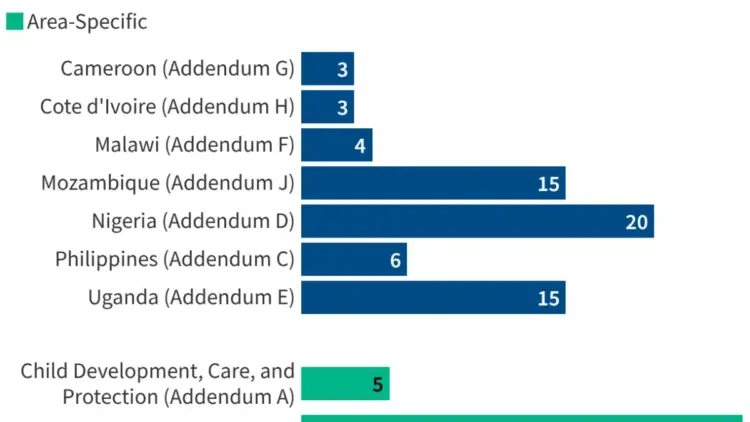
Across the seven country-specific addenda, funding has been directed toward nations such as Cameroon, Côte d’Ivoire, Malawi, Mozambique, Nigeria, the Philippines, and Uganda. These country-focused grants are generally designed to support the implementation of bilateral MOU plans, strengthen national and subnational health systems, enhance disease surveillance for outbreak preparedness, and accelerate the transition toward sustainable, government-led health infrastructure by the year 2030. For instance, large-scale allocations in Nigeria and the Philippines reach up to $200 million each, targeting high-burden populations, expanding digital health innovations, and reinforcing local supply chains. Similarly, substantial investments in Mozambique ($180 million), Uganda ($60 million), Côte d’Ivoire ($50 million), Malawi ($35 million), and Cameroon ($5.4 million) focus heavily on integrating health services, improving maternal and child health outcomes, and sustaining gains against infectious diseases like HIV, tuberculosis, and malaria.
Simultaneously, the five area-specific addenda address broader, cross-cutting global health challenges. These include child development, care, and protection initiatives backed by $52.65 million across five awards, and a massive $290 million allocation dedicated to rapid outbreak responses across 10 potential awards. To tackle persistent regional epidemics, the State Department has allocated $162 million across 25 awards to accelerate the elimination of neglected tropical diseases in specific countries spanning the Western Hemisphere, Africa, and the Asia-Pacific region. Furthermore, maternal and child nutrition programs have received $115 million across 12 awards targeting high-burden nations, while $80 million has been set aside across four awards to foster innovations in population-based surveys and health surveillance systems.
These findings offer crucial insight into how the United States intends to operationalize its foreign assistance policy under the AFGHS. The selected priorities highlight which MOU partner countries are receiving focused attention, which global health areas are deemed vital for cross-cutting support, and what specific objectives are being pursued beyond baseline bilateral agreements.
Nevertheless, the APS competitive process remains active, and additional addenda are anticipated as the final funding round proceeds. As of late 2026, no specific award recipients have been publicly announced, leaving the ultimate distribution of funds subject to change based on the evaluation of incoming applications. Moving forward, continuous monitoring will be essential to understand how the APS mechanism and its resulting awards successfully complement the broader framework of the America First Global Health Strategy.