Millions of Americans rely on Medicaid home- and community-based services to manage daily life, but behind those statistics lies a massive network of family members who provide the bulk of hands-on daily support. According to estimates from KFF, roughly 5.3 million Medicaid enrollees utilize home care, which delivers essential medical and supportive assistance for individuals struggling with daily activities such as bathing, eating, preparing meals, and managing medications. While Medicare generally excludes home care from its standard coverage, Medicaid stepped up to finance roughly two-thirds of all home care spending across the United States in 2023.
Within this expansive framework, many participants "self-direct" their care. This approach gives enrollees greater autonomy over the types of services they receive, the schedules they maintain, and the individuals they hire to provide care—including, in many cases, family members and friends. These compensation structures serve as a critical buffer against the severe financial hardships experienced by family caregivers, many of whom are forced to scale back their employment hours or exit the workforce entirely to meet the relentless demands of caregiving.
Focus groups conducted by KFF reveal that family caregivers routinely struggle to stay afloat financially due to lost wages and reduced hours at outside jobs. Furthermore, a 2026 study on out-of-pocket caregiving costs published by AARP found that caregiving expenses consume nearly one-third of average household incomes, with burdens rising even higher for lower-income individuals and those managing complex medical needs. Beyond alleviating financial stress, self-directed care models help counteract persistent labor shortages among traditional paid home care workers, a dynamic that often places an unsustainable strain on families. To help shoulder these burdens, Medicaid also extends non-financial supports such as specialized training, support groups, and respite care, which offers paid temporary relief so family caregivers can take necessary breaks from their daily responsibilities.
However, as the nation approaches 2027, states are increasingly pressured to pare back or closely scrutinize Medicaid supports. Factors driving these pressures include slower state revenue growth, major shifts in Medicaid financing stemming from the 2025 reconciliation law, and aggressive federal initiatives focused on program integrity. While federal program integrity efforts have primarily targeted provider organizations suspected of fraud, the decentralized nature of delivering home care inside private residences—coupled with direct payments to family and friends who operate outside traditional registered provider networks—has drawn heightened regulatory scrutiny. Recent tracking of programmatic changes across state Medicaid home care systems indicates that several proposed policy cuts directly target programs assisting family caregivers.
Against this backdrop, new data from KFF’s 24th annual survey of state officials administering Medicaid home care programs sheds light on how self-direction and family caregiver supports are functioning. The survey, completed between April and August 2026, gathered insights from officials across 50 states and the District of Columbia. The findings illustrate a nationwide commitment to self-direction and family caregiving, even as structural and fiscal challenges loom on the horizon.
How Many States Allow Medicaid Enrollees to Self-Direct Their Home Care?
Nearly all states permit Medicaid enrollees to self-direct their home care under specific circumstances. The practice of self-direction traces its roots back to the consumer-directed movement for personal care services that began with demonstration grants funded by the Robert Wood Johnson Foundation in 19-state initiatives. Today, states incorporate self-direction options across a wide array of program structures, most frequently deploying them within waiver programs designed for individuals with intellectual or developmental disabilities, followed by programs serving adults aged 65 and older or those with physical disabilities. Among the responding states, Alaska stands out as the only jurisdiction that does not permit self-direction in any of its home care programs.
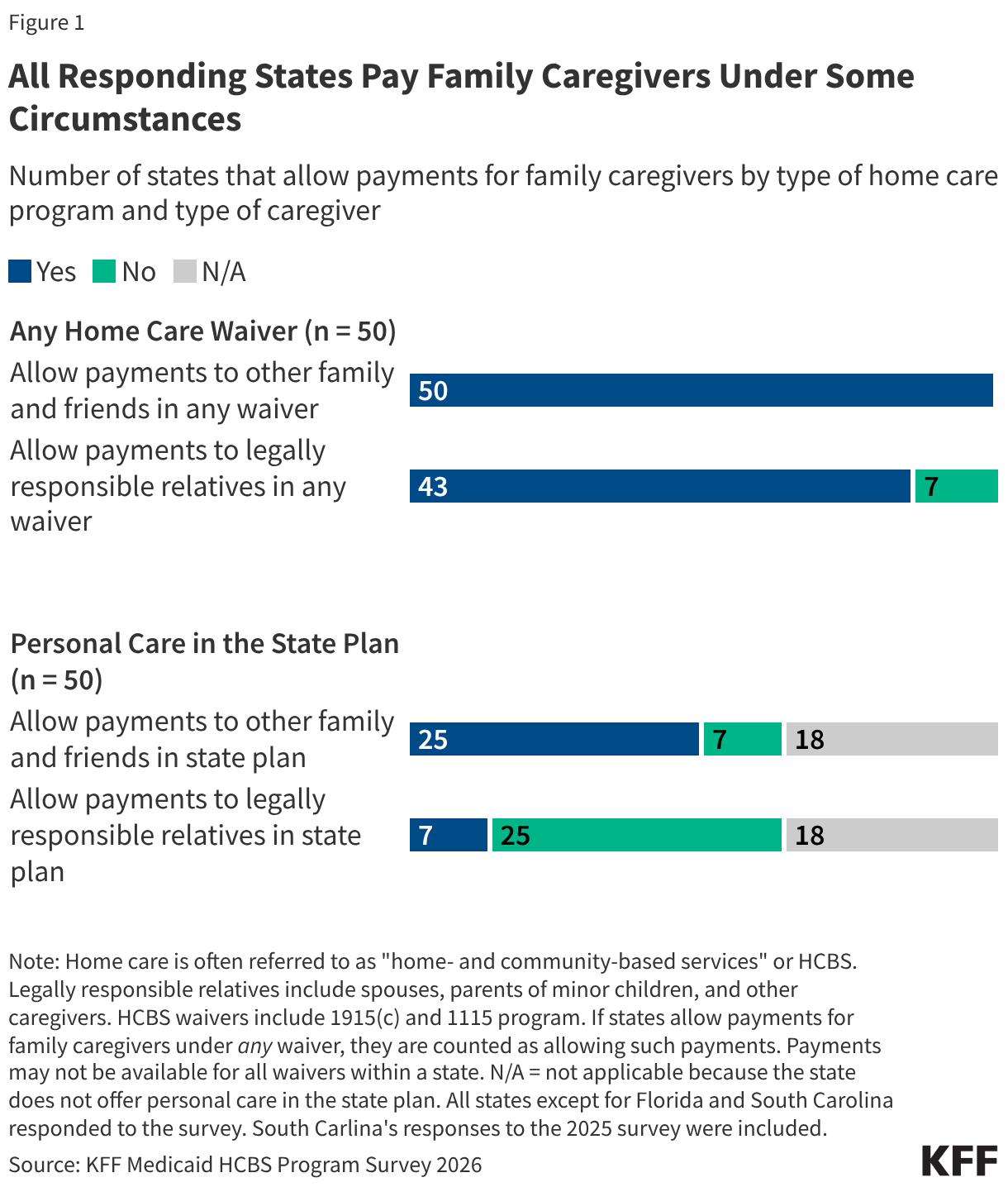
While nearly every responding state authorizes self-direction under at least one program, several states further expanded these options between 2025 and 2026. For example, Indiana newly permitted self-direction within its waivers for individuals with intellectual or developmental disabilities and those with traumatic brain or spinal cord injuries. New York introduced self-direction into its waivers for older adults and individuals with physical disabilities, while New Mexico expanded the option to its waiver for medically fragile and technology-dependent children. Additionally, the District of Columbia incorporated self-direction into its state plan personal care benefit.
Among the states authorizing self-direction, all permit enrollees to select, train, dismiss workers, and set caregiver schedules. This foundational authority, commonly known as "employer authority," empowers participants—with assistance from designated representatives when appropriate—to decide who enters their home to provide care. Furthermore, every state with a self-directed program allows participants to hire independent providers who are not formally registered as traditional Medicaid provider organizations.
For example, consider Helen, an 85-year-old woman living alone who requires daily assistance after suffering a stroke. Because her state permits self-direction and the hiring of family members, Helen chooses to hire her adult daughter, Emily, as her caregiver. To take on this role, Emily quits her previous job, enrolls with the state, and completes all mandatory paperwork. The state establishes Emily’s hourly wage and authorizes seven hours of daily care. Helen assigns Emily’s daily tasks within state guidelines, and Emily submits weekly timesheets so the state can issue pay and handle necessary tax withholdings.
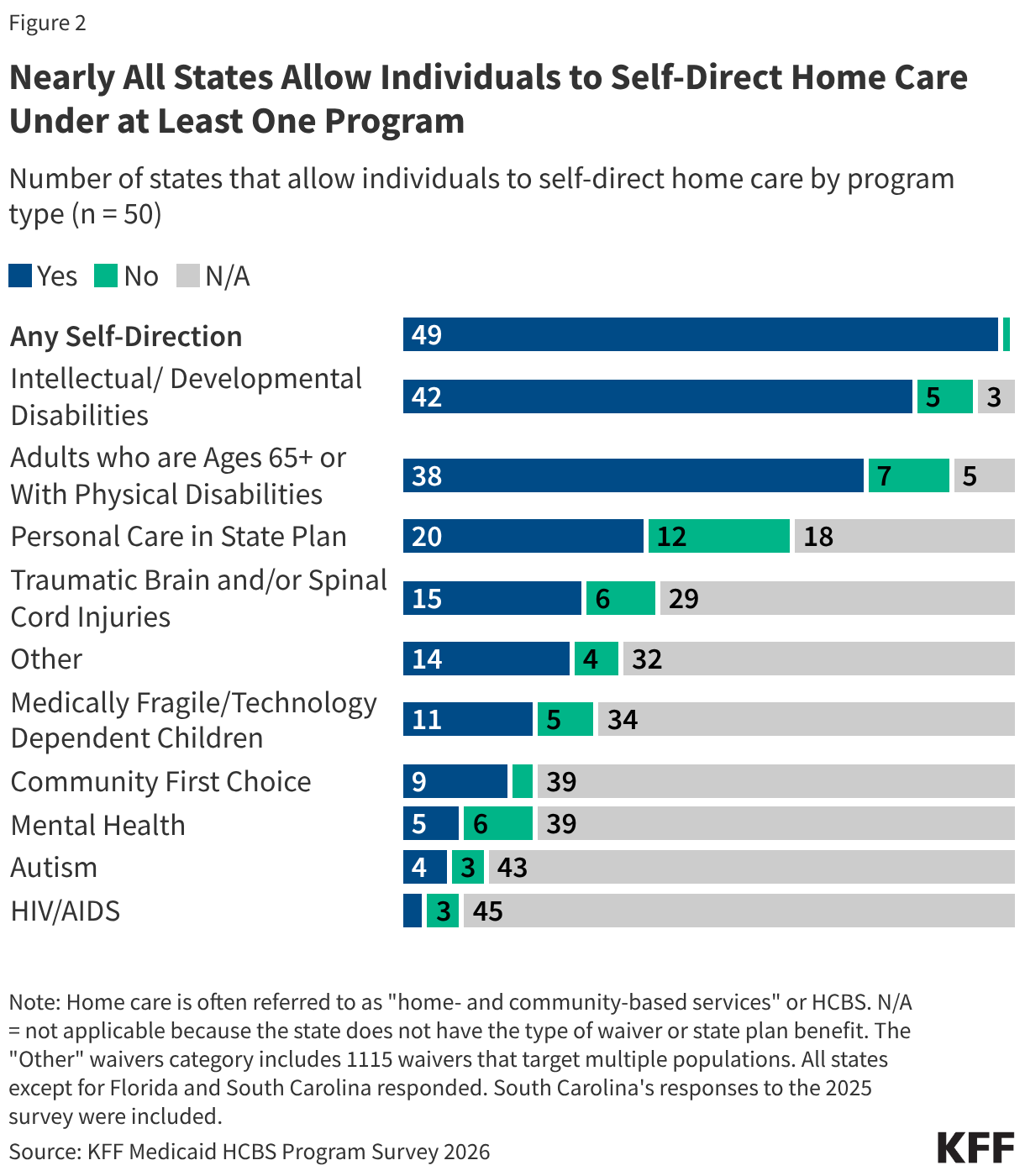
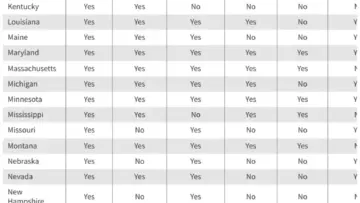
Beyond employer authority, a vast majority of states grant participants "budget authority," which allows enrollees to establish payment rates for their caregivers and decide how Medicaid funds are distributed across various authorized services. Forty states permit enrollees to set caregiver payment rates, and 39 states allow participants to determine how their approved budget is allocated among multiple approved supports.
This model often involves a fiscal intermediary. For instance, Jason, a 32-year-old man with a spinal cord injury, receives a monthly care budget that he manages with the help of a state-contracted fiscal intermediary. Jason uses his budget to hire a caregiver named Steve, set Steve’s hourly wage, and allocate remaining funds toward additional approved supports, such as meal delivery services or respite care to give his wife a break from unpaid caregiving duties. The intermediary handles payroll, tax compliance, and spending tracking to ensure Jason remains within his allocated budget.
Federal rules require states offering budget authority to provide participants with financial management services to assist with billing, documentation, payroll, tax withholding, and expenditure tracking. Nearly all states utilize outside fiscal intermediaries for these tasks, though exceptions exist. Mississippi handles these functions directly through its Department of Rehabilitation Services, while the Nebraska state Medicaid agency acts as the direct fiscal agent for participants. Despite the widespread availability of self-direction, the exact proportion of individuals utilizing these options remains difficult to pin down, as over half of reporting states could not provide precise enrollment percentages, though reporting states generally indicated that fewer than 25% of participants actively self-direct care.
How Many States Pay Family Caregivers and Through Which Home Care Programs?
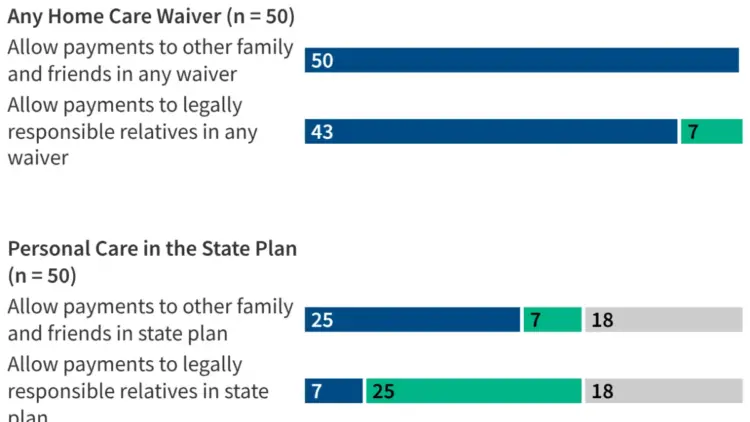
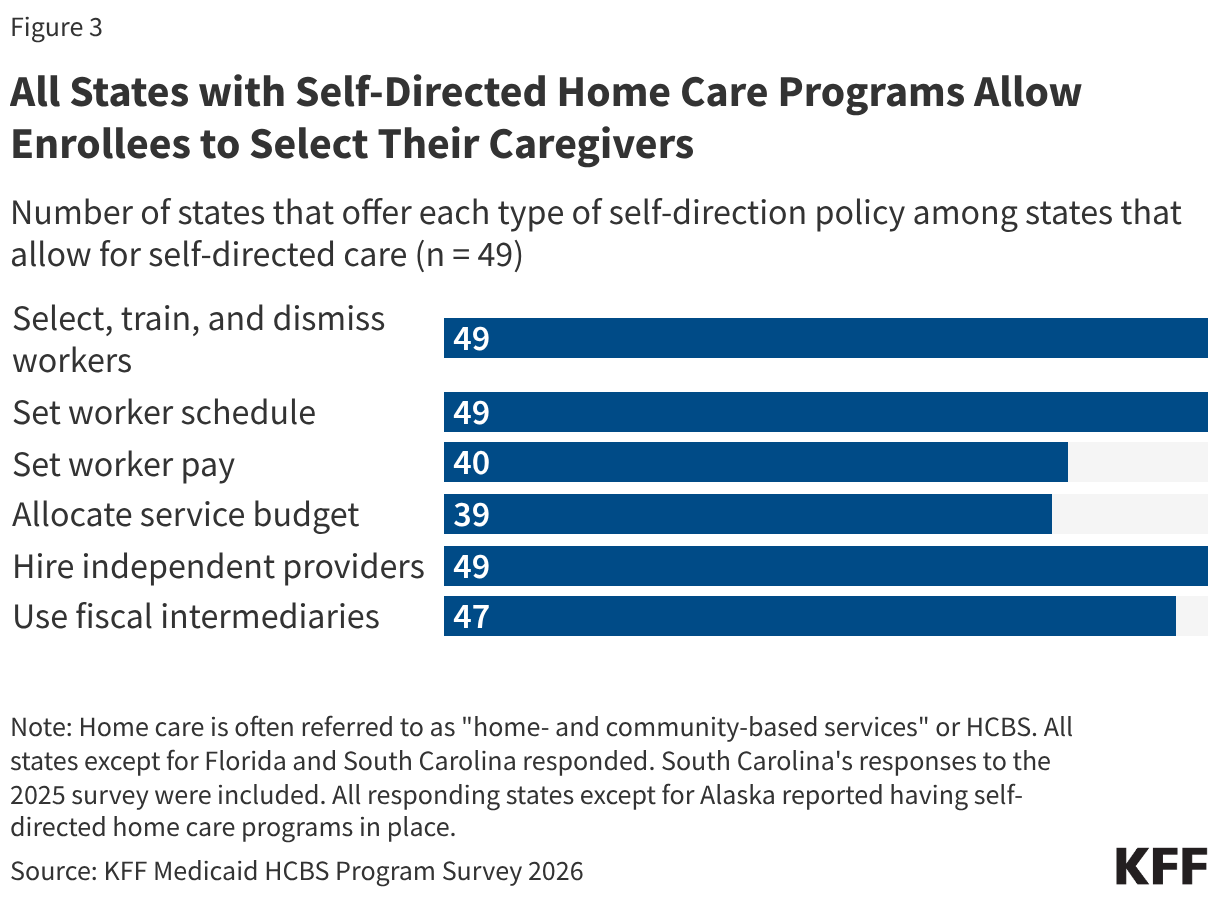
All responding states compensate family caregivers through at least one Medicaid home care program. Payments are most frequently authorized for personal care delivered via waivers, such as Section 1115 or Section 1915(c) programs, or through combined state plan options. While waiver programs often encompass a broader suite of benefits, they are typically restricted to specific target populations, geographic regions, or limited enrollment numbers, which frequently results in waiting lists.
While every responding state allows payments to family and friends through waiver programs, fewer jurisdictions permit payments to legally responsible relatives, such as spouses or parents of minor children. Forty-four states authorize payments to legally responsible relatives under waivers, reflecting the more complex federal legal requirements governing these relationships. Under federal rules, personal care provided by spouses and parents through standard state plan authorities is generally prohibited unless strict criteria are met. However, waiver programs often permit payments to legally responsible relatives if the care is deemed "extraordinary"—meaning it exceeds normal family responsibilities and is strictly necessary to prevent institutionalization. Nebraska expanded its policies in 2026 to newly permit payments to legally responsible relatives across its intellectual and developmental disability waivers as well as its programs for older adults and individuals with physical disabilities.
Payments to family caregivers are most prevalent within intellectual and developmental disability waivers, where all 47 responding states with such programs authorize family compensation. By contrast, 41 out of 45 responding states with waivers for older adults and individuals with physical disabilities permit family payments, and 18 out of 21 states with traumatic brain or spinal cord injury waivers do the same.
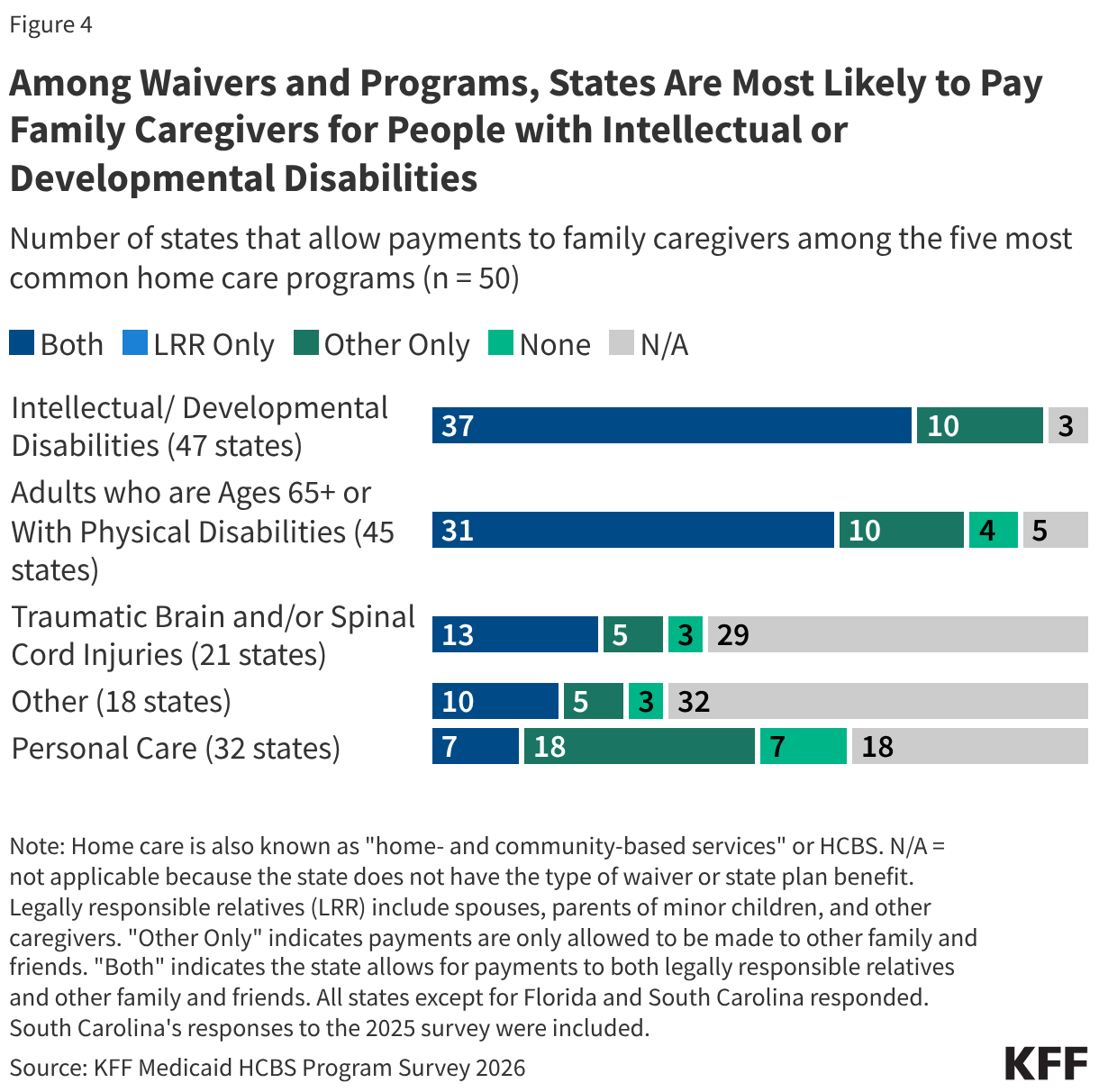
Despite widespread authorization, exact data regarding the proportion of waiver participants receiving care from family members remains sparse, as over half of states could not provide specific figures. Furthermore, most states collect minimal demographic or employment data regarding family caregivers, tracking little beyond basic names and ages. Only 14 states reported knowing the total count of paid or unpaid caregivers assisting waiver participants, and just seven states knew whether their family caregivers were enrolled in Medicaid through the Affordable Care Act expansion. As new community engagement and work requirements take effect for ACA expansion enrollees, the lack of centralized data could increase administrative paperwork burdens for family caregivers who must independently prove compliance or exemption.
While most family caregivers receive standard hourly wages, 12 states have adopted "structured family caregiving" models. In these programs, Medicaid pays provider agencies a daily per diem stipend—ranging generally from $40 to $70 per day—to support unpaid family caregivers. The overseeing agency provides a care coordinator, social worker, and nurse to conduct monthly home visits, offer guidance, and pass a fixed percentage of the daily stipend directly to the family caregiver. Nevada introduced a structured family caregiving program in 2026 under a newly launched waiver, while Kansas, Maryland, Michigan, and Oklahoma have plans to introduce similar benefits soon.
What Other Types of Support Does Medicaid Home Care Provide for Family Caregivers?
In addition to financial compensation, all responding states offer a variety of support services designed to sustain both paid and unpaid family caregivers. Respite care remains the most universally covered benefit, providing temporary relief that allows caregivers to rest, handle personal appointments, or attend to other responsibilities. Because Medicare restricts respite care strictly to patients receiving terminal hospice care, Medicaid serves as the primary safety net for families managing chronic and disabling conditions.
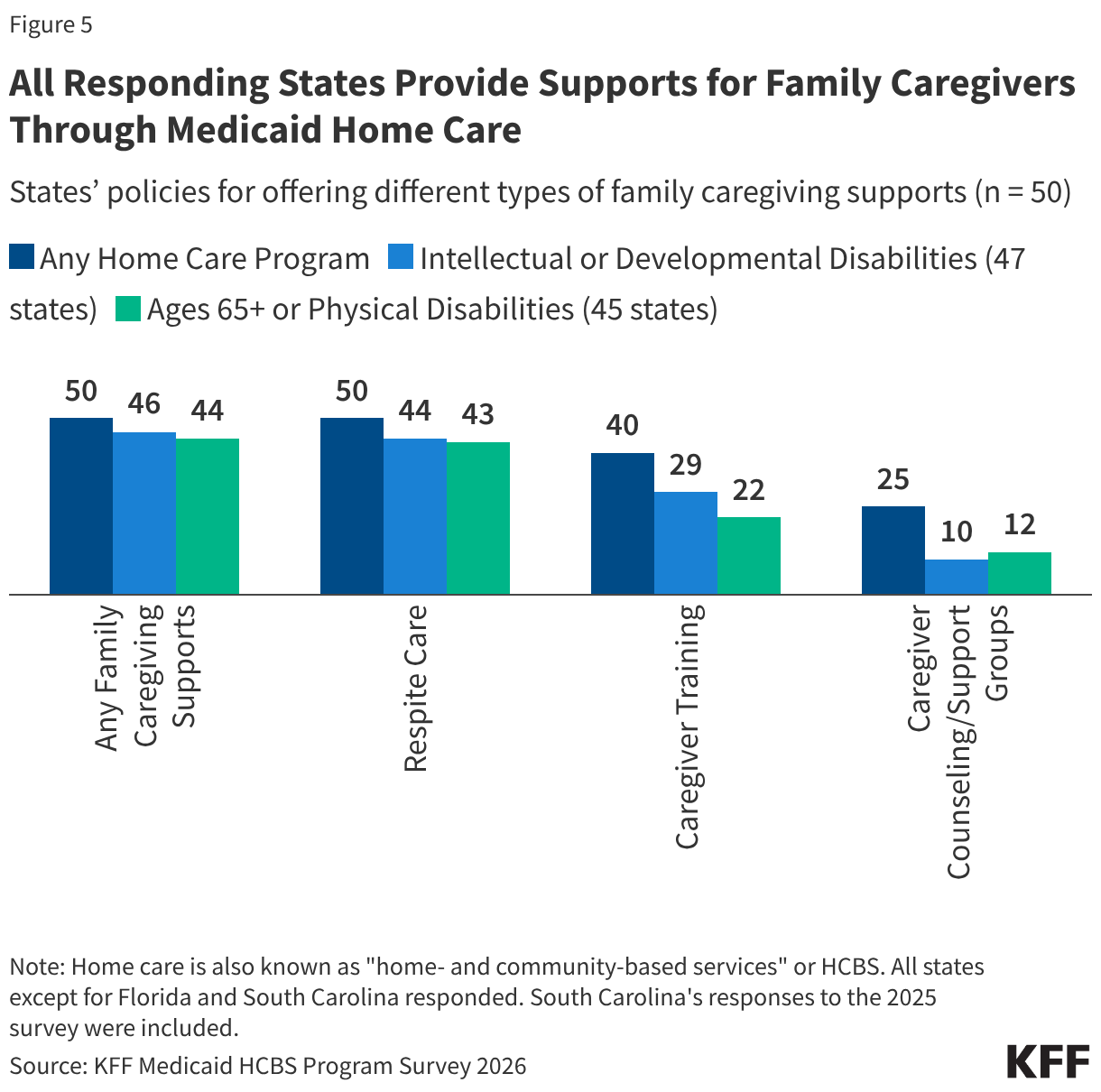
Respite care is offered most frequently under waivers for individuals with intellectual or developmental disabilities, with 44 states providing coverage, closely followed by 43 states offering respite services within waivers for older adults and individuals with physical disabilities. States deliver respite care in various formats, with 44 states offering daily respite and 43 states providing institutional respite options. Weekly respite is less common, offered in 29 states, while more than half of states provide flexible hourly, monthly, or annual respite arrangements.
Beyond respite, states provide targeted educational and emotional resources. Forty states cover caregiver training, and 25 states provide professional counseling or support groups. Several states expanded these resources in 2026, with Delaware, Missouri, Nevada, and Rhode Island newly incorporating caregiver training, and Arizona launching a peer-to-peer family support initiative for both paid and unpaid caregivers.