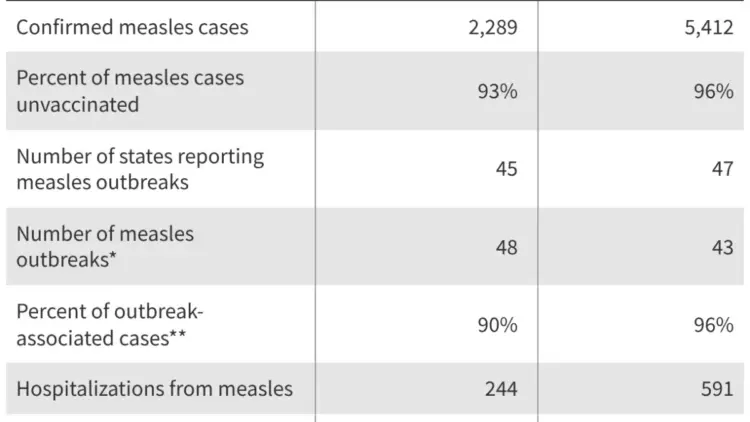
Originally published in July 2025 and updated to reflect significant developments through November 2026, public health tracking indicates that the United States is facing a critical juncture regarding its official measles elimination status. The country had not seen widespread, uncontrolled domestic transmission of the virus since before 2000, the year measles was officially declared eliminated from the United States. However, a continuous wave of outbreaks beginning in early 2025 has dramatically altered the epidemiological landscape. Between January 2025 and November 13, 2026, states across the nation have reported a staggering 5,412 cases of measles.
This ongoing transmission is being driven by a convergence of systemic and social challenges. Public health efforts at the federal, state, and local levels have been hampered by funding and staffing reductions, directly affecting prevention and response capabilities nationwide. Compounding these structural hurdles are mixed messages from federal health leadership, including Department of Health and Human Services Secretary Robert F. Kennedy, Jr., regarding the official response to the outbreaks. Furthermore, public skepticism regarding vaccine safety and effectiveness—coupled with an overall decline in institutional trust—has driven down vaccination rates, complicating vital community outreach and containment campaigns.
As health authorities review the trajectory of these outbreaks, policymakers and epidemiologists are confronting profound questions about what the persistent transmission means for the future of disease control and the nation’s coveted elimination status.
Understanding the Threat of Measles
Measles remains one of the most contagious human viruses known to science. When introduced into a population lacking prior immunity, a single case can spark an average of 12 to 18 secondary infections, a metric epidemiologists refer to as the basic reproduction number. While many cases present with standard symptoms and resolve without long-term damage, complications arise in approximately 30 percent of infections. Severe outcomes are disproportionately concentrated among young children and immunocompromised individuals, with roughly 1 in every 1,000 infections resulting in death.
The human toll of the recent surge has been stark. Among the 2,288 confirmed cases recorded in 2025 alone, 243 individuals required hospitalization, and three deaths were officially documented. Beyond the immediate acute illness, measles is known to cause long-lasting damage to the broader immune system, particularly in pediatric patients, leaving survivors more vulnerable to other dangerous infections down the line. Those who successfully recover from the acute phase generally develop long-term immunity against future infections.
Safe and effective vaccines have been accessible in the United States since 1963, providing robust protection against both illness and onward transmission. Clinical data indicates that receiving the recommended two doses of a measles-containing vaccine—most commonly the measles, mumps, and rubella (MMR) shot—is roughly 97 percent effective at preventing infection. Federal guidelines advise children to receive their initial dose between 12 and 15 months of age, followed by a second booster between 4 and 6 years of age prior to school entry.
To achieve herd immunity and prevent large-scale outbreaks, epidemiologists estimate that at least 95 percent of a population must possess immunity through vaccination or prior infection. This 95 percent coverage threshold serves as a core benchmark for immunization campaigns and aligns with the federal Healthy People 2030 target. However, national data reveals that estimated two-dose MMR coverage for children entering kindergarten dropped to 92.4 percent for the 2025-2026 school year, continuing a slow downward trend from 94.7 percent in 2011.
Furthermore, coverage varies dramatically by state, creating geographic pockets of vulnerability. While West Virginia reported kindergarten coverage at 98.9 percent, Idaho lagged significantly at 75.2 percent. Across the entire country, only 10 states achieved coverage levels at or above the 95 percent benchmark during the 2025-2026 period.
National, Regional, and Global Elimination Goals
The pursuit of measles elimination in the United States has a lengthy history, beginning with the announcement of the first national interruption goal in 1966, shortly after the vaccine was licensed. Subsequent federal targets were established by the Centers for Disease Control and Prevention in 1978 and 1993. On a broader scale, member states of the Pan American Health Organization—the regional office of the World Health Organization for the Americas—vowed in 1994 to interrupt endemic transmission across the region by the year 2000. In 2012, WHO member states endorsed a Global Vaccine Action Plan extending elimination goals to all six WHO regions by 2020.
Despite these decades-long efforts, the U.S. did not achieve official elimination status until March 2000, following rigorous internal and external reviews of public health strategies, case data, and vaccination records by a panel of expert advisors. This status was successfully re-verified a decade later, when an independent expert panel assembled by the CDC reviewed epidemiological data spanning from 2001 to 2011 and concluded that endemic transmission had not resumed. Periodic reviews have since been maintained through oversight committees, including the U.S. National Sustainability Committee for the Elimination of Measles, Rubella, and Congenital Rubella Syndrome.
PAHO has similarly monitored member nations through its Measles and Rubella Elimination Regional Monitoring and Re-Verification Commission. While the U.S. was historically designated as having sustained elimination year after year, the regional commission adjusted its evaluation during its November 2025 meeting, placing the United States into a newly designated category of "sustained with major concerns."
Defining Elimination and Historic Precedents
Within the framework established by the U.S. and other PAHO member nations, measles elimination is formally defined as the interruption of endemic virus transmission for a continuous period of 12 months or longer, maintained under conditions of high-quality disease surveillance. Conversely, if continuous transmission persists across a full 12-month span, the virus is once again considered endemic to the region.
To evaluate whether transmission has been successfully interrupted, health authorities analyze a constellation of indicators, including transmission chains, public health response capabilities, and local vaccination rates. During the last major resurgence prior to the current crisis—the 2018-2019 outbreak centered primarily in close-knit communities with low vaccination rates in New York City and surrounding counties—authorities deployed aggressive containment measures. These included declaring public health emergencies, mandating vaccinations under threat of fines, closing schools, restricting unvaccinated children from attending classes, and launching extensive public communication campaigns. Federal agencies provided technical assistance, while high-ranking officials from both the CDC and the White House publicly emphasized the vital importance of vaccination and condemned the spread of misleading medical information. Those concerted efforts successfully interrupted transmission within a year, containing the outbreak by August 2019.
The Current Outbreak and Threat to Elimination
The epidemiological picture shifted dramatically in 2025, which saw more reported measles cases, active outbreaks, affected states, and deaths than any single year since 1992. These outbreaks rolled continuously into 2026. Unlike prior years where a significant share of cases stemmed from international importations, the vast majority of cases since early 2025 have been attributed to domestic, local transmission.
The metrics tell a stark story when compared against historical benchmarks. During the ten-year verification period spanning from 2001 to 2011, the U.S. recorded a total of 64 outbreaks, with roughly 40 percent of cases traced back to international importations. By contrast, the country endured 48 outbreaks in 2025 alone, with only 10 percent of cases deemed imported. Through November 13, 2026, an additional 43 new outbreaks had emerged, with imported cases dropping to just 4 percent. Mortality figures have similarly escalated; while the ten-year elimination window recorded a single death, 2025 saw three deaths, and states reported eight deaths through mid-November 2026, prompting adjustments in how the federal government tallies fatal outcomes.
State and local health departments bear primary responsibility for disease response, yet they have navigated these crises against a backdrop of diminished federal funding and infrastructural support compared to previous years. Federal grants historically account for over half of many local public health department budgets. Furthermore, states experiencing the heaviest caseloads—such as Texas, New Mexico, and South Carolina—did not implement the sweeping mandates and institutional closures utilized in New York in 2019.
Federal messaging has also evolved during the current crisis. While agencies like the CDC have dispatched technical support and deployed $100 million in targeted outbreak response funding to state and local health departments, top leadership has at times offered mixed perspectives. Earlier in the crisis, officials downplayed risks or framed outbreaks as personal freedoms, though subsequent agency leadership has forcefully reaffirmed that the MMR vaccine remains the single most effective tool for preventing infection and is completely safe.
Public opinion data indicates that these outbreaks are occurring alongside broader erosions of public trust in health institutions and vaccine safety. Surveys reveal that nearly 20 percent of American adults view the false claim that vaccination is more dangerous than contracting the disease as likely or definitely true, underscoring the pervasive nature of vaccine misinformation. Consequently, if current trends persist, public health analysts warn that the U.S. is on track to lose its official measles elimination status under historical definitions.
Regional and Global Context
The United States is not alone in grappling with surging measles transmission. Neighboring countries have experienced unprecedented caseloads, with Mexico reporting 6,213 cases and Canada reporting 5,463 cases in 2025. The situation prompted PAHO to formally strip Canada of its measles elimination status in November 2025 following more than a year of continuous domestic transmission. Across the broader Americas region, 13 countries reported nearly 15,000 cases in 2025, with the vast majority concentrated in North America.
Globally, the scale is vastly larger. The World Health Organization reported hundreds of thousands of global cases, with severe outbreaks flaring across the European and Eastern Mediterranean regions. Outside the Americas, nations reporting the highest case counts over a recent six-month window included Bangladesh, Guatemala, and Yemen. This widespread international circulation maintains a persistent risk for U.S. travelers, who face heightened exposure abroad and potential importation of the virus upon returning home.
Looking Ahead
Federal health agencies and external epidemiologists continue to review genomic sequencing data to untangle whether ongoing U.S. cases trace directly back to the West Texas outbreak that began in January 2025 or stem from entirely separate importation events. If genetic tracking demonstrates unbroken chains of domestic transmission extending past a 12-month window, the formal criteria for maintaining elimination will have been broken.
The ultimate determination rests with PAHO’s independent regional verification commission, which scheduled its comprehensive review of U.S. elimination status. Losing this status would mark a historic turning point for American public health, signaling that measles has shifted from an eliminated threat back to an endemic, continuously circulating disease. Such a regression carries the prospect of rising hospitalizations, preventable deaths among vulnerable children, and recurring community disruptions as schools and daycares are forced to manage ongoing infection risks. As health systems grapple with these mounting pressures, the trajectory of the outbreaks highlights the ongoing tension between infectious disease control and the challenges of public health infrastructure and vaccine hesitancy.