More than four years after the Supreme Court decision that upended reproductive rights across the United States, the national landscape regarding abortion access remains intensely fractured, defined by a complex patchwork of state-level bans, evolving legal battles, and shifting public opinion. On June 24, 2022, the Supreme Court officially overturned Roe v. Wade, eliminating the nearly half-century-old federal constitutional standard that had protected the right to abortion. In the absence of any federal standard regarding abortion access, authority was returned directly to individual states, paving the way for a deeply polarized environment where access to reproductive healthcare depends almost entirely on geographic location.
To track these rapid and ongoing shifts, comprehensive research projects like the Abortion in the United States Dashboard continue to monitor state abortion policies, legislative changes, and major litigation. Data compiled through late 2026 illustrates a starkly divided nation where reproductive freedoms are robustly protected in some jurisdictions while being entirely prohibited or heavily restricted in others.
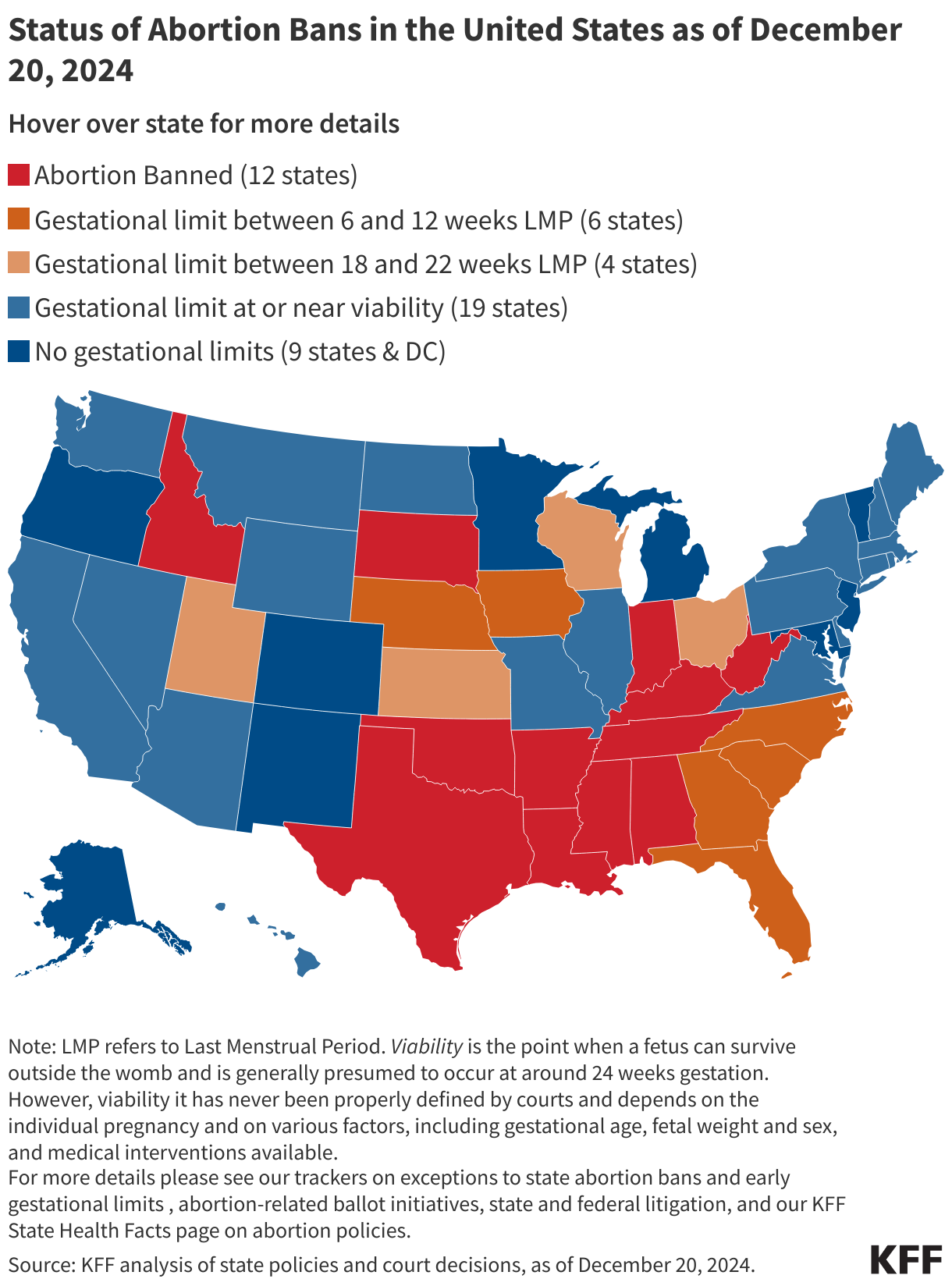
According to tracking data updated through November 2026, total abortion bans remain in effect across 13 states: Alabama, Arkansas, Idaho, Indiana, Kentucky, Louisiana, Mississippi, North Dakota, Oklahoma, South Dakota, Tennessee, Texas, and West Virginia. Meanwhile, early gestational limits have drastically altered access in numerous other regions. Seven states currently enforce strict gestational limits between six and 12 weeks of the last menstrual period (LMP). Among these, Florida, Georgia, Iowa, South Carolina, and Wyoming have implemented six-week bans, while Nebraska and North Carolina have set limits at 12 weeks. An additional four states—Kansas, Ohio, Utah, and Wisconsin—enforce gestational limits ranging between 15 and 22 weeks LMP.
Conversely, 17 states maintain gestational limits set at or near fetal viability, including Arizona, California, Connecticut, Delaware, Hawaii, Illinois, Maine, Missouri, Montana, Nevada, New Hampshire, New York, Pennsylvania, Rhode Island, Virginia, and Washington. Furthermore, 10 states and the District of Columbia report no gestational limits at all, creating safe havens for patients traveling from restricted states. These include Alaska, Colorado, Maryland, Massachusetts, Michigan, Minnesota, New Jersey, New Mexico, Oregon, Vermont, and Washington D.C.
This geographic divergence has placed an enormous emphasis on the timing of medical care. Historical data underscores that the vast majority of patients seek care during the earliest stages of pregnancy. More than four in ten, or approximately 45 percent of all abortions, occur by six weeks of gestation. An additional 36 percent take place between seven and nine weeks, while 13 percent occur between 10 and 13 weeks. Only a small fraction—just 7 percent of all procedures—happen after the first trimester, highlighting how early gestational limits effectively ban the vast majority of procedures.
The legal fallout from the post-Roe era has extended far beyond statehouse bans, triggering high-stakes battles in federal courts over emergency medical care and federal preemption. A prominent example unfolded around the Emergency Medical Treatment and Labor Act, commonly known as EMTALA. On June 27, 2024, the Supreme Court dismissed the case Moyle v. United States, which had asked the high court to determine whether the federal EMTALA law preempted Idaho’s strict abortion ban when emergency care was required to protect the health of a pregnant patient. By dismissing the case and returning it to lower courts, the Supreme Court reinstated a preliminary injunction blocking the enforcement of Idaho’s ban in situations where emergency medical care is necessary. Despite this temporary reprieve, legal experts warn that federal protections remain fragile.
Simultaneously, advocates and legal scholars are closely monitoring older, dormant federal statutes that could be weaponized by a hostile administration. The Comstock Act, a 19th-century obscenity law, has re-emerged as a major point of contention. Policy analysts have reviewed how the statute was interpreted by the Biden administration’s Department of Justice while warning of the severe implications if a future administration chose to enforce the law aggressively. An expansive enforcement of the Comstock Act could criminalize the mailing of any drugs, equipment, or supplies used to perform abortions, effectively choking off medication abortion access and medical supply chains nationwide, regardless of individual state laws.
As states implement total bans and early restrictions, navigating exceptions for rape and incest has proven remarkably difficult for survivors. Research examining the fine print of these exceptions reveals that 10 of the 21 states with complete bans or early gestational limits do not include any exception for pregnancies resulting from sexual assault. Even in the 11 states that technically permit abortions in cases of rape and incest, procedural hurdles often render the exception unattainable in practice. Strict law enforcement reporting requirements, narrow gestational timeframes, and a severe shortage of willing medical providers create insurmountable barriers for survivors seeking care.

The chilling effect of state bans has also created unprecedented legal jeopardy for physicians and healthcare providers. State laws frequently feature severe criminal penalties, including lengthy prison sentences and the revocation of medical licenses for doctors who perform unauthorized procedures. Beyond criminal prosecution, physicians face mounting concerns regarding medical malpractice lawsuits stemming from delayed care. Because many abortion bans contain vague medical emergency exemptions, clinicians often report hesitating to provide necessary interventions until a patient’s condition deteriorates to a dangerous threshold, fearing aggressive prosecution by state authorities—even across state lines.
The legal uncertainty has additionally sparked intense debate regarding patient privacy and employer-sponsored health coverage. With numerous states enacting legislation that penalizes individuals or entities assisting in out-of-state abortions, employers offering comprehensive health benefits face significant legal risks. Questions have mounted over whether employers can access private employee health information when health plans cover abortion services, leading experts to warn that traditional federal privacy safeguards, such as the Health Insurance Portability and Accountability Act (HIPAA), may offer limited protection in a post-Dobbs legal environment.
In response to widespread travel restrictions and local prohibitions, a significant number of large employers began offering financial assistance and travel cost coverage for workers forced to cross state lines to obtain legal reproductive care. While these corporate policies aim to bridge the gap in healthcare access, they have also drawn fierce political backlash and legal scrutiny from anti-abortion lawmakers and state officials seeking to penalize out-of-state travel facilitation. Concurrently, broader insurance landscapes continue to shift, with stark limitations on abortion coverage persisting across various Medicaid programs, individual Marketplace options, and private insurance plans.
Public opinion and voter sentiment regarding reproductive rights have remained a central driving force in American politics, frequently influencing electoral outcomes and public policy debates. Findings from ongoing tracking initiatives, such as the KFF Health Tracking Poll, demonstrate that abortion policy remains a top-tier priority for voters, though deep gaps in public knowledge persist. Surveys regarding mifepristone—the primary medication used in medical abortions—reveal that a significant portion of the public, including women of reproductive age, remain unfamiliar with the drug’s safety profile and legal availability. Awareness of medication abortion has fluctuated amidst ongoing FDA reviews and political challenges, with public trust in the safety of abortion pills declining compared to prior years. Furthermore, polling data consistently shows that voters who consider abortion policy an essential discussion point for candidates tend to be disproportionately aligned with the Democratic Party.
To better understand how these sweeping national changes impact local populations, targeted research has examined specific battleground states. Reports focusing on regions like Florida and Arizona—utilizing nationally representative health surveys—have detailed how women between the ages of 18 and 49 navigate the immediate fallout of state-level restrictions, measuring their personal experiences, awareness of local laws, and evolving attitudes toward reproductive healthcare access.
Ultimately, the ongoing research and comprehensive policy tracking projects serve as critical barometers for a nation navigating an unprecedented era in healthcare law. As litigation continues to wind through federal and state courts, and as policymakers and voters grapple with the realities of a fragmented medical landscape, the future of reproductive rights in the United States remains profoundly uncertain.