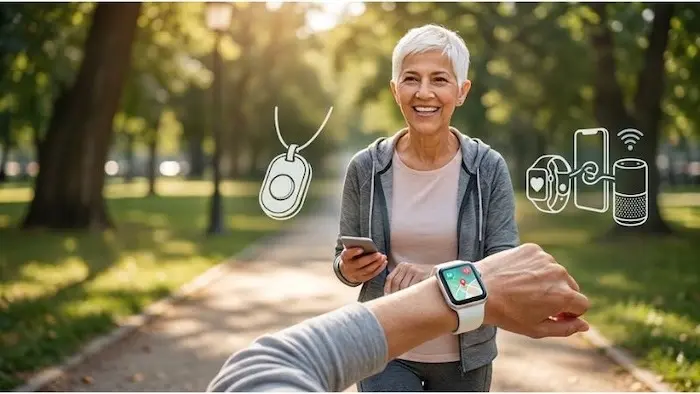
The iconic phrase "I’ve fallen and I can’t get up" once defined an entire generation of medical assistance technology. For decades, the standard emergency response tool for older adults was a bulky pendant tethered to a base unit, relying entirely on a traditional landline. Today, that narrow concept has evolved dramatically. Modern medical alert systems have transformed into comprehensive, proactive health and safety hubs, serving as a critical bridge that allows older adults to remain independent in their own homes rather than transitioning prematurely to a care facility.
This technological evolution comes at a crucial time. According to data from AARP, nearly 90 percent of individuals aged 65 and older express a strong preference for aging in place rather than moving to institutional care facilities. As independent living remains the preferred standard for older adults, the industry supporting this lifestyle has rapidly matured. Market analysts project that the global medical alert systems market size will reach $11.8 billion, driven directly by a surging public and familial demand for advanced, reliable safety monitoring that preserves dignity while ensuring rapid emergency intervention.
To understand how far the industry has come, it helps to examine the limitations of the old standard. The legacy format typically consisted of a wearable panic button connected to a localized base unit within the home, utilizing an analog telephone line to contact a monitoring center. While groundbreaking for its time, the system suffered from severe functional bottlenecks. It only worked if an aging adult consistently remembered to wear the device, remained within a few hundred feet of the base station, and retained enough consciousness and physical capability to push the button manually following an accident. If a user suffered a sudden medical emergency outside the home or fell unconscious before reaching the button, the traditional system failed to trigger help.
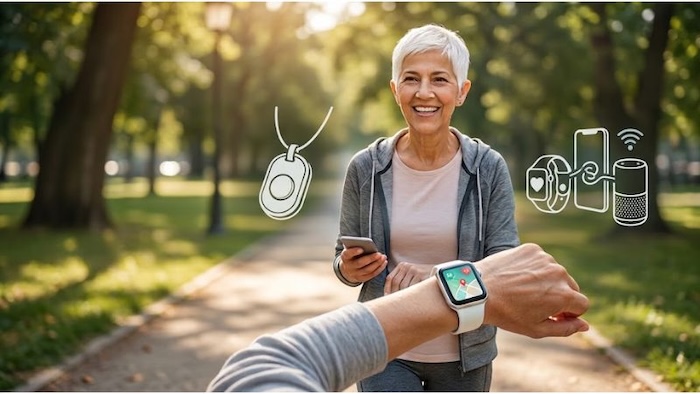
In contrast, contemporary devices leverage sophisticated wearable artificial intelligence and cellular networks to shift the paradigm from reactive emergency alarms to real-time health-monitoring systems. The modern landscape offers several distinct technological tiers designed to fit different lifestyles, living arrangements, and cognitive abilities.
Traditional landline-based systems remain available primarily for budget-conscious, homebound adults who live in areas with poor cellular reception. However, they have been largely overshadowed by modern smartwatches equipped with cellular connectivity and GPS tracking. These contemporary wearables offer unlimited nationwide coverage, allowing older adults to maintain their active lifestyles outside the home while giving caregivers real-time visibility into their location, battery status, and daily activity logs through dedicated mobile applications.
For individuals with cognitive decline or those who stubbornly refuse to wear traditional pendants or watches, ambient sensors utilizing radar and artificial intelligence represent the cutting edge of home safety. These passive systems monitor whole homes via Wi-Fi and wall-mounted units, detecting falls and recognizing routine deviations in daily activity without requiring the user to wear any physical device whatsoever.
Choosing the right system requires careful matching between the technology and the user’s actual needs and cognitive capabilities. For instance, an advanced smartwatch featuring a complex touchscreen interface may prove entirely ineffective for an individual suffering from severe dementia or advanced macular degeneration, who would be better served by passive ambient sensors or a simple, single-function wearable button.

Despite these remarkable technological leaps, experts emphasize that a medical alert system is never a viable substitute for direct human supervision or structured in-home care. Instead, these tools function primarily as risk-mitigation instruments designed to buy precious minutes during an emergency. Caregivers are strongly advised to review foundational health resources, such as the National Institute on Aging’s fall prevention guidelines, before relying solely on a wearable device to manage a loved one’s safety.
Questions regarding coverage and logistics frequently arise for families navigating these options. Original Medicare Part A and Part B do not classify medical alert systems as durable medical equipment, meaning standard Medicare does not cover their cost. Nevertheless, certain Medicare Advantage Part C plans or state-specific Medicaid programs may offer limited coverage, equipment discounts, or financial reimbursements. Furthermore, unlike legacy models, modern systems no longer require a traditional landline, as they operate seamlessly over built-in cellular networks or home internet connections.
Automatic fall detection has likewise seen significant refinement. By utilizing sophisticated internal accelerometers and gyroscopes, modern devices continuously monitor changes in motion, velocity, and impact angles. When the system detects a physical pattern consistent with a hard fall, it initiates contact with a monitoring center automatically. This ensures that help is dispatched even if the user is rendered unconscious or is physically unable to press the alert button, with notifications simultaneously routed to family caregivers via connected mobile applications alongside medication reminders and daily status updates.
Ultimately, navigating the balance between personal safety and autonomy remains one of the most demanding responsibilities in modern caregiving. The ongoing evolution of medical alert technology has successfully replaced the stigma of the outdated panic button with sleek, proactive safety solutions. Whether families choose a discreet GPS-enabled watch for an active parent or invisible ambient sensors for a loved one experiencing memory loss, today’s innovations are engineered to protect independence while offering invaluable peace of mind.