WASHINGTON — For years, the escalating cost of insulin remained at the very center of national policy discussions regarding prescription drug affordability. Across the United States, patients diagnosed with diabetes faced mounting financial hurdles just to afford a medication essential to their daily survival. Public opinion polls repeatedly highlighted widespread anxiety over soaring healthcare and prescription costs, putting immense pressure on federal lawmakers to intervene.
Those persistent policy debates culminated in significant legislative action when the federal government implemented sweeping changes designed to rein in out-of-pocket healthcare expenses. A major turning point arrived with the passage of the Inflation Reduction Act of 2022, signed into law by President Biden. The landmark legislation introduced several critical provisions targeted directly at prescription drug spending within the Medicare program. Among the most prominent changes was a provision establishing a strict monthly out-of-pocket cap of $35 for insulin products relied upon by Medicare beneficiaries, a policy that officially took effect at the beginning of 2023. This crucial cap applied comprehensively to all insulin products covered under both the Medicare Part D prescription drug benefit and Part B.
Before the nationwide mandate went into effect, federal efforts to lower insulin expenses had already begun on a smaller, more experimental scale. A separate voluntary, time-limited initiative known as the Part D Senior Savings Model was initiated under the first Trump administration. Starting in 2021, this voluntary framework allowed participating Medicare Part D plans to agree to cap monthly copays for selected insulin products at $35 for enrolled beneficiaries. That model remained operational as a bridge through the end of 2023, paving the way for the permanent and universal protections established by the Inflation Reduction Act.
Beyond the Medicare program, policymakers have explored expanding similar financial protections to the broader American population. Federal lawmakers have introduced legislation aimed at extending the $35 monthly insulin copay cap to individuals with private health insurance coverage, though those proposals have not yet crossed the finish line to become federal law. In the absence of federal action for the commercially insured, numerous state-level governments have taken matters into their own hands, enacting a patchwork of state-level cost-sharing caps for patients covered by private health plans.
To measure the real-world impact of these voluntary and mandatory policy shifts, health policy researchers recently analyzed out-of-pocket spending trends for insulin among Medicare Part D enrollees between 2020 and 2024. The comprehensive analysis, drawing upon Medicare Part D prescription drug event data, specifically isolated the financial experiences of enrollees who did not receive Part D Low-Income Subsidies. Because beneficiaries receiving low-income assistance already face merely nominal copays for their prescribed medications, focusing on non-subsidized enrollees provided a clearer picture of how policy caps altered the financial landscape for everyday patients.
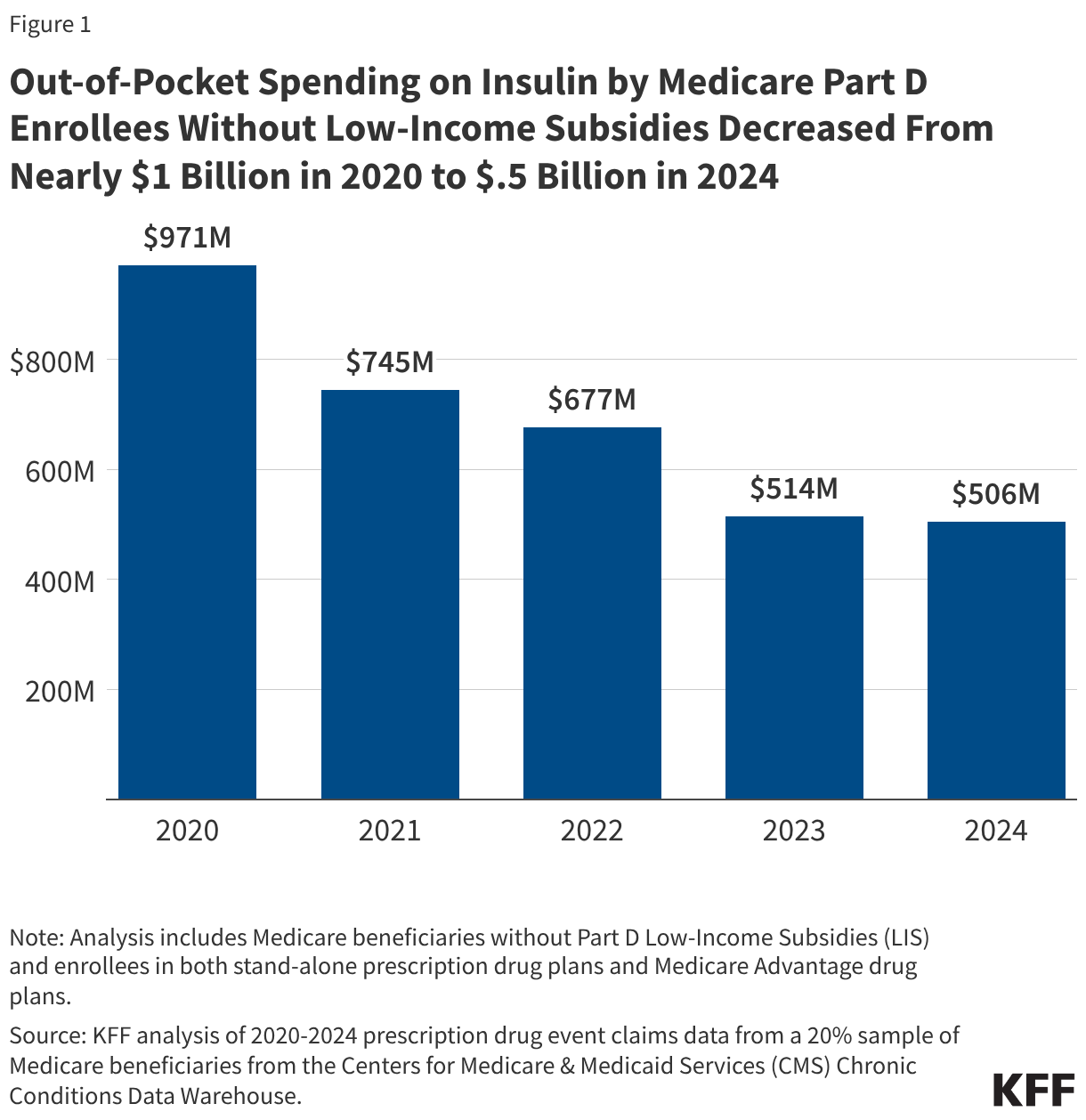
The implementation of these voluntary and mandatory measures yielded a dramatic improvement in insulin affordability. According to the data, out-of-pocket spending by non-subsidized Part D enrollees who used insulin plummeted significantly over the four-year study window. Aggregate out-of-pocket spending on insulin among this group fell sharply from $971 million in 2020 down to $506 million by 2024. When broken down to an individual level, the financial relief was similarly striking, with average out-of-pocket spending dropping from $54 to $25 for each individual insulin prescription over the exact same timeframe.
Among Medicare Part D Enrollees Without Low-Income Subsidies, Total Out-of-Pocket Spending on Insulin Decreased from Nearly $1 Billion in 2020 to $0.5 Billion in 2024
A closer examination of the annual data reveals a steady downward trajectory in total out-of-pocket expenditures as successive policy layers took effect. For Part D enrollees without low-income subsidies, aggregate out-of-pocket spending on insulin dropped by 23% during the very first year of the temporary Part D Senior Savings Model. In monetary terms, spending fell from $971 million in 2020 to $745 million in 2021.
The financial relief continued into the second year of the voluntary model. By 2022, aggregate spending dropped further to $677 million. The most dramatic drop, however, coincided with the nationwide rollout of the Inflation Reduction Act. In 2023, marking the first year of the law’s mandatory $35 insulin copay cap, out-of-pocket spending experienced another steep 23% reduction, sliding down to $514 million. This downward trend stabilized with a modest additional decrease in 2024, bringing total spending down to $506 million.
When researchers broadened the scope to include Part D enrollees who do receive low-income subsidies alongside those who do not, the aggregate figures demonstrated a similarly profound shift. Total out-of-pocket spending across the entire Medicare Part D population dropped from slightly over $1.0 billion in 2020 to $535 million by 2024.
Despite these dramatic financial shifts, utilization patterns among Medicare beneficiaries remained relatively stable. The total number of Part D enrollees overall who utilized insulin rose modestly from 3.3 million in 2020 to 3.5 million in 2024. Concurrently, the total number of insulin prescriptions filled—measured per 30-day supply—increased from 37.5 million to 38.8 million across the entire program.
Looking specifically at Part D enrollees without low-income subsidies, the number of individual insulin users grew from 1.7 million to 1.9 million over the four-year period, while total prescriptions filled rose from 18.1 million to 20.4 million. Despite these aggregate increases in total users and total prescriptions, per capita insulin utilization remained remarkably flat. Throughout the study period, beneficiaries averaged roughly 11 fills per user annually. Researchers noted that this flat per capita usage indicates the aggregate rise in prescriptions was likely driven by broader enrollment growth within the Medicare Part D program as a whole rather than a surge in individual consumption.
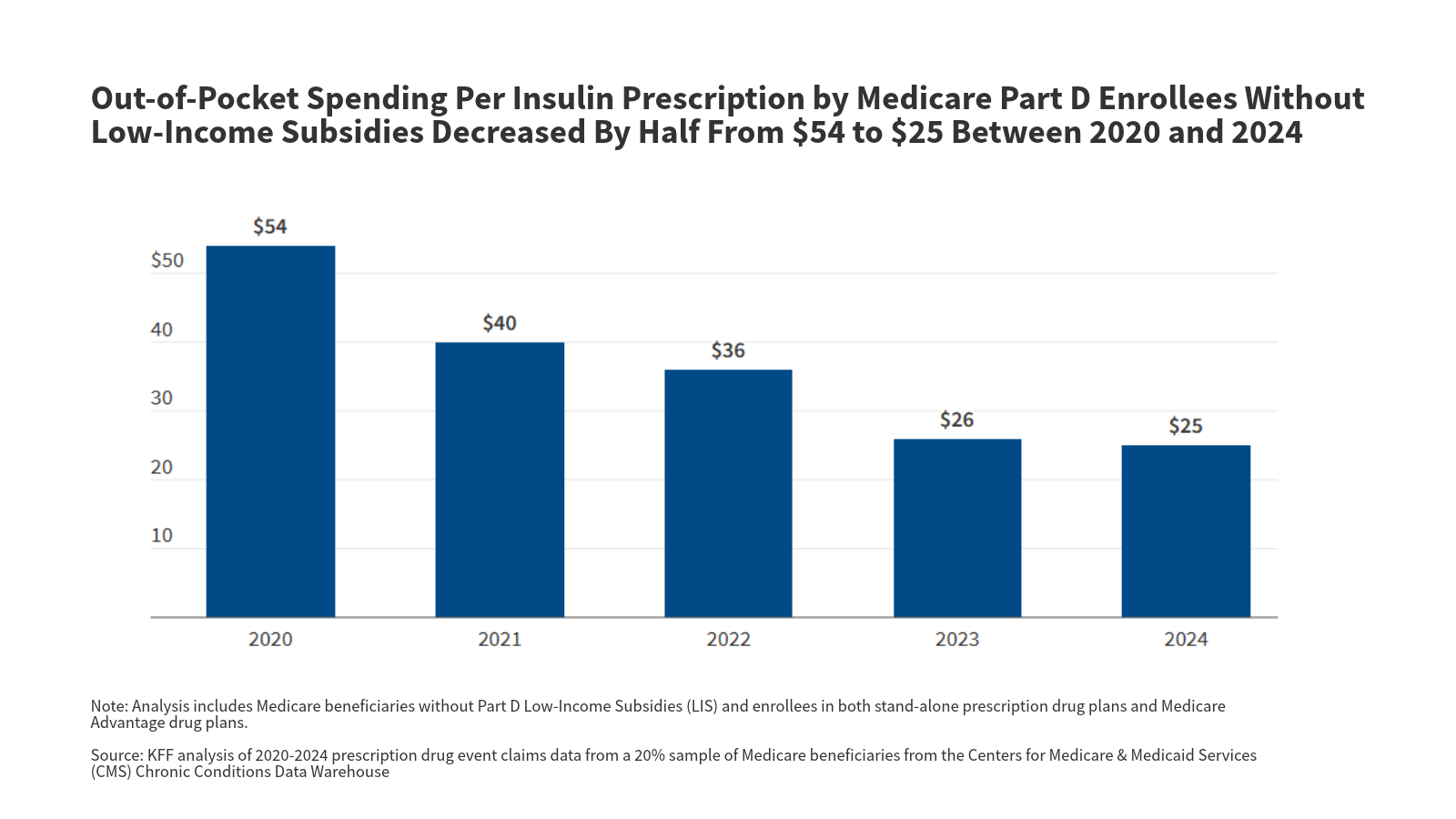
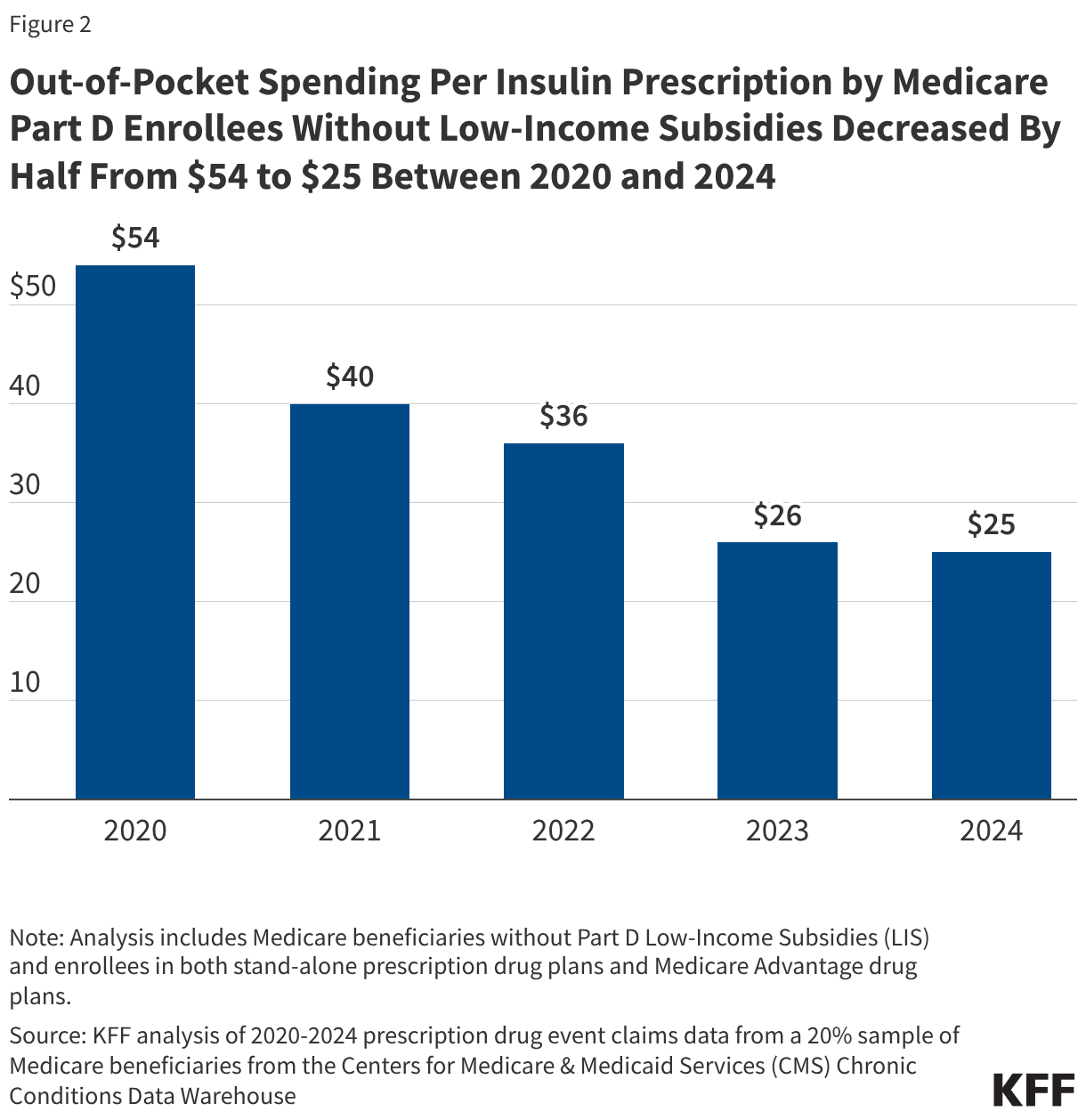
Out-of-Pocket Costs per Insulin Prescription Among Enrollees Without Low-Income Subsidies Decreased by Half Between 2020 and 2024
The reduction in aggregate spending translated directly into substantial per-prescription savings for everyday beneficiaries. For Part D enrollees not protected by low-income subsidies, the average out-of-pocket cost for a single insulin prescription dropped from $54 in 2020 to $40 in 2021. That initial 26% reduction marked the immediate impact of the voluntary Part D Senior Savings Model.
As the policy landscape shifted from voluntary plans to the universal mandate of the Inflation Reduction Act, costs dropped even further. Out-of-pocket spending per prescription experienced an additional 28% reduction, falling from $36 in 2022 down to $26 in 2023 during the first full year of the mandatory $35 cap. This was followed by a modest additional reduction, bringing the average cost down to $25 per prescription by 2024.
Because beneficiaries consistently maintained an average of 11 insulin prescriptions filled each year throughout the duration of the study, annual out-of-pocket spending for individual enrollees fell in direct proportion to the per-prescription savings. The data revealed a striking 54% reduction in annual out-of-pocket costs per patient, dropping from an average of $572 in 2020 down to $265 by 2024.
Average Out-of-Pocket Costs for a 30-Day Supply of Top Insulin Products Decreased Across the Board
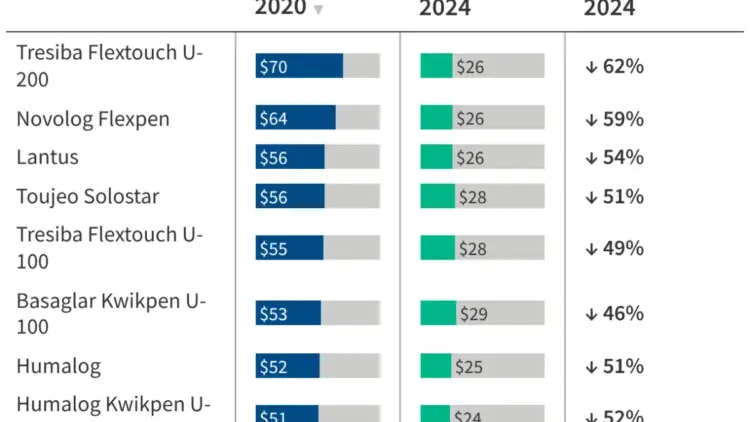
The tangible effects of the pricing caps became even more apparent when analyzing individual pharmaceutical products. In 2020, before the widespread implementation of the federal caps, Part D enrollees without low-income subsidies routinely paid significantly more than $35 for a standard 30-day supply of the most commonly prescribed insulin formulations.
Financial burdens varied widely depending on the specific brand and delivery mechanism prescribed. Costs in 2020 reached as high as $70 out-of-pocket for a 30-day supply of Tresiba Flextouch U-200. Other widely used products also carried steep price tags for patients, with costs scaling downward to $43 for an Insulin Lispro Kwikpen U-100.
By 2024, the implementation of the statutory caps had effectively compressed out-of-pocket expenses for all of these leading medications. The average patient cost for every single one of the top 10 most commonly used insulin products fell below the $35 threshold. Costs in 2024 ranged from a high of $29 for a Basaglar Kwikpen U-100 down to a low of $23 for Lantus Solostar.
The analysis was supported in part by Arnold Ventures, with KFF maintaining complete editorial independence over its polling, journalism, and policy research activities. The underlying findings were compiled by health policy researchers Juliette Cubanski and Meredith Freed of KFF, alongside independent health data consultant Anthony Damico.