Nearly 29 million adults across the United States have been diagnosed with diabetes, with roughly 32% of them relying on insulin to manage their condition. For years, the high cost of this lifesaving medication has served as a severe barrier to care, prompting many Americans to ration their doses or skip treatments entirely. To mitigate these financial hurdles, policymakers at both the state and federal levels have increasingly turned to a specific mechanism: a monthly cap on patient cost sharing. While these caps do not directly lower the underlying list price of insulin, they make out-of-pocket expenses more predictable and manageable, helping patients maintain consistent access to their medication.
Since 2023, Medicare beneficiaries have benefited from a federal $35 monthly cap on insulin costs, a change that has dramatically reduced out-of-pocket spending for older Americans. Public support for extending these protections beyond Medicare is overwhelmingly high and notably bipartisan, with a recent KFF poll showing that three out of four adults support a broader cap, including 84% of Democrats and 70% of Republicans.
Applying a cost-sharing cap to private insurance coverage, including employer-sponsored plans, has rapidly gained momentum among lawmakers. Since 2019, a growing number of states have enacted laws limiting cost sharing in state-regulated plans, and a federal bill targeting private coverage has advanced in Congress. This evolving landscape reflects a concerted effort to address insulin affordability, though significant policy considerations and structural limitations remain.
Background
Insulin affordability has long been a pressing concern for healthcare advocates and policymakers. Between 2007 and 2018, the list prices for various forms of insulin surged by more than 260%. In Medicare Part D alone, aggregate out-of-pocket spending by patients quadrupled between 2007 and 2020.
Government investigations have frequently linked these escalating costs to rising manufacturer list prices and complex contracting practices involving pharmacy benefit managers, or PBMs. In 2019, the Senate Finance Committee launched a bipartisan investigation into insulin pricing, culminating in a landmark 2021 report that scrutinized the roles of the three major insulin manufacturers—Eli Lilly, Novo Nordisk, and Sanofi—alongside major PBMs like CVS Caremark, Express Scripts, and Optum Rx.
The committee concluded that the leading manufacturers aggressively raised their list prices, often moving in lockstep. The list price, or Wholesale Acquisition Cost, serves as the baseline price set by manufacturers before discounts and rebates are applied. Investigators found that PBMs, utilizing significant market power, negotiated rebates with drug manufacturers in exchange for placing preferred drugs on health plan formularies. This rebate system heavily contributed to rising list prices and limited the market uptake of lower-priced alternatives, as formularies routinely favored high-cost insulins with substantial rebates while disadvantaging cheaper options.
Additional studies have underscored the financial strain placed on patients who must pay high out-of-pocket list prices before meeting their insurance deductibles, or whose cost sharing is tied to high coinsurance rates. Furthermore, privately insured patients typically pay for medications based on negotiated rates that do not automatically pass manufacturer rebates down to the consumer.
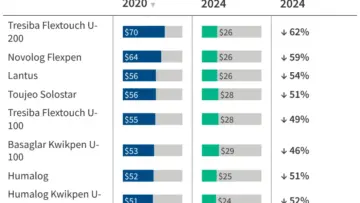
Federal interventions have evolved significantly in the years since these initial investigations. The passage of the Inflation Reduction Act of 2022 established the $35 monthly cost-sharing cap for Medicare beneficiaries, cutting average out-of-pocket costs for seniors in half between 2020 and 2024. Although initial drafts of the legislation proposed extending the same cap to private plans, that provision was ultimately dropped before passage. Subsequent analyses of private claims data indicated that a $35 cap would have financially benefited at least one in five privately insured enrollees who use insulin.
While private insurance enrollees lack a universal statutory cap, federal tax guidance has allowed individuals with health savings accounts to access preventive services, including insulin and related supplies, before meeting their annual deductibles. According to recent employer health surveys, nearly 30% of covered workers are enrolled in such high-deductible plans.
Meanwhile, voluntary price reductions initiated by major drug manufacturers in 2023 lowered the list price of certain insulins and expanded discount programs to cap patient costs at $35 a month at participating pharmacies. Analysts attribute these voluntary cuts largely to a shift in federal Medicaid rebate calculations stemming from the American Rescue Plan Act of 2021, which eliminated a statutory limit on rebates owed by manufacturers to the government.
Federal and state authorities have also pursued aggressive antitrust and regulatory actions. In late 2024, the Federal Trade Commission filed an administrative complaint against the three largest PBMs, alleging they systematically favored high-list-price insulin products over cheaper alternatives. By 2026, the FTC secured major settlements with Express Scripts and CVS Caremark, requiring them to reform their pricing and rebate practices by 2028, expand access to low-cost insulin programs, and potentially count third-party cash payment coupons toward patient deductibles. Concurrently, dozens of state attorneys general, cities, and school districts have filed consolidated lawsuits against major manufacturers and PBMs over alleged anticompetitive practices.
Alternative distribution channels are also expanding. California launched its CalRx program to manufacture and distribute lower-cost biosimilar insulin, while online pharmacies and direct-to-consumer sales platforms offer discounted cash-pay options outside of traditional insurance frameworks. Despite these varied pathways, regulatory experts note that structural affordability challenges persist across the commercial insurance market.
Cost-Sharing Caps for Those with Private Insurance
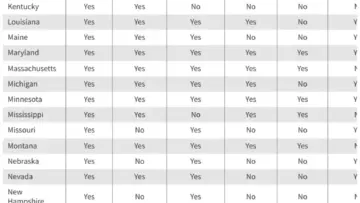
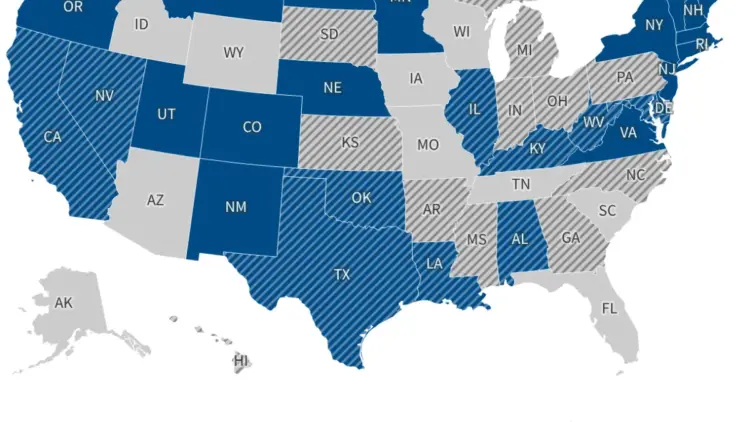
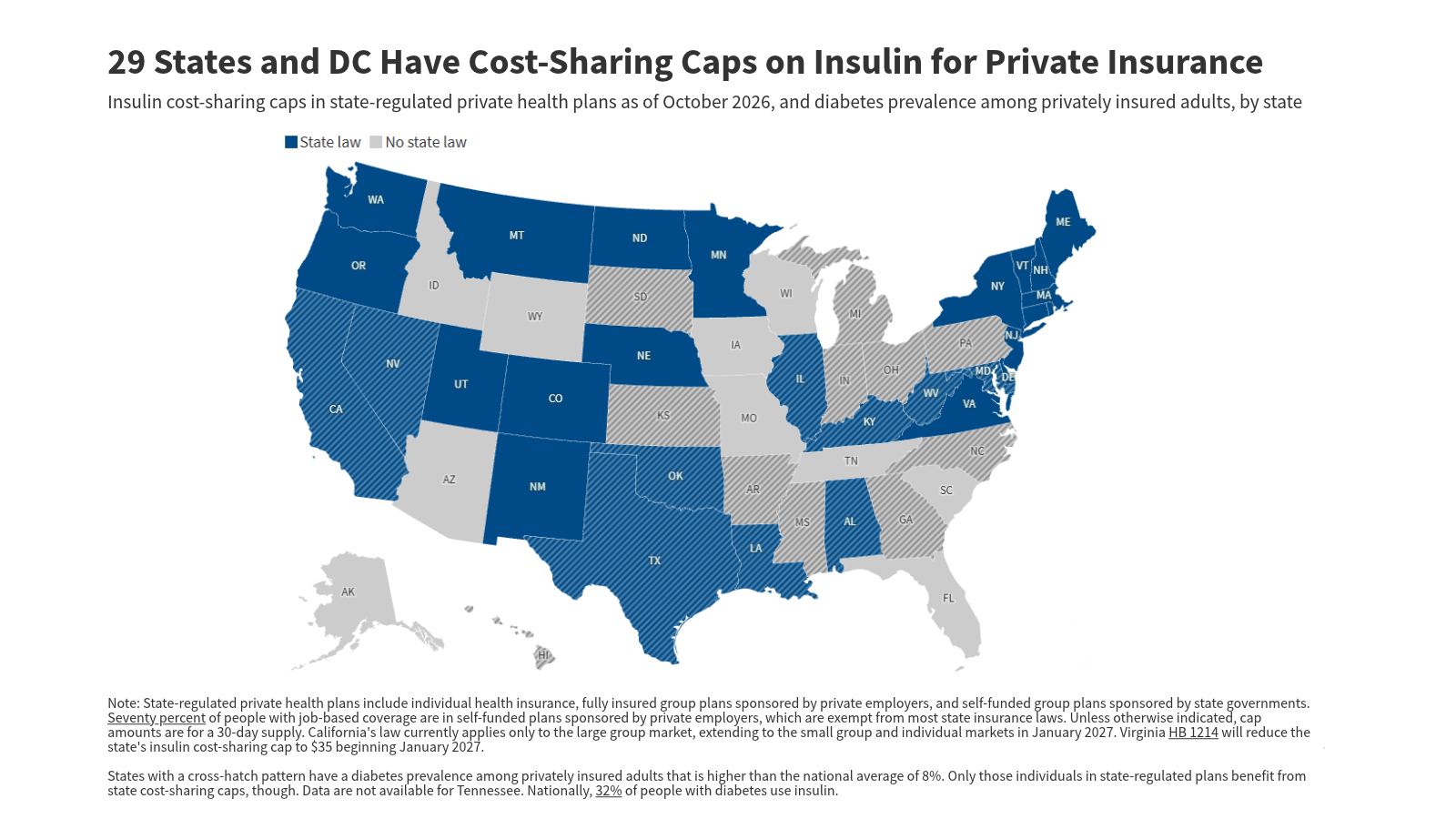
As of late 2026, 29 states and the District of Columbia have enacted legislation capping cost sharing for insulin in privately insured plans, beginning with Colorado in 2019. However, at least 11 states with relatively high rates of diabetes currently lack such laws.
The structure and dollar amounts of these state caps vary widely. While New York and Massachusetts have eliminated cost sharing entirely for certain generic insulins, other states maintain caps reaching up to $100 for a 30-day supply. The most common threshold is $35, utilized by approximately three-quarters of the states with caps. A small number of states have extended their protections to cover 90-day supply regimens or established aggregate monthly caps that limit total spending across multiple types of insulin rather than applying limits per individual prescription.
Despite the proliferation of state laws, their practical reach remains limited. Under the federal Employee Retirement Income Security Act of 1974, self-funded employer-sponsored health plans—which cover roughly 70% of workers with job-based insurance—are largely exempt from state insurance regulations. Consequently, state-level cost-sharing caps only apply to state-regulated individual market plans, small group policies, and fully insured employer plans, leaving the vast majority of workers dependent on federal policy for comprehensive protections.
Out-of-Pocket Insulin Caps for the Uninsured and Underinsured
Uninsured individuals face even steeper barriers to maintaining regular diabetes care. Federal health data indicates that a disproportionate share of uninsured adults with diabetes routinely delay or avoid necessary medical care due to cost compared to their insured counterparts.
To bridge this gap, a handful of states—including Minnesota, Maine, and Colorado—have established emergency safety net programs. These initiatives require major insulin manufacturers to provide short-term emergency supplies at little to no cost for low-income residents facing an immediate lapse in coverage, alongside longer-term patient assistance frameworks designed to distribute discounted insulin through community health centers and local pharmacies.
Proposed Federal Insulin Cost-Sharing Cap
Bipartisan federal legislation known as the INSULIN Act has advanced through congressional committees, aiming to establish a uniform national cost-sharing cap for private health insurance plans.
The proposed legislation would require all private health plans, including self-funded employer plans and individual market options, to cover selected insulin products across all dosage forms and types without applying a deductible. Patient cost sharing for these selected products would be capped at $35 per 30-day supply or 25% of the net negotiated price, whichever is lower. The bill also places strict limitations on prior authorization requirements for covered insulins and creates a federal pilot grant program to assist uninsured patients in high-need states.
Policy Considerations
While a federal out-of-pocket cap would establish a nationwide floor for consumer protections, policy analysts note that it does not directly regulate the underlying manufacturer price of insulin or fundamentally dismantle the complex rebate structures maintained by PBMs.
Recent studies of existing state caps indicate that their impact on average out-of-pocket spending can vary, as many privately insured consumers already experience relatively low cost sharing for certain medications. Nevertheless, broad analyses show that a significant minority of commercially insured patients continue to pay substantial monthly sums for their prescriptions.
Policymakers and economic analysts also point to potential trade-offs, warning that shifting more financial responsibility onto health plans could drive up overall plan costs and result in higher monthly premiums for enrollees, or prompt insurers to increase cost-sharing requirements for other vital medical services and high-cost specialty medications. As legislative and regulatory efforts continue to unfold, the ongoing debate highlights the delicate balance between expanding immediate financial relief for patients and addressing the broader structural drivers of prescription drug pricing in the United States.