Gaps in Immigrant Health Coverage Following Federal Policy Shifts
As of 2024, an estimated 24 million noncitizen immigrants—encompassing both lawfully present and undocumented individuals—live in the United States. These populations continue to encounter profound structural barriers when attempting to access comprehensive health care and coverage. Historically and currently, noncitizens are significantly more likely than native-born citizens to remain uninsured. This persistent coverage gap stems primarily from limited access to private health plans and strict eligibility criteria governing federally funded health programs.
While undocumented immigrants remain completely ineligible for federal health programs, lawfully present immigrants also face stringent restrictions. The landscape of immigrant health policy shifted further with the implementation of the 2025 federal budget reconciliation law. This legislation heightened eligibility restrictions across major federal programs, including Medicaid, the Children’s Health Insurance Program (CHIP), subsidized Affordable Care Act (ACA) Marketplace coverage, and Medicare. In response to these federal shifts, state governments have adopted varying approaches. Some states utilize existing Medicaid and CHIP options to broaden coverage for lawfully present populations, while others have established entirely state-funded initiatives to bridge gaps. However, intensifying fiscal pressures have recently forced several state governments to scale back or eliminate these localized programs, even as a select few introduce new measures to counter federal rollbacks.
Federal Eligibility Restrictions and the 2025 Reconciliation Law
Under the statutory framework established by the 2025 reconciliation law, federal health coverage eligibility is tightly restricted. Access to Medicaid, CHIP, subsidized ACA Marketplaces, and Medicare is generally limited to lawful permanent residents (LPRs), green card holders, certain Cuban and Haitian entrants, and citizens of the Freely Associated States (COFA) of the Marshall Islands, Micronesia, and Palau. Furthermore, many LPRs must navigate a mandatory five-year waiting period before they can enroll in Medicaid, regardless of whether they meet standard income and resource criteria.
The law introduced specific timelines for these changes. Restrictions within Medicaid and CHIP took effect on October 1, 2026, while tighter rules for subsidized Marketplaces and Medicare are scheduled to take full effect in January 2027. Additionally, the legislation eliminated ACA Marketplace subsidies for lawfully present immigrants with household incomes below 100 percent of the federal poverty level, effective January 1, 2026.
These federal adjustments have directly stripped coverage from vulnerable groups of lawfully present immigrants, including refugees and asylees. Projections from the Congressional Budget Office indicate that the provisions within the 2025 reconciliation law will result in approximately 1.4 million lawfully present immigrants becoming uninsured by the year 2034.
Meanwhile, undocumented immigrants remain barred from all federally funded health programs. While Emergency Medicaid helps hospitals offset the costs of mandatory emergency treatment for individuals who meet financial criteria but lack eligible immigration status, these reimbursements function as hospital payments rather than comprehensive individual health coverage. Federal data indicates that Emergency Medicaid spending accounted for less than one percent of total Medicaid spending between fiscal years 2017 and 2023. Furthermore, the 2025 reconciliation law reduced the federal Medicaid matching rate for certain emergency services provided to expansion adults down to the standard matching rate as of October 1, 2026.
State Take-up of Optional Coverage for Lawfully Present Immigrants
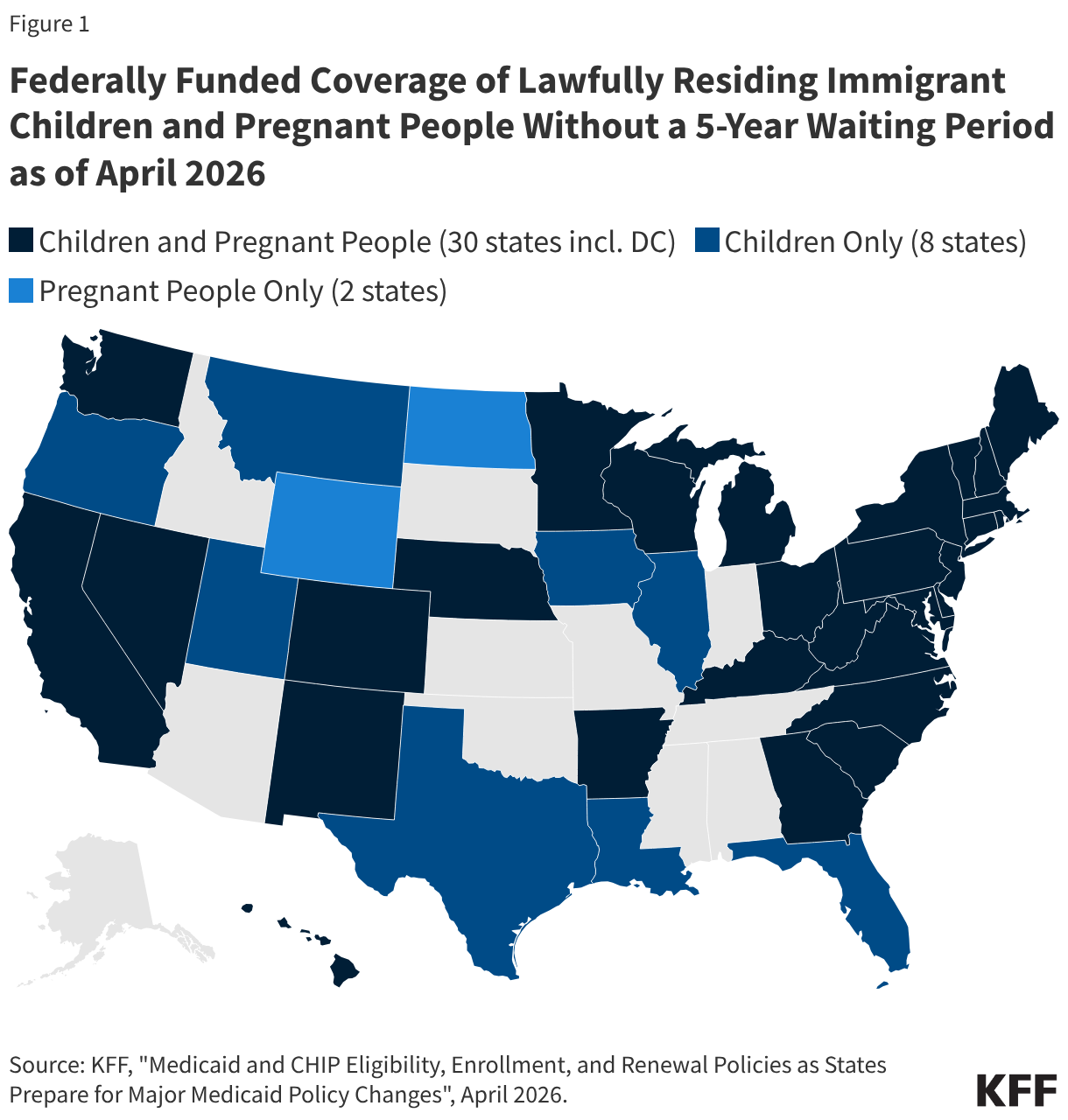
Faced with tightening federal standards, states retain the authority to adopt discretionary pathways within Medicaid and CHIP. As of April 2026, 38 states, including the District of Columbia, have exercised the option to provide Medicaid or CHIP coverage to lawfully residing immigrant children without enforcing the standard five-year waiting period. Similarly, 32 states and the District of Columbia have elected to waive the five-year waiting period for lawfully residing pregnant individuals.
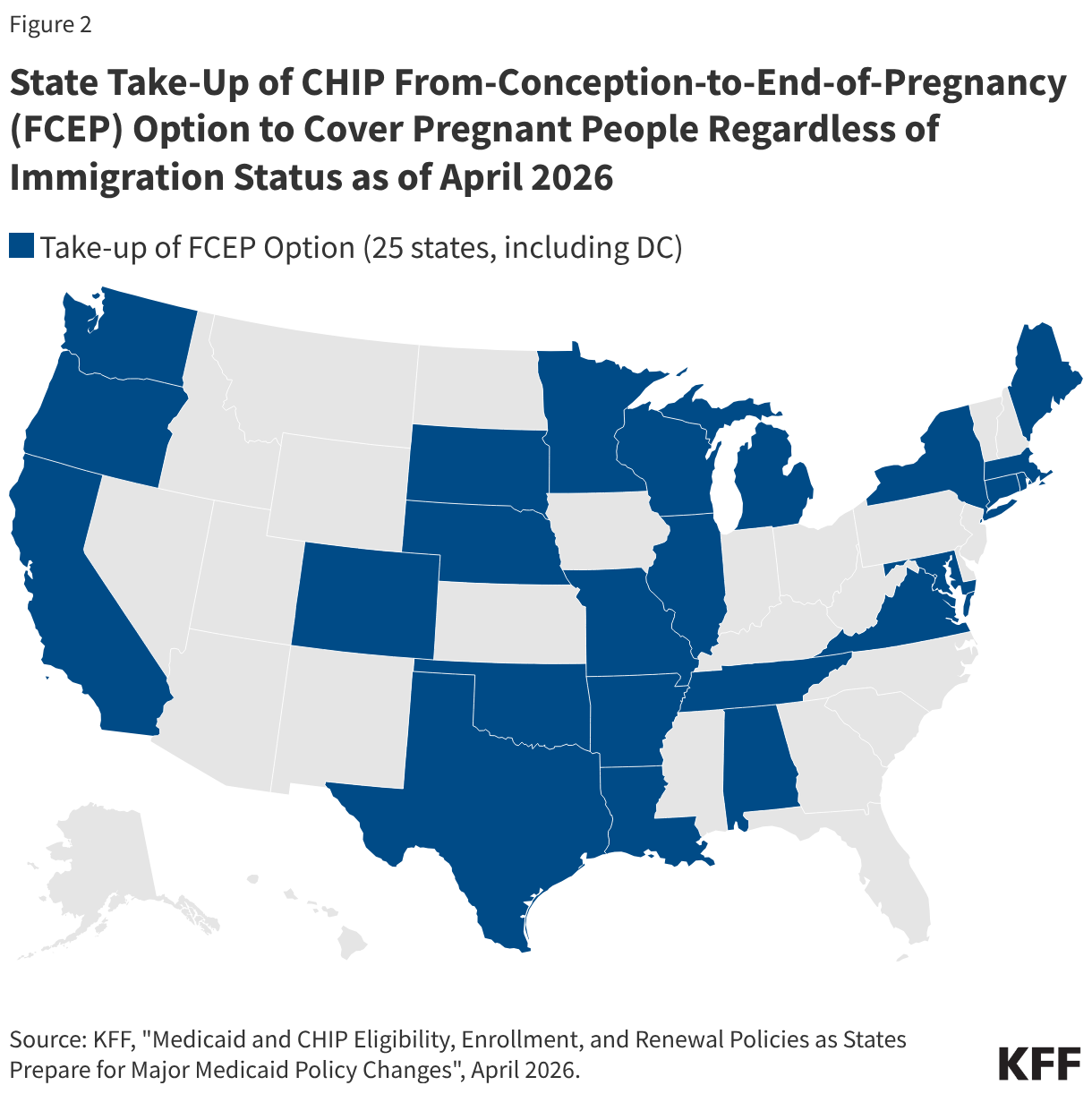
To further protect maternal health, 25 states and the District of Columbia have utilized the CHIP From-Conception-to-End-of-Pregnancy (FCEP) option. While traditional Medicaid and CHIP pregnancy pathways mandate 60 days of postpartum coverage, the standard FCEP option does not inherently include postpartum care. To bridge this gap, 11 states—California, Colorado, Connecticut, Illinois, Maine, Massachusetts, Minnesota, New York, Oregon, Rhode Island, and Washington—utilize state funding or CHIP health services initiatives to extend comprehensive postpartum coverage to a full 12 months, aligning with the permanent Medicaid extension established by the American Rescue Plan Act. Other jurisdictions, such as Maryland, Alabama, Texas, Virginia, and the District of Columbia, provide shorter postpartum extensions ranging from 60 days to four months through specialized state initiatives.
Fully State-Funded Coverage Programs and Fiscal Pressures
Beyond leveraging federal program options, several states have created fully state-funded coverage programs to support residents excluded from federal assistance. These state-backed initiatives vary considerably regarding eligibility thresholds and benefit packages, frequently targeting lawfully present immigrants caught in waiting periods and, in some jurisdictions, undocumented residents.
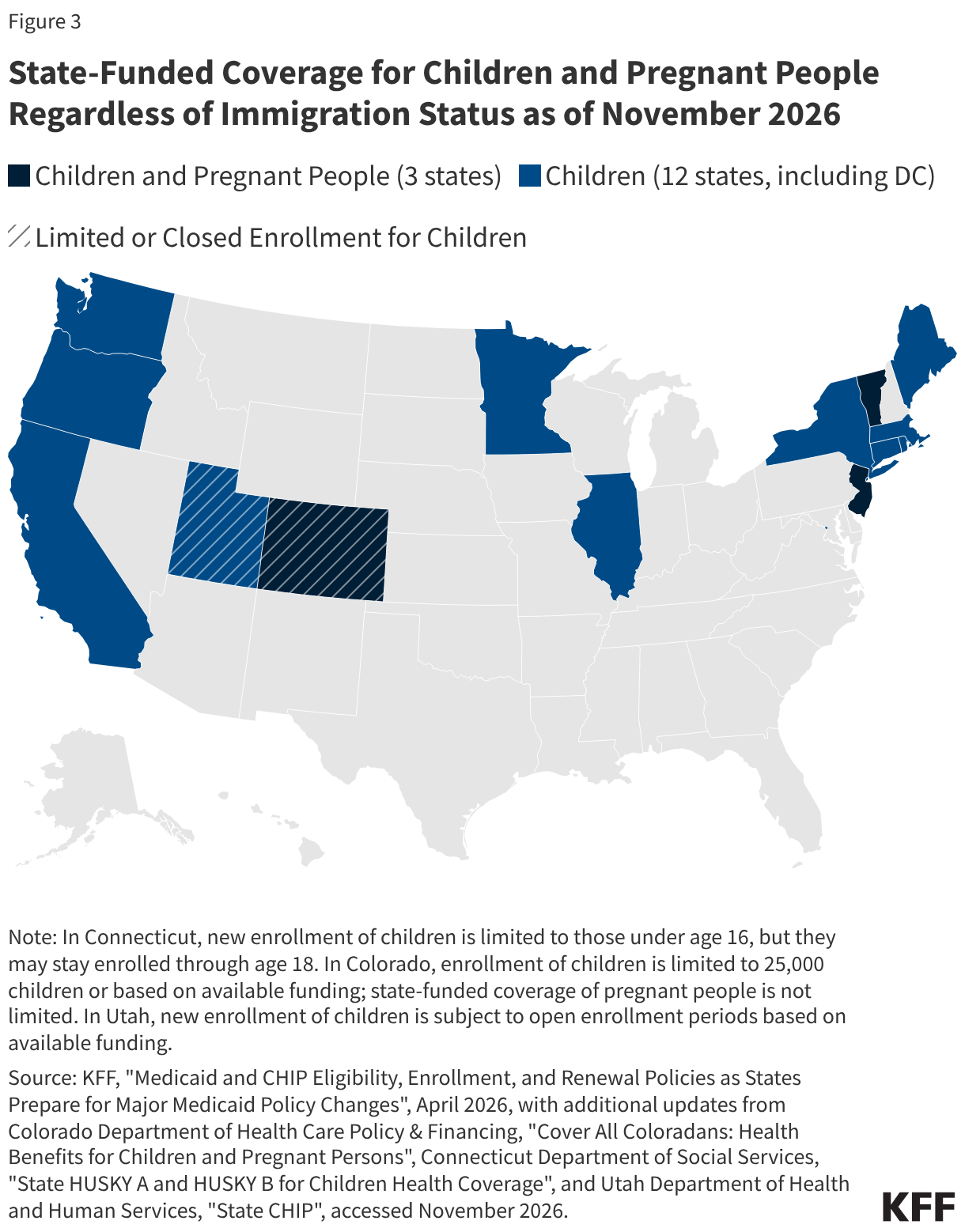
As of November 2026, 15 states and the District of Columbia provide comprehensive state-funded health coverage to income-eligible children regardless of their immigration status. This group includes California, Colorado, Connecticut, Illinois, Maine, Massachusetts, Minnesota, New Jersey, New York, Oregon, Rhode Island, Utah, Vermont, Washington, and the District of Columbia. Among these, Colorado, New Jersey, and Vermont also extend coverage to income-eligible pregnant individuals regardless of status, with Vermont maintaining a 12-month postpartum provision.
However, fiscal constraints have strained these state-level efforts. Colorado implemented significant rollbacks to its state-funded children’s coverage program in July 2026, capping enrollment at 25,000 children and restricting dental benefits, with plans to phase out long-term services for new enrollees and potentially eliminate the program entirely by January 2028. Utah has similarly closed its state-funded children’s coverage to new enrollment due to an established cap of approximately 2,000 children.
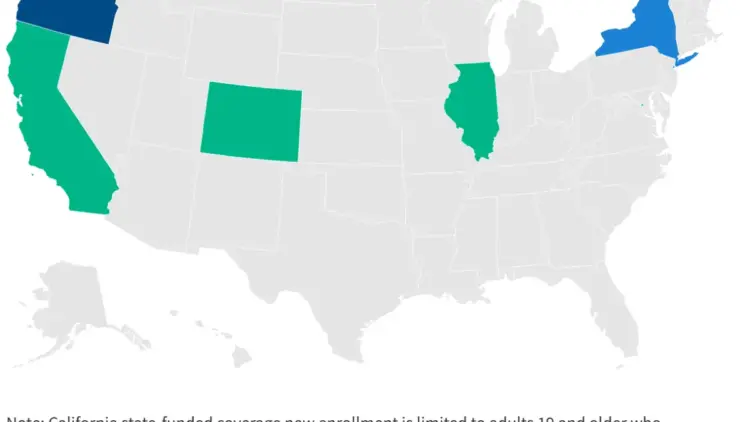
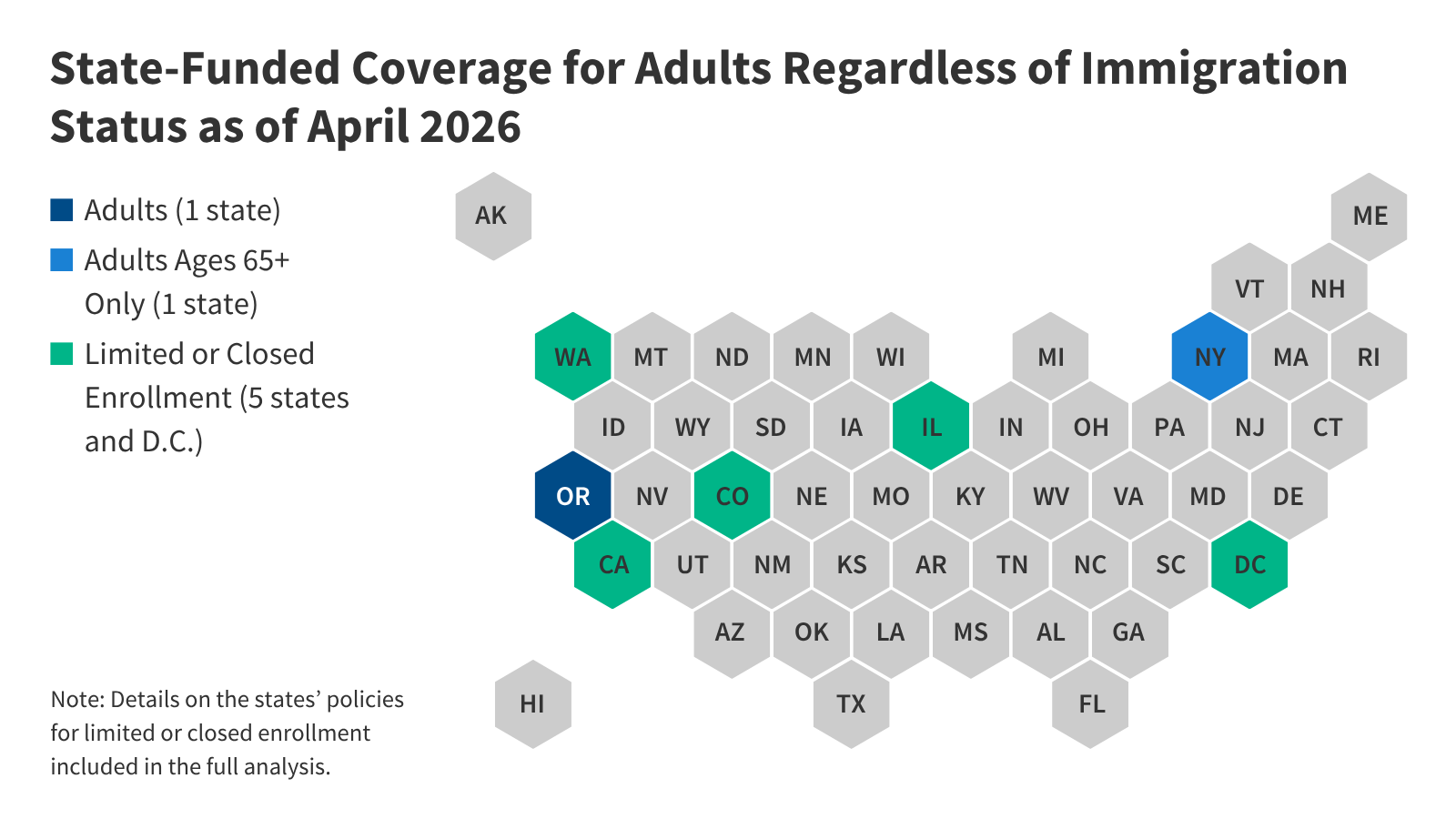
For adult populations, seven states—California, Colorado, the District of Columbia, Illinois, New York, Oregon, and Washington—have extended fully state-funded coverage to at least some income-eligible adults regardless of immigration status, though several have imposed strict age limits or frozen new enrollment. Conversely, six jurisdictions have recently reduced, eliminated, or announced plans to scale back adult state-funded coverage in response to budget shortfalls. Additionally, Maryland delayed its planned 2026 rollout allowing unsubsidized purchases on the state health insurance exchange regardless of immigration status to 2028, citing the heavy administrative burden required to implement the changes mandated by the 2025 federal reconciliation law.
To directly counteract the losses caused by federal policy shifts, five states—California, Minnesota, New Mexico, New York, and Oregon—have established fully state-funded mechanisms specifically for lawfully present immigrants who lost Medicaid or subsidized Marketplace access under the 2025 reconciliation law. These states utilize a mix of direct state appropriations, Basic Health Program trust reserves, and premium exchange subsidies to maintain coverage for affected residents.
Impact of Coverage Expansions on Health Care Access and Use
Public health research consistently demonstrates that health coverage expansions for immigrant populations yield measurable benefits, significantly reducing uninsured rates, increasing appropriate health care utilization, and improving long-term health outcomes. Findings from the KFF/New York Times Survey of Immigrants reveal that noncitizen adults residing in states with expansive health coverage policies are roughly half as likely to be uninsured compared to peers living in restrictive states.
Analyses of specific state implementations show similarly pronounced effects. California’s 2016 expansion of health coverage to low-income children regardless of immigration status correlated with a 34 percent decline in uninsurance rates within that demographic. Subsequent expansions targeting older immigrant adults in the state also demonstrated increased coverage rates. Furthermore, peer-reviewed studies indicate that children living in states providing universal coverage options are less likely to forgo necessary medical or dental care, more likely to maintain continuous insurance coverage, and better positioned to utilize a consistent primary care provider.
Similarly, extending Medicaid and CHIP pathways to pregnant individuals regardless of immigration status is consistently associated with higher rates of timely prenatal care and healthier birth outcomes, whereas restrictive state policies correspond directly with diminished utilization of postpartum medical care. As states grapple with competing fiscal demands and shifting federal parameters, the long-term trajectory of immigrant health coverage remains closely tied to both localized budget decisions and broader political developments.