
When planning international travel to historic destinations, finding accommodations that successfully blend modern luxury with genuine architectural accessibility can present a significant challenge. This balancing act is particularly evident in cities like Cartagena, Colombia, where historic preservation often intersects with contemporary development. Recently, travelers evaluating lodging options in the city’s bustling modern tourism district have turned their attention to the InterContinental Cartagena de Indias, a prominent beachfront property operating under the global IHG Hotels portfolio.
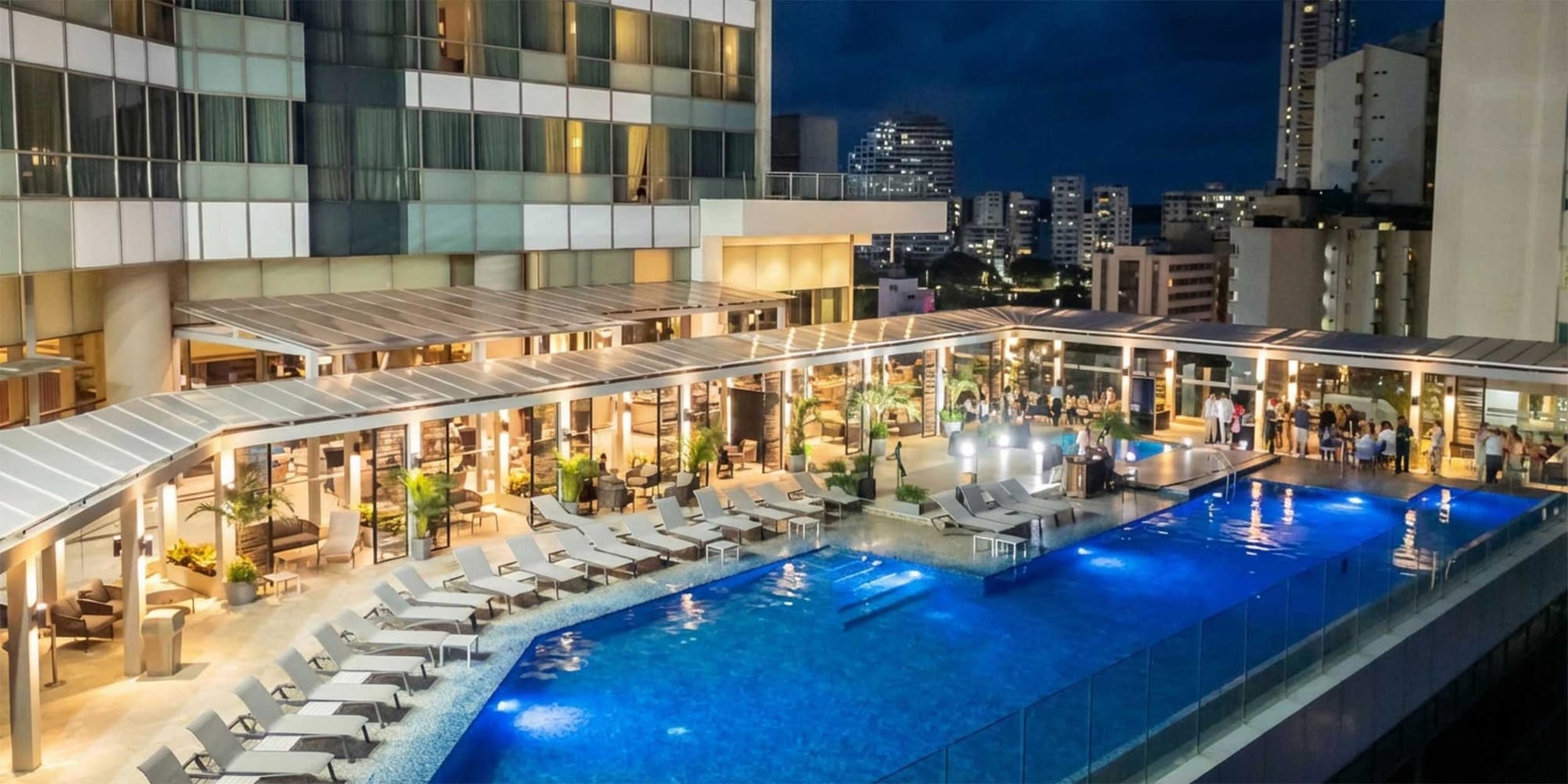
Located in Bocagrande—Cartagena’s primary commercial and hotel zone—the 285-room luxury property offers an appealing base for travelers looking to explore the Colombian Caribbean coast. The hotel sits approximately three miles away from the city’s celebrated Walled City, a designated UNESCO World Heritage Site renowned for its colonial architecture and rich history. For international visitors arriving by air, the property is situated roughly a 25-minute drive from Rafael Núñez International Airport, making it a geographically convenient option for both business travelers and vacationers alike.
A recent evaluation conducted during a familiarization trip sponsored by the Colombian government sheds light on the property’s infrastructure. While the hotel incorporates several thoughtful features designed to accommodate guests with mobility impairments, it also presents a series of notable shortcomings, particularly within its bathroom facilities, that wheelchair users should carefully consider prior to securing a reservation.
Room Rates and Reservation Policies
Pricing at the InterContinental Cartagena generally aligns with upscale urban and resort standards for the region. Standard nightly rates typically hover around $175 USD during off-peak periods, though prices are subject to significant upward adjustments during major holidays, festivals, and peak international travel seasons.
Travelers seeking accessible accommodations should note that accessible guest rooms are restricted exclusively to the ocean view category. These rooms are priced comparably to standard guest rooms within the same tier, preventing travelers with disabilities from facing financial penalties simply for booking a room with necessary adaptations. Reservations can be coordinated directly through the official InterContinental Cartagena website or via standard IHG booking channels.
The property maintains a total of three wheelchair-accessible hotel rooms within its inventory. Notably, each of these designated accessible spaces is configured with two queen-sized beds, catering to families, groups, or travelers requiring traveling companions or aides.
Evaluating the Wheelchair Accessible Guest Room Experience
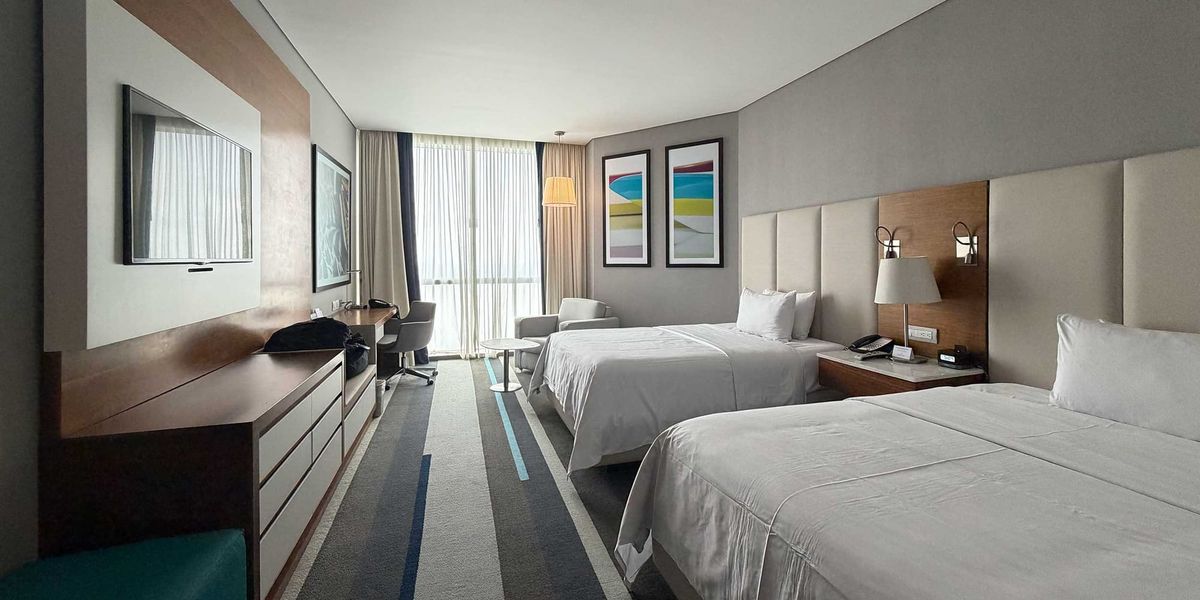
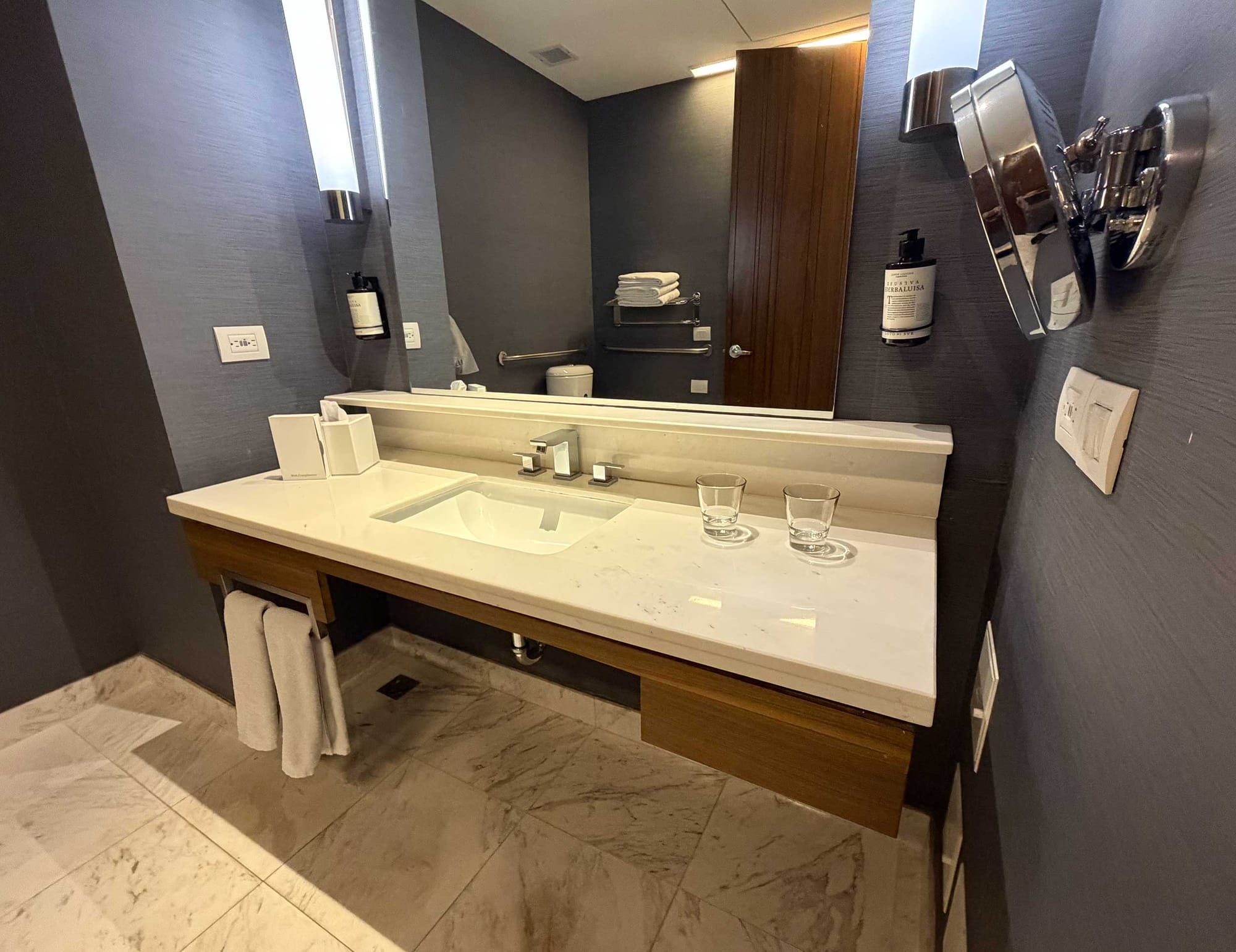
A detailed look inside Room 911, an accessible accommodation located on the ninth floor, reveals both the strengths and limitations of the hotel’s physical layout. Access to the room begins at the entryway, where the main door measures a generous 35 inches (89 cm) in width, providing ample clearance for virtually any motorized or manual wheelchair. The door opens with relative ease, welcoming guests into a bright, modern interior characterized by colorful regional artwork, classic striped carpeting, and expansive floor-to-ceiling windows. These large glass panes flood the room with natural light while offering sweeping, unobstructed views of the Caribbean Sea.
Upon entering, guests will find sufficient floor clearance to maneuver a large power wheelchair comfortably. There is adequate turning radius throughout the space, including enough room to park and maneuver between the two queen beds.
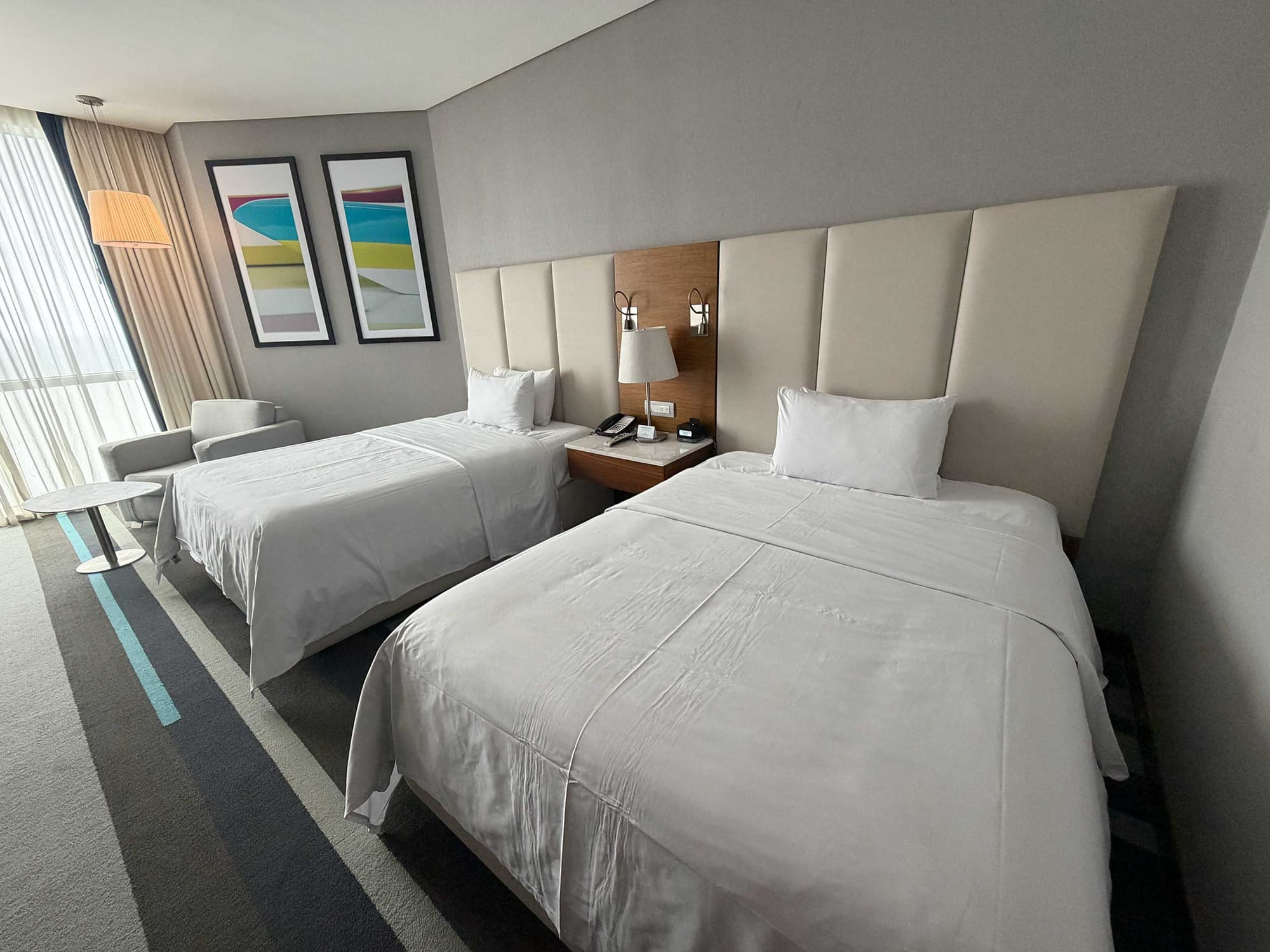
The beds themselves sit at a height of 25 inches (64 cm) from the floor to the top of the mattress, presenting a comfortable surface for lateral transfers from a seated position. However, the beds are constructed with solid platform bases that offer zero clearance underneath. This design choice prevents the use of a mechanical patient transfer hoist, a crucial detail for guests who rely on overhead or floor-based lifting equipment.
Other architectural details in the room present mixed utility. The entry door is equipped with two peepholes to accommodate guests of varying statures or seated positions. The upper peephole is set at 59.5 inches (151 cm), while a lower option is positioned at 40 inches (102 cm). While the inclusion of a lower peephole is a commendable nod to accessibility, the 40-inch height remains somewhat too low to be effectively utilized from the specific eye level of a power wheelchair user.
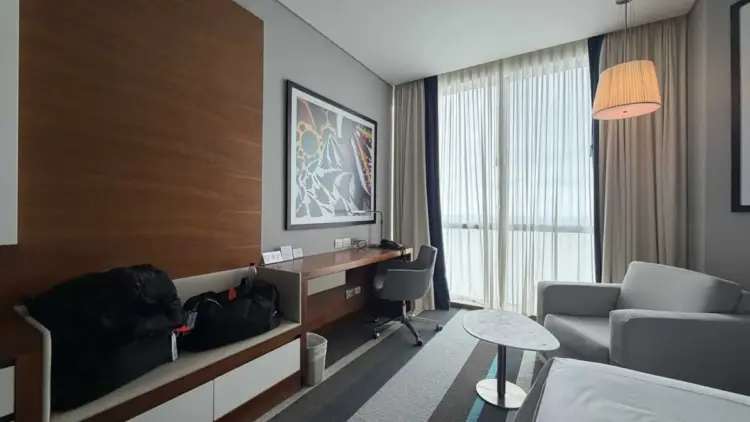
Additional furnishings include a wood-paneled desk positioned along the wall opposite the beds. The desk stands at 29.5 inches (75 cm) in height, offering 27.5 inches (70 cm) of knee clearance underneath, allowing a wheelchair user to pull up comfortably to work. Seating options near the window include a standard office chair and an upholstered armchair, accompanied by a small round side table.
The Accessible Bathroom: A Mix of Practical Features and Flawed Execution
While the main living quarters offer a comfortable and spacious environment, the adjoining wheelchair-accessible bathroom highlights a disconnect between standard hospitality design and practical accessibility needs. The space features a modern aesthetic, but the execution of its accessible elements reveals significant functional challenges, particularly within the roll-in shower area.
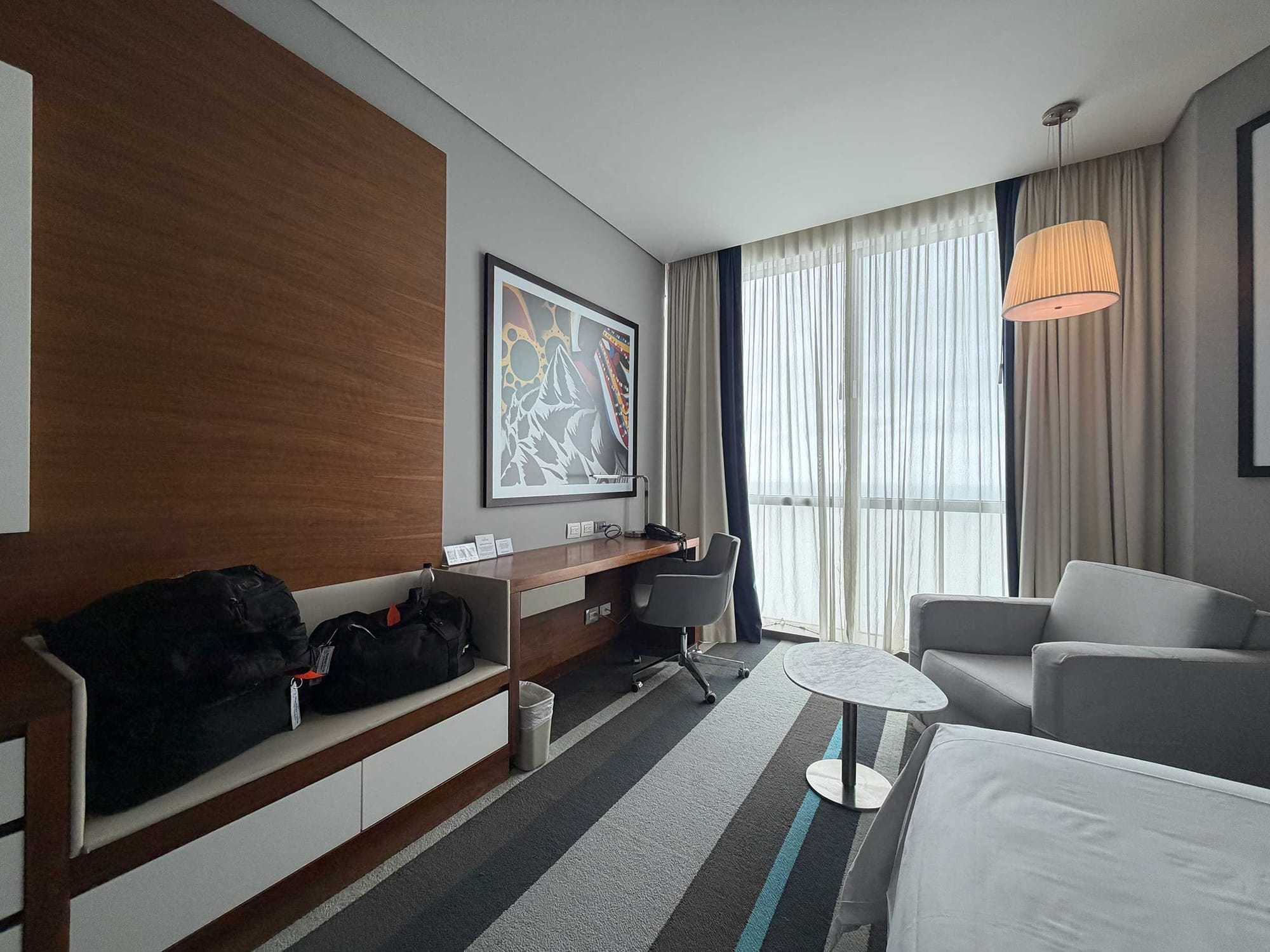
To examine the positive elements first, both the toilet and the vanity area demonstrate strong adherence to functional design principles. The toilet is positioned neatly in a corner and measures 18.5 inches (47 cm) from the floor to the top of the seat, placing it comfortably within the standard height range expected by accessibility advocates. Horizontal grab bars are securely mounted on both the rear wall and the adjacent side wall, positioned at a height of 37.5 inches (95 cm) to provide secure leverage and stability during transfers.
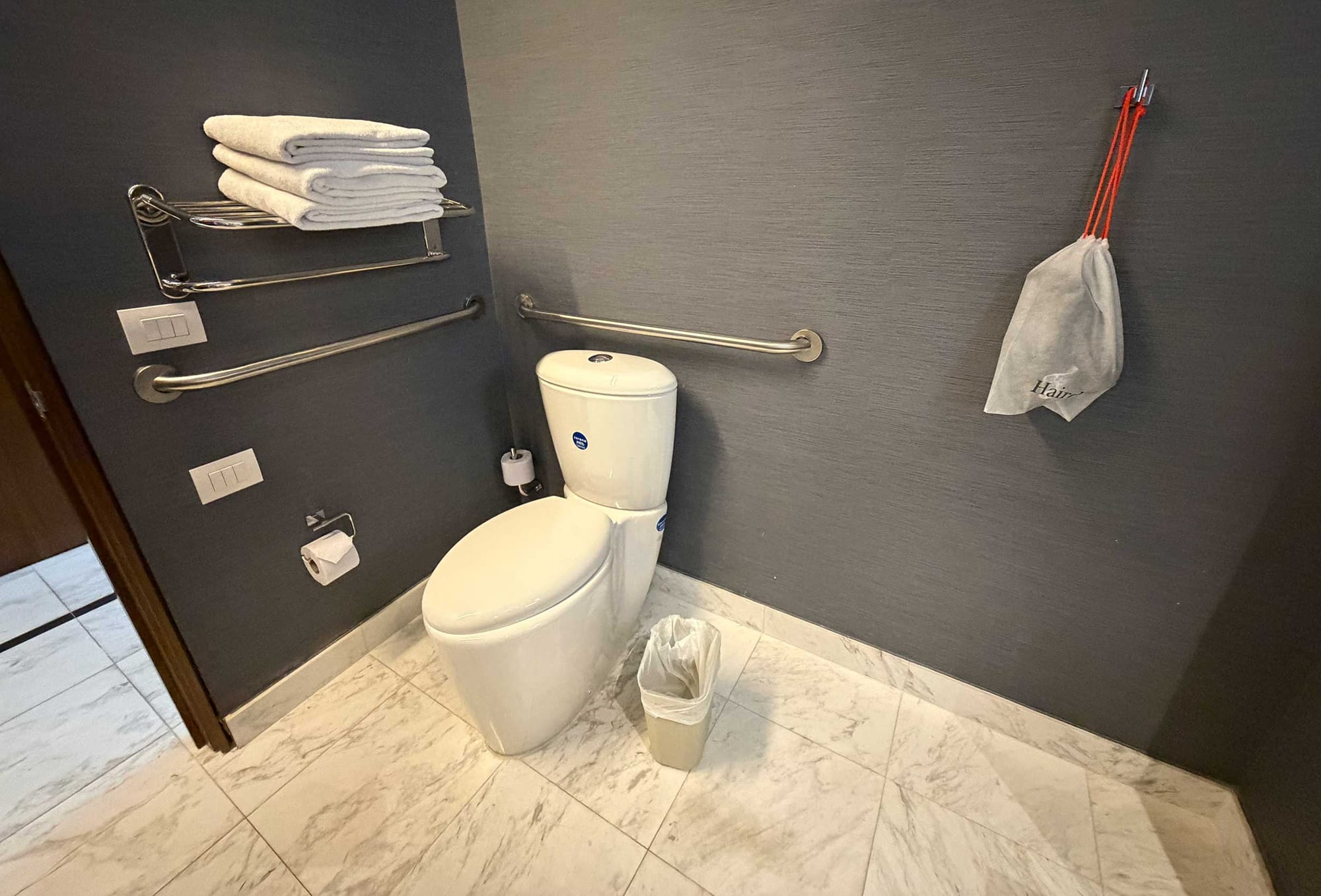
The vanity area features a long white marble countertop paired with an open-base wood-framed design. The countertop stands at a height of 30.5 inches (77 cm), providing 27 inches (69 cm) of vertical knee clearance underneath. This open configuration allows a wheelchair user to roll directly beneath the sink to access the undermount basin. While an additional inch or two of vertical clearance would enhance ergonomic comfort, the current setup remains functional.
Conversely, the roll-in shower represents a major departure from accessibility best practices. Although the installation includes all the necessary individual components required for an accessible shower, their spatial arrangement renders the space awkward and difficult to use safely.
The shower features a small fold-down seat mounted centrally on the back wall, measuring 18 inches (46 cm) wide by 14.5 inches (37 cm) deep, and sitting at a height of 16.5 inches (42 cm) above the floor. The placement of this seat creates immediate operational hurdles. It is positioned far away from the grab bar located on the adjacent side wall and similarly distant from the handheld shower head and water controls.
As a result, a guest utilizing the built-in seat is forced to sit sideways and grasp desperately at a grab bar positioned behind them simply to maintain stability. Navigating the water controls and the shower head from this seated position proves exceedingly difficult. Observers note that the shower layout appears to have been designed without meaningful input from individuals who understand the practical realities of bathing from a wheelchair. For future stays at the property, guests with similar mobility profiles would be well-advised to request or rent a portable shower chair that can be positioned closer to the fixtures.
Location, Surrounding Infrastructure, and Transportation
Beyond the hotel doors, the property’s location in Bocagrande places guests in the heart of Cartagena’s most active commercial corridor. The neighborhood offers an array of restaurants, shops, and entertainment options within easy walking distance of the lobby.
However, navigating the surrounding municipal infrastructure requires patience and caution. Sidewalk conditions throughout Bocagrande are inconsistent. While some areas feature smooth, well-maintained pedestrian pathways, others are in a state of disrepair. Similarly, curb ramps are present at many intersections but are entirely absent at others, making independent street navigation a variable experience for wheelchair users.
Visitors hoping to explore attractions outside the immediate neighborhood—such as the historic Walled City or Cartagena’s accessible beach areas—will find that relying solely on public pedestrian routes is impractical. Most travelers with mobility disabilities will need to arrange private transportation, accessible taxis, or rental cars equipped for specialized needs. Valet parking services are available directly through the hotel for guests operating personal or rented vehicles.
Ultimately, the InterContinental Cartagena de Indias provides a comfortable, visually appealing environment featuring spacious accommodations and select accessible amenities. For travelers heading to Colombia’s Caribbean coast who are comfortable bringing or requesting auxiliary equipment like a portable shower chair, the property remains a viable and high-end lodging option.



