
For generations, the cultural image of senior safety technology was defined by a single, dramatic phrase: "I’ve fallen and I can’t get up." Immortalized by television commercials, the classic wearable pendant connected older adults to a localized base unit, which then relied on a traditional landline telephone to reach a central monitoring station. While revolutionary for its time, that legacy format was plagued by severe limitations. It only functioned if an aging adult remembered to place the device around their neck, remained within a strict radius of several hundred feet from the home base station, and possessed the physical capability and consciousness to actively press the button after a debilitating accident.
Today, that simplistic concept has been entirely upended. Driven by a massive demographic shift and rapid technological innovation, modern medical alert systems have evolved into sophisticated safety hubs. Rather than serving as mere reactive panic buttons, contemporary devices act as proactive health-monitoring tools that can ultimately determine whether an older adult remains safely independent in their own home or faces a premature transition to a residential care facility.
The urgency behind this technological evolution is clear. According to data compiled by AARP, nearly 90 percent of individuals aged 65 and older express a strong preference to age in place in their familiar home environments rather than relocate to assisted living or skilled nursing facilities. Because independent living remains the preferred standard for the aging population, the market supporting it has matured at an unprecedented pace. Industry projections indicate that the global market size for medical alert systems and personal emergency response systems is slated to reach $11.8 billion, propelled directly by a soaring consumer demand for advanced, reliable safety monitoring that preserves autonomy.
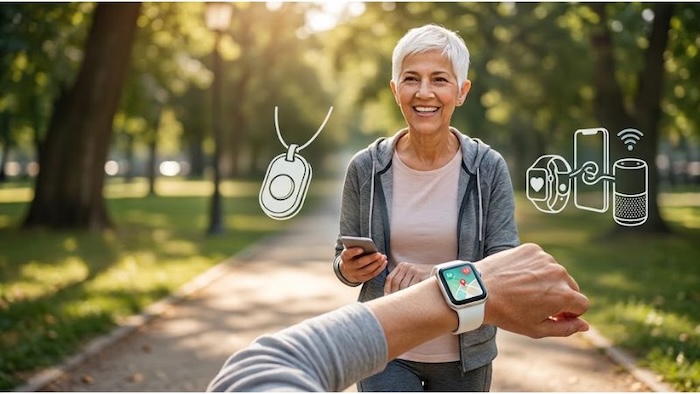
The transformation from the old standard to the modern era is rooted in the integration of wearable artificial intelligence and cellular connectivity. Modern devices have largely discarded the tether of the landline and the physical boundaries of the home. Instead, today’s options range from sleek, everyday smartwatches equipped with nationwide cellular coverage and precise global positioning system tracking to passive ambient sensors utilizing radar and artificial intelligence.
These technological leaps have fundamentally changed how emergencies are detected and managed. Traditional systems relied on basic impact triggers that frequently resulted in high false-alarm rates, or required the user to be conscious and capable of manual activation. In contrast, modern smartwatches utilize advanced artificial intelligence-filtered accelerometers and gyroscopes that continuously analyze motion patterns, identifying the distinct dynamics of a hard fall even if the user is rendered unconscious or disoriented. For older adults dealing with cognitive decline who may persistently refuse to wear traditional pendants or smartwatches, whole-home ambient sensors deployed via Wi-Fi and wall monitors can passively track daily routines and detect falls without requiring any wearable hardware at all.

This shift has also expanded the role of family caregivers. While legacy formats offered no digital integration beyond a telephone call notification following an alarm, modern systems connect directly to dedicated caregiver mobile applications. These platforms provide real-time updates regarding location, battery status, daily activity tracking, and routine deviation alerts, allowing families to monitor their loved ones’ well-being with unprecedented precision.
Despite these remarkable advancements, selecting the right medical alert system requires careful consideration of an individual’s specific needs and cognitive capabilities. Experts emphasize that technology must be matched thoughtfully to the user. For instance, an advanced smartwatch featuring a complex touchscreen interface will inevitably prove ineffective for a user dealing with severe dementia, advanced Parkinson’s disease, or significant macular degeneration. Conversely, a passive radar system or a simple, discreet wearable may offer the ideal solution for someone who resists more intrusive devices.
Caregivers are also reminded that even the most sophisticated medical alert system can never serve as a substitute for direct human supervision, structured in-home care, or professional medical evaluations. Industry organizations, including the National Institute on Aging, stress that safety technology is fundamentally a risk-mitigation tool designed to buy precious minutes during an acute emergency, rather than a comprehensive prevention strategy. Families are strongly encouraged to review established fall prevention guidelines and consult with qualified healthcare providers or occupational therapists before relying entirely on wearable devices to manage mobility and home safety.

The financial landscape surrounding these technologies remains a point of consideration for many households. Under current federal guidelines, Original Medicare, encompassing Part A and Part B, does not provide coverage for medical alert systems because they are not officially classified as durable medical equipment. However, certain Medicare Advantage Part C plans or state Medicaid programs may offer limited coverage, partial financial reimbursement, or product discounts depending on regional regulations and policy specifics.
Ultimately, navigating the delicate balance between ensuring safety and preserving personal independence remains one of the most demanding challenges of modern caregiving. The evolution of medical alert systems has successfully stripped away much of the stigma traditionally associated with bulky panic buttons, replacing them with sleek, proactive health hubs. Whether families choose a discreet GPS-enabled watch for an active parent or passive ambient sensors for a loved one navigating cognitive changes, today’s technology is designed to protect dignity while offering invaluable peace of mind. While no gadget can ever replicate the warmth, intuition, and watchful eye of dedicated human caregiving, integrating these advanced digital tools into a comprehensive safety plan ensures that reliable help is always quietly waiting in the wings.



