WASHINGTON — A broad coalition of disability rights organizations has voiced strong support for a newly introduced bipartisan resolution in the United States House of Representatives that explicitly reaffirms the foundational right of individuals with disabilities to live, thrive, and receive necessary services within their home communities rather than being segregated in institutional settings.
The Defend Community Integration Coalition (DCIC), a leading collective of national advocacy groups, formally applauded the introduction of the measure this week. The legislative effort, designated as H. Res. 1586, underscores the core principles of community integration that have defined decades of civil rights advocacy and federal statutory law.
The resolution is led by Bipartisan Disability Caucus Co-Chairs Representatives Debbie Dingell, a Democrat from Michigan, and Brian Fitzpatrick, a Republican from Pennsylvania. Their leadership in bringing the measure forward highlights a long-standing tradition of bipartisan cooperation surrounding disability rights and community inclusion. The resolution has also drawn crucial early backing from a diverse group of cosponsors, including Representatives Kean, Lawler, Wilson, Scanlon, and Simon. Advocates say this cross-party sponsorship demonstrates that the protection of civil rights for individuals with disabilities remains a shared priority across the political spectrum.
At the heart of the resolution is a reaffirmation of the landmark 1999 Supreme Court ruling in Olmstead v. Lois Curtis. More than twenty-seven years ago, the nation’s highest court held that the unjustified institutional isolation and segregation of people with disabilities constitutes a form of unlawful discrimination prohibited under the Americans with Disabilities Act (ADA). The Olmstead decision established that individuals with intellectual, developmental, and physical disabilities have the right to receive public services in integrated settings whenever appropriate and desired.
However, advocates and legislative sponsors emphasize that the Olmstead ruling did not emerge in a vacuum; rather, it was the culmination of a deeply rooted statutory and regulatory evolution stretching back decades. H. Res. 1586 carefully outlines this historical legislative record to demonstrate that the mandate for community integration is a firmly established pillar of federal law.
According to the congressional record detailed in the resolution, federal regulations enacted in 1977 and 1978 under Section 504 of the Rehabilitation Act explicitly mandated that services and programs for people with disabilities must be delivered in the most integrated setting appropriate to their individual needs. Congress subsequently ratified those vital regulatory standards when it amended Section 504 in 1978.

More than a decade later, in the landmark Americans with Disabilities Act of 1990, Congress formally codified explicit findings regarding the treatment of disabled Americans. Lawmakers wrote directly into the statute that the isolation and segregation of individuals with disabilities represent a serious and pervasive form of discrimination. Furthermore, Congress incorporated the core integration regulations established under Section 504 directly into the public services title of the ADA. When the Supreme Court later issued its ruling in Olmstead, it affirmed what Congress had already written into law: that unnecessary segregation is a civil rights violation.
For the coalition of organizations championing H. Res. 1586, this legislative clarity is more urgent today than ever before. Representatives of the DCIC note that the integration mandate is currently facing new, unprecedented challenges and legal headwinds across various jurisdictions. Consequently, proponents argue that a formal congressional affirmation of these enduring directives could not arrive at a more critical juncture.
Supporters maintain that disabled individuals belong in mainstream community life, sharing neighborhoods, workplaces, and social spheres alongside their non-disabled peers. The newly introduced resolution delivers an unequivocal message from both sides of the aisle that the legislative intent of Congress remains unchanged: community integration is not merely a policy preference, but a federally protected civil right that must be fiercely guarded.
In response to the introduction of H. Res. 1586, advocacy leaders are calling on the broader legislative body to act swiftly. The Defend Community Integration Coalition is urging every member of the House of Representatives to sign on as a cosponsor of the resolution. Additionally, the coalition is calling upon the United States Senate to introduce a companion bipartisan resolution as soon as possible to solidify congressional support from both chambers of Capitol Hill.
Beyond legislative resolutions, the coalition emphasizes that federal and state policymakers must back these commitments with tangible financial investments. Advocates stress that safeguarding community living requires robust, sustained funding for home and community-based services (HCBS), as well as targeted investments to support the direct care workforce. Without adequate compensation, recruitment, and retention for direct support professionals, the infrastructure necessary to sustain independent community living remains vulnerable.
The introduction of H. Res. 1586 serves as a reminder of the ongoing struggle for true equality and accessibility. As the legislative process moves forward, the Defend Community Integration Coalition and its member organizations continue to rally public and political support to defend and expand community integration nationwide.
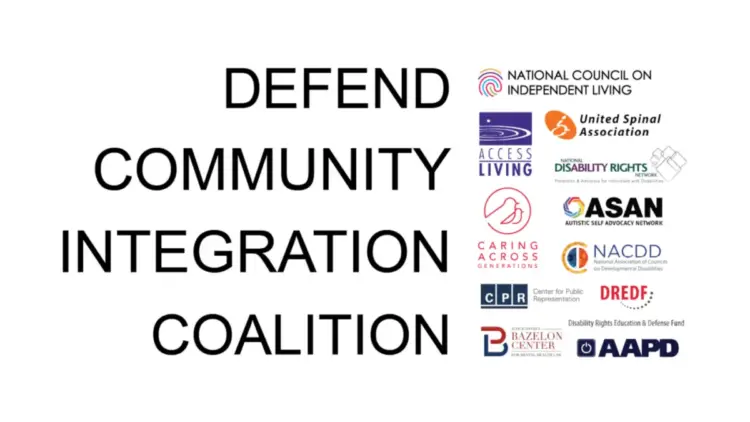
The Defend Community Integration Coalition comprises numerous prominent national organizations dedicated to advancing the rights and autonomy of individuals with disabilities. Its founding members include the National Council on Independent Living, the American Association of People with Disabilities, the Autistic Self Advocacy Network, Caring Across Generations, the National Disability Rights Network, United Spinal Association, Access Living, the National Association of Councils on Developmental Disabilities, the Center for Public Representation, the Bazelon Center for Mental Health Law, and the Disability Rights Education and Defense Fund.