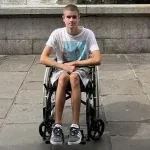
Carlos Murillo refuses to let a physical diagnosis set the boundaries of his world. At 32 years old, the Illinois resident is spending his third decade proving that using a wheelchair is no barrier to high-octane adventure, personal fulfillment, or athletic accomplishment. Born with spina bifida—a neural tube defect where the spine and spinal cord do not form properly—Murillo received his first wheelchair at just three years old. Rather than viewing the chair as a restriction, he has transformed it into a vehicle for exploring the world on his own terms.
Over the years, Murillo has built an athletic and adventure resume that would intimidate even the most seasoned adrenaline enthusiasts. He has gone zip-lining, waterskiing, kayaking, snow skiing, scuba diving, go-kart racing, sled hockey, wheelchair rugby, archery, horseback riding, and rock climbing. Yet, despite having already conquered a broad spectrum of adaptive sports, he remains relentlessly focused on whatever challenge comes next.
His vision extends far beyond his current accomplishments. Murillo has established an ambitious personal bucket list featuring NASCAR drive-alongs, supercar rides, adaptive paragliding, helicopter flights, parasailing, adaptive surfing, whitewater rafting, adaptive mountain biking, skydiving, and extensive international travel. Concurrently, he is pursuing a grand tour of sports venues across North America, checking off stadiums across Major League Baseball, the National Hockey League, the National Basketball Association, NCAA collegiate sports, minor league baseball, professional rugby, and the National Women’s Soccer League.
For Murillo, his journey is built on four core pillars: the expansion of adaptive sports, the development of accessible travel, personal determination, and a firm refusal to let physical obstacles define what is possible. In a comprehensive interview detailing his life, mindset, and ongoing pursuits, Murillo shared how his adventure movement began, the practical realities of adaptive athletics, and where his ambitions are heading next.
Origin Story and Mindset
Murillo’s entry into the world of adaptive athletics was not an immediate, grand strategic plan; rather, it began with a single social gathering. In 2007, he attended a holiday Christmas party organized by GLASA (Great Lakes Adaptive Sports Association), where he was introduced to wheelchair basketball. That initial experience opened his eyes to the possibilities of adaptive sports, sparking a interest that would gradually transform his entire lifestyle.
While he engaged in sports throughout his youth and twenties, the formalization of his adventures into an organized mission took shape more recently. About two years ago, Murillo decided to turn his personal desires into an active bucket list.
"The bucket list started about two years ago because there were a lot of things I wanted to do," Murillo explained. "I just didn’t know how to go about it, so that’s why I made my bucket list."
That decision marked a shift in perspective. For Murillo, entering his 30s brought a renewed sense of purpose and exploration that surpassed his earlier years. He noted that the concept of adventure has evolved significantly as he has grown older and gained more experience navigating adaptive opportunities.
"It means a lot, because I’m finding so much more in my 30s than I ever did in my 20s," he said.
Navigating complex physical challenges and stepping into unfamiliar sporting environments often causes hesitation, but Murillo maintains an upbeat, forward-looking attitude toward failure or self-doubt. When asked if he ever questioned the path he chose, his response reflected a mindset focused on resilience: "I don’t have doubts or regrets. I have lessons!"
Pushing Boundaries Through Adaptive Sports
The sheer diversity of sports Murillo has attempted requires a continuous adaptation to new techniques, physical demands, and specialized equipment. His list of accomplishments encompasses water sports, winter sports, contact sports, and high-altitude activities. Yet, among all the disciplines he has tackled, certain experiences stood out unexpectedly.
When reflecting on what surprised him most, Murillo pointed to his experience with zip-lining—an activity he long assumed was out of reach due to equipment constraints.
"Zip-lining, because I didn’t think there was an adaptive program out there," Murillo recalled. Finding a program capable of safely harnessing and supporting a wheelchair user proved to be a major revelation, opening up a whole new category of outdoor adventure.
Conversely, not every sport came easily. While zip-lining provided an aerial thrill, hand-cycling presented an intense physical test that pushed his stamina and upper-body strength to their limits.
"Cycling was hard because going uphill was very challenging," Murillo admitted. "Pushing a bike uphill is not the greatest."
Despite the distinct mechanics required for sports as varied as scuba diving, sled hockey, rock climbing, and wheelchair rugby, Murillo approaches the learning curve of each new activity with remarkable simplicity. Rather than overthinking technical mechanics, he relies on intuitive trial and error.
"I really don’t have any techniques!" Murillo said. "It just takes a few tries to get the hang of each sport."
While some sports serve as one-time bucket-list achievements, others instantly captured his heart. Murillo noted that zip-lining, para-motoring, and waterskiing immediately stood out as activities he knew he would want to return to repeatedly.
Key to Murillo’s success has been the ecosystem of adaptive sports organizations and non-profit programs designed to make athletics accessible. Organizations such as GLASA, H2O Adaptive Sports, Diveheart, the Shirley Ryan AbilityLab, and Wisconsin Adaptive Ski provide the specialized equipment, trained instructors, and safety protocols necessary for athletes with mobility impairments to participate fully.
For newcomers who might feel intimidated by stepping into an adaptive sports environment for the first time, Murillo emphasized that the atmosphere at these organizations is welcoming and collaborative from day one. "It’s actually really fun when you start interacting with different athletes and trying different sports," he said.
The Expanding Bucket List and High-Adrenaline Pursuits
With a substantial list of sports already mastered, Murillo’s attention has turned to the remaining items on his bucket list. His future ambitions lean heavily toward high-speed, high-altitude, and high-intensity activities, including NASCAR driving experiences, supercar rides, adaptive paragliding, parasailing, adaptive surfing, whitewater rafting, adaptive mountain biking, helicopter flights, and skydiving.
When asked what draws him toward ventures like NASCAR and paragliding, Murillo did not hesitate: "I love the adrenaline rush they give me."
However, even dedicated thrill-seekers experience varying degrees of anticipation depending on the terrain. Murillo distinguishes between the events he looks forward to with pure excitement and those that induce a healthy level of nervousness. He noted that supercar rides and parasailing spark pure excitement, while aquatic extreme sports like adaptive surfing and whitewater rafting push him outside his comfort zone.
"I’m excited about supercar rides and parasailing, and nervous about adaptive surfing and whitewater rafting," Murillo shared.
Managing an evolving bucket list requires a practical selection process. Rather than adding every extreme activity he encounters online, Murillo evaluates each concept systematically before committing to it. "I look at the pros and cons, and also at what looks more appealing to do," he explained.
Once an item is successfully checked off, the process of finding the next challenge begins anew. Murillo stays constantly engaged in research to identify emerging adaptive opportunities around the globe, filling any empty slot on his list "just by searching the web and thinking of new ideas."
Sports Fandom and the Stadium Tour
Alongside his athletic pursuits, Murillo is an avid sports fan with a passion for venue chasing. His goal is to visit as many professional, collegiate, and minor league stadiums as possible, immersing himself in live sports culture across the United States and beyond.
His stadium collection spans major professional leagues—including MLB, the NHL, the NBA, and the NWSL—as well as collegiate NCAA facilities and professional rugby venues. "I really love sports, so honestly, I just wanted to go to as many stadiums as possible," Murillo said of the motivation behind his ballpark tour.
A distinct feature of Murillo’s stadium journey is his affinity for minor league baseball parks. His travel logs frequently feature visits to minor league venues, including ballparks in Kenosha and Schaumburg, Illinois; South Bend, Indiana; Midland, Michigan; and San Antonio, Texas.
For Murillo, minor league games offer a unique blend of community atmosphere, affordability, and accessibility. He has developed a practical, proactive approach to securing access to these venues.
"The cost of the games," Murillo pointed out as a primary draw. "I also usually email the teams to ask for complimentary tickets." Many minor league organizations are responsive to community outreach, making it easier for fans to plan accessible stadium visits.
Evaluating stadium infrastructure from a wheelchair perspective provides Murillo with a unique lens on venue design. While modern major league facilities generally comply with accessibility legislation, venue experiences can vary significantly. When asked to identify a stadium that stood out for exceptional accessibility features, Murillo singled out Wintrust Field, home of the Schaumburg Boomers in Illinois, praising its thoughtful layout and fan accommodations.
As for completing his stadium quest, Murillo views it as an ongoing journey rather than a finite checklist. "There are a lot on the list," he noted. "I couldn’t pick just one."
Navigating Accessible Travel Near and Far
Murillo’s adventures and stadium tours have turned him into an experienced traveler. His journeys have taken him across numerous U.S. states—including California, Texas, Florida, Michigan, Indiana, Minnesota, and Wisconsin—as well as international trips to Mexico and Canada.
Traveling as a power or manual wheelchair user requires careful preparation, as unexpected accessibility barriers can disrupt an otherwise well-planned itinerary.
"There is a lot of planning involved, such as hotels and accommodations, transportation, and wheelchair-accessible things to do," Murillo explained. Ensuring that hotel rooms feature true roll-in showers, that public transit or rental vehicles can accommodate a chair, and that target destinations lack step barriers forms the bedrock of his travel prep.
Through his extensive travels, Murillo has observed clear differences in regional accessibility infrastructure. Domestically, he identified Texas and California as top-tier destinations that consistently excel in accessible design and public infrastructure. Internationally, however, older historical architecture can present real physical barriers.
"Texas and California stood out the most accessibility-wise," Murillo observed. "The country that fell short was Mexico, just because of the cobblestones." The uneven surface of historic cobblestone streets in many Mexican cities creates severe friction and instability for wheelchair wheels, requiring extra effort to navigate.
Despite past challenges, Murillo’s international travel schedule continues to expand. His upcoming itinerary includes a multi-stop cruise featuring calls in Honduras, the Bahamas, and a return to Mexico. Cruising offers a controlled environment with guaranteed accessible cabins and onboard facilities, serving as an effective hub for international exploration.
When reflecting on the broader landscape of travel advice, Murillo noted that mainstream resources often paint an overly simplified picture of barrier-free travel. What he wishes accessible travel guides stated more clearly is straightforward: "That not everything is wheelchair accessible."
Despite those realities, his core message to fellow wheelchair users who feel intimidated by the logistics of solo travel remains uncompromising: "Just do it. Be fearless."
Advocacy, Motivation, and Redefining Possibility
Through his public adventures and personal journey, Murillo has naturally stepped into the role of an advocate, showing what is possible when adaptive resources are fully utilized. He believes that one of the biggest obstacles facing people with mobility impairments is simply a lack of awareness regarding the programs available to them.
"That it is out there; you just have to look for it," Murillo said when asked what he wishes more people understood about accessibility in extreme and adaptive sports.
For individuals who are newly diagnosed, newly injured, or adjusting to life in a wheelchair—and who may believe their adventurous days are behind them—Murillo offers direct, actionable encouragement: "Don’t be afraid to try new things. Just send it."
Murillo hopes his ongoing journey helps shift perceptions across society, encouraging both able-bodied individuals and members of the disability community to reevaluate their assumptions about physical limitations. He wants his experiences to demonstrate that adaptive sports are not merely recreational therapy, but legitimate avenues for high-level athletic pursuit and adventure.
When daunting new challenges arise or physical fatigue sets in during difficult activities, Murillo relies on an internal drive reinforced by the support of his coaches. "My coaches and myself, because giving up is not an option," he emphasized.
Looking back on a decade-plus of breaking barriers, Murillo finds it difficult to isolate a single crowning achievement, choosing instead to take pride in the entire trajectory of his life. "I’m proud of everything I’ve done," Murillo reflected. "If I weren’t, I wouldn’t have done it."
His journey stands as proof that independence and adventure are not defined by mobility status, but by persistence, creative problem-solving, and the courage to pursue new horizons. Offered the chance to give advice to his younger self at the very start of his adaptive sports journey, Murillo’s conclusion was simple and clear: "That a lot of things are possible. You just have to work for them."