The Defend Community Integration Coalition (DCIC), a powerful alliance of leading national disability rights organizations, has issued a strong and unequivocal condemnation of a recently proposed joint resolution filed in the ongoing legal battle Texas v. Kennedy. Introduced on August 31, the proposed resolution directly targets the pivotal 2024 community integration regulations established under Section 504 of the Rehabilitation Act of 1973, aiming to dismantle provisions that advocates have long considered foundational to the civil rights of people with disabilities.
According to the coalition, this legislative and legal maneuver flies directly in the face of decades of established judicial precedent and clear Congressional intent. For generations, lawmakers, advocates, and individuals with disabilities have worked tirelessly to ensure that community integration is firmly recognized as a fundamental civil right, rather than a mere policy preference or an optional service model. By attempting to strike down the 2024 Section 504 regulations, the resolution threatens to roll back years of hard-fought progress that has allowed countless individuals to move out of restrictive institutional settings and into community-based homes and neighborhoods.
As national disability rights leaders and allied organizations, the members of the DCIC have dedicated decades to advancing and protecting these rights. In their joint statement, coalition representatives emphasized that they strongly condemn any organized attacks aimed at undoing work that has been meticulously built by and for people with disabilities. The core of this struggle, leaders note, revolves around autonomy and the fundamental human right to self-determination.
For people with disabilities, advocates stress, there is simply no right more essential than the ability to make one’s own choices. Far too often, systemic barriers and institutional biases force individuals into positions where others dictate the terms of their daily lives. Achieving genuine autonomy requires robust, reliable supports that allow individuals to make real choices about how they want to live, work, and participate in society. Building the necessary infrastructure to support people in going to school, securing meaningful employment, enjoying regular meals, maintaining stable housing, and raising families has taken years of advocacy, litigation, and community organizing.
As human beings, people with disabilities deserve the basic security of knowing they have access to the resources and support systems required to live fulfilling lives. True quality of life extends far beyond the bare necessities of institutional care—such as receiving three scheduled meals a day and having medications administered on a rigid timetable. A meaningful life encompasses the entire human experience: growing, working, loving, dreaming, making mistakes, and ultimately reaching one’s full potential. It is about having the autonomy to decide when to wake up in the morning, when to leave the house, what to eat, and with whom to share a home.
Coalition leaders point out that these basic aspects of daily life become exceedingly difficult, if not impossible, to achieve when individuals are forced to remain in congregate settings where they are stripped of decision-making power over nearly every aspect of their existence. Institutionalization systematically removes personal agency, replacing individual dignity with bureaucratic schedules and facility-wide rules.

Amid these mounting legal and political threats, advocates emphasize the resilience of the disability community. Disabled individuals are survivors, as well as spouses, parents, siblings, classmates, colleagues, and neighbors. Above all, they are Americans who are deeply determined to push back against policies, ideas, and legal actions that strip away their dignity and threaten to erase decades of hard-won civil rights progress.
The DCIC has made it clear that its member organizations will continue to stand shoulder-to-shoulder, working collaboratively to fight for the full realization and enforcement of the community integration mandate. From the perspective of the coalition and its supporters, the community integration of people with disabilities is entirely non-negotiable.
Describing the current legal challenge as a monumental fight, coalition leaders are calling on allies, advocates, and community members across the nation to join forces and engage in collective action. In moments of profound challenge, unity and shared purpose remain the community’s greatest strengths, reinforcing the belief that advocates are undeniably stronger together as they face down efforts to dismantle their civil rights.
The ongoing battle surrounding Texas v. Kennedy has galvanized the broader disability community, prompting a wave of educational initiatives, resource sharing, and calls to action from numerous national organizations. To help the public and legal advocates understand the scope of the threat and the history of these protections, several coalition members and allied organizations have compiled comprehensive educational materials and legal analyses.
Among these resources, the American Association of People with Disabilities (AAPD) has highlighted its ongoing educational programming, including webinars focused on understanding and protecting disability rights under landmark legal frameworks such as the Supreme Court’s Olmstead decision, the Americans with Disabilities Act (ADA), and Section 504, complete with actionable steps for concerned citizens and advocates.
Additionally, organizations such as the Disability Rights Education & Defense Fund (DREDForganization) have released formal statements detailing the broader implications of the proposed resolution in Texas v. Kennedy, alongside dedicated online resource pages designed to keep the public informed about developments in the case. Analytical summaries provided by networks such as Red Line for Civil Rights have further dissected the legal history, examining the federal government’s historical enforcement of the Olmstead integration mandate and the potential consequences if these federal protections are weakened or struck down.
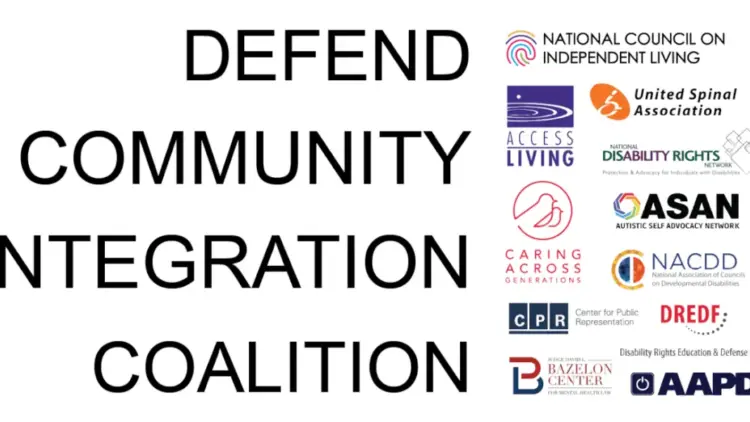
The Defend Community Integration Coalition comprises a robust network of advocacy organizations dedicated to preserving and expanding the rights of people with disabilities. Its current membership includes Access Living, the American Association of People with Disabilities, the Autistic Self Advocacy Network, the Bazelon Center for Mental Health Law, Caring Across Generations, the Center for Public Representation, the Disability Rights Education & Defense Fund, the National Association of Councils on Developmental Disabilities, the National Council on Independent Living, the National Disability Rights Network, and United Spinal Association.