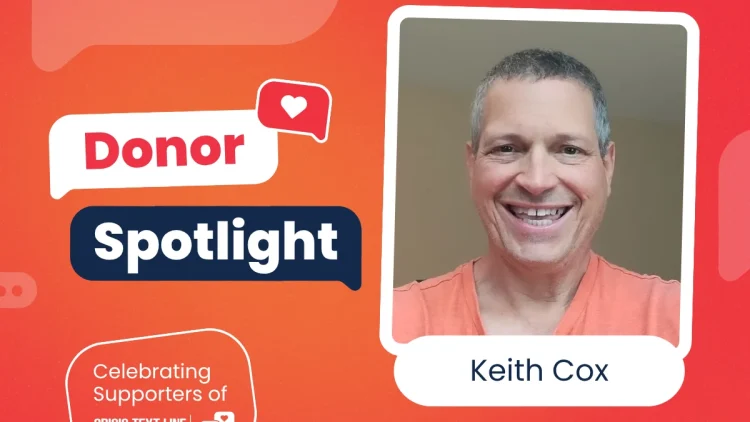
At Crisis Text Line, the generosity of donors serves as the foundational pillar that helps the organization continue to save and transform lives every single day. Within this dedicated community of supporters, individuals who contribute both their financial resources and their personal time embody the ultimate commitment to mental health advocacy. This month, Crisis Text Line is shining its donor spotlight on Keith Cox, a dedicated philanthropist who also serves on the front lines as a volunteer Crisis Counselor. By pairing his financial contributions with direct, hands-on intervention, Cox has taken active steps to ensure that no individual ever has to face their darkest moments in isolation.
The need for accessible, round-the-clock mental health support has never been more urgent, and organizations like Crisis Text Line rely heavily on the dual support of donors and volunteers to keep their vital services free and operational 24/7. In a recent question-and-answer interview, Cox shared insights into his journey with the organization, the realities of the modern mental health landscape, and what drives his deep-seated commitment to helping others.
Finding Inspiration in Real-World Struggles
When asked about what initially inspired him to support Crisis Text Line, Cox pointed to the widespread and deeply personal nature of mental illness in contemporary society. Throughout his life and career, he has encountered numerous people grappling with mental health conditions. He noted that mental illness is entirely real and that virtually everyone knows someone who is affected by it. Tragically, these struggles sometimes lead individuals to contemplate or complete suicide, making accessible intervention tools an absolute necessity.
Cox recognized Crisis Text Line as a critical lifeline for anyone experiencing a severe mental health crisis and considering ending their life. Driven by a desire to be part of the solution, he chose to extend his support beyond financial donations by undergoing training to become an active volunteer Crisis Counselor. For Cox, supporting the organization’s mission is a comprehensive endeavor that engages both his philanthropic resources and his personal time.
Confronting the Reality of Crises Head-On
The commitment to supporting individuals in distress requires immense emotional resilience, a reality that Cox experienced firsthand early in his volunteer work. When asked to share a defining moment that reinforced his dedication, Cox recalled taking back-to-back emergency service intervention calls involving two individuals who were in the middle of active suicide attempts. Fortunately, both individuals reached out to Crisis Text Line in their moments of acute danger, allowing counselors to intervene.
Compounding this heavy reality was the realization that such despair is not limited to adults. Cox noted that he has also interacted with minors reaching out to the platform while experiencing active suicidal ideation. Observing that children, alongside adults, are plagued by these profound thoughts cemented his belief that the current mental health landscape represents an urgent public crisis. For Cox, encountering these young callers made it unequivocally clear that supporting vulnerable populations is an imperative duty, and he expressed deep gratitude for the opportunity to be part of the intervention network.
The Critical Importance of Mental Health Funding
As mental health services face unprecedented financial pressures, the role of private philanthropy has become increasingly critical. Reflecting on why he prioritizes mental health initiatives and crisis intervention, Cox expressed his appreciation for everyone who supports charitable causes in need. He pointed out that funding for mental health services has faced severe cutbacks precisely at a time when communities require them the most.
For Cox, the choice to act is straightforward. Whether through financial contributions or direct volunteering, he views active participation as a practical and meaningful way to help save lives. He has consistently voiced the hope that others will recognize this pressing need and follow suit by supporting organizations dedicated to psychological well-being.
Witnessing Direct Impact as a Volunteer
Unlike donors who only see the macro-level impact of their contributions through annual reports, Cox has a unique, ground-level perspective on how his support makes a difference. Because he actively volunteers as a Crisis Counselor, he witnesses the immediate effects of the service on those who reach out for help.
Cox frequently hears expressions of gratitude from texters who utilize the platform. He noted that many individuals share a profound sense of isolation, confiding that Crisis Text Line is often the singular safe space they can turn to when they feel unable to speak with friends or family members about their struggles. This firsthand feedback reinforces his understanding that both the financial backing of the organization and the direct labor of its counselors are directly altering the trajectories of people in crisis.
Guided by the Wisdom of Helpers
Cox’s broader philanthropic philosophy is rooted in a lifelong concern for global events and a persistent desire to be of service. When discussing what drives his charitable giving and why he places Crisis Text Line at the forefront of his efforts, he invoked a famous piece of wisdom shared by Fred Rogers. Recalling the words of Mr. Rogers, Cox reflected on how his own mother advised him when he encountered frightening news as a child: to look for the helpers, because there will always be people helping.
While Cox contributes his time and money to a variety of different charitable groups, he considers his involvement with Crisis Text Line to be the most meaningful application of his philanthropic philosophy. Given the gravity of the mental health crisis, he takes immense pride in helping keep the service entirely free and accessible around the clock for anyone in need.
Taking Action Against Feelings of Helplessness
The sheer volume of distress and difficulty in the world can easily lead individuals to experience a profound sense of helplessness. Rather than succumbing to despair, Cox views proactive involvement as the necessary antidote. He noted that while people frequently talk about the need to "do something" in the face of adversity, he has chosen to be among those who actually take action.
Having dedicated his life to helping others through both his time and his financial resources, Cox views his philanthropy not as an extraordinary sacrifice, but simply as the right thing to do. When asked what advice he would offer to others contemplating a donation to Crisis Text Line, he encouraged people to explore the organization’s platform and review the documented stories of the impactful work being accomplished. By examining these accounts, prospective donors can clearly visualize the difference their financial support makes and recognize the profound value of backing the mission.
Sustaining Personal Well-Being
Sustaining a commitment to heavy emotional work requires intentional self-care practices. To maintain his own mental health, Cox turns to the restorative power of nature and quality time with his family. He frequently takes long walks in the woods to relax and clear his mind.
Furthermore, Cox emphasizes that the act of volunteering itself provides a profound sense of personal meaning and purpose. Knowing that he is actively making a tangible difference in the world serves as a vital component of his own psychological resilience and well-being.
Individuals interested in making a direct impact on transforming and saving lives can support the mission by contributing financially to Crisis Text Line or by applying to become a volunteer Crisis Counselor.