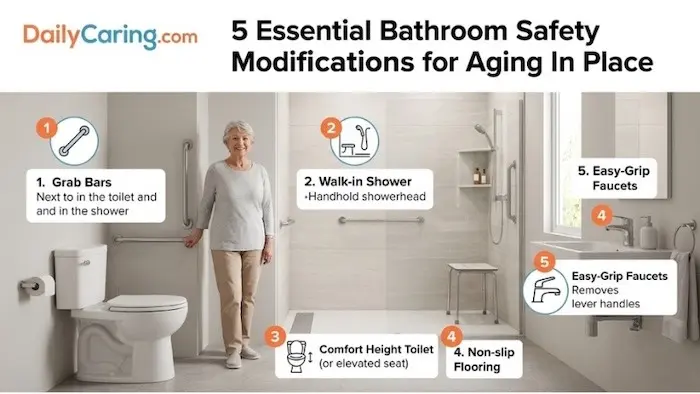
For family caregivers, a familiar and persistent anxiety often follows aging parents throughout their daily routines. This worry typically peaks whenever an older adult steps into the bathroom, a private sanctuary that frequently becomes a hazardous environment. Experts are now emphasizing five vital safety modifications designed to drastically reduce the risk of falling in this high-risk space, reframing home safety through a lens of clinical precision rather than simple do-it-yourself improvements.
The bathroom represents a convergence of environmental factors that create a severe hazard for aging bodies. Characterized by hard surfaces, water, and soap, the space naturally strips away traction. When combined with the physical realities of growing older, including muscle weakness, stiff joints, and diminishing vision, the potential for a severe fall increases exponentially. Addressing these risks requires more than a quick trip to the local hardware store; it demands careful planning and professional execution to protect seniors who wish to age in place.
Among the primary interventions is the proper installation of grab bars, which safety advocates describe as clinical tools rather than casual accessories. Rather than treating grab bars as simple hardware mounted to any available wall stud, specialists evaluate how specific mobility limitations dictate bar placement to effectively arrest a sudden fall. Experts strongly caution against relying on suction-cup alternatives, which invariably fail under the kinetic energy of a falling adult and risk turning a safety device into a secondary hazard. When shopping for appropriate hardware, specialists recommend diameters between 1.25 and 1.5 inches to accommodate aging hands, alongside ADA-compliant knurled finishes that provide a secure grip superior
to smooth chrome.
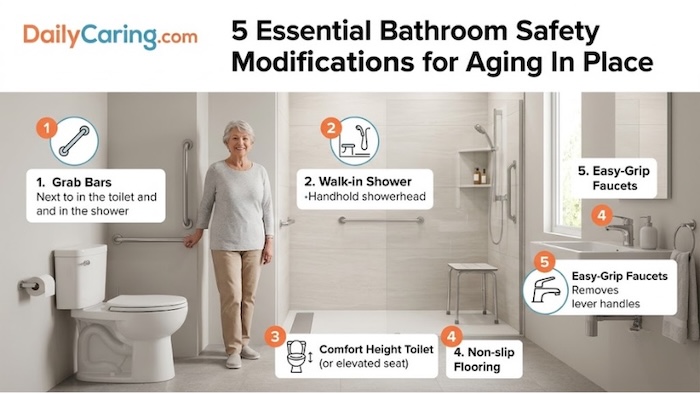
Another critical area of concern involves standard toilet dimensions, which often present significant obstacles for older adults. Standard 15-inch toilets demand excessive joint flexion and powerful quadriceps strength just to transition into a standing position. While the Americans with Disabilities Act recommends heights between 17 and 19 inches for wheelchair accessibility, residential safety often calls for a customized fit tailored to the individual’s anatomy. Calculating the ideal height requires measuring from the floor to the back of the senior’s thigh behind the knee, ensuring that any necessary seat raises directly alleviate unnecessary joint stress during daily routines.
Visual changes associated with aging also demand a strategic overhaul of bathroom lighting. Aging eyes frequently suffer from decreased pupil size and lens clouding, creating a legitimate need for increased ambient illumination. However, installing excessively bright bulbs often generates harsh glares that obscure depth perception, proving even more hazardous than dim conditions. The overarching objective remains achieving uniform illumination and high contrast, utilizing bulbs with a Color Rendering Index of 80 or higher and color temperatures between 2700 K and 3000 K to clearly distinguish the edge of a tub from the surrounding floor.
Flooring materials represent another foundational element in preventing severe injuries. While traditional ceramic tile offers water resistance, it provides zero shock absorption. If a fall does occur, hard tile surfaces fail to dissipate impact energy, frequently resulting in fractured hips and severe physical trauma. Safety experts recommend shifting perspectives toward materials that cushion impacts, noting that alternatives like rubber flooring offer exceptional traction and maximum shock absorption to protect bones and joints, while textured cork and slip-resistant vinyl serve as effective options compared to hazardous tile.
Thresholds and door saddles are frequently overlooked tripping hazards that demand immediate attention in homes adapted for aging in place. A standard door saddle creates a sudden height variation right where carpet transitions to tile. For seniors who experience a shuffling gait, this abrupt change practically guarantees a trip-and-fall incident. Replacing standard thresholds with graded door saddles creates a smooth, zero-edge transition that significantly minimizes the likelihood of accidents as individuals move between rooms.

Executing these structural changes requires specialized expertise, leading safety advocates to urge families to work exclusively with Certified Aging-in-Place Specialists. Administered by the National Association of Home Builders, the CAPS designation indicates that a contractor has undergone rigorous training regarding the unique biomechanical needs of older adults, mobility-barrier solutions, and structural load-bearing requirements. Relying on standard handymen or general contractors for clinical safety modifications can leave critical vulnerabilities unaddressed.
Financial considerations often surface when families contemplate these renovations, but experts urge a broader perspective regarding long-term costs. Comprehensive professional modifications—including grab bar installation, upgraded lighting, comfort-height toilets, and threshold removal—typically range from two thousand to five thousand dollars. By contrast, a single reactive fall resulting in emergency hospitalization, surgical hip replacement, and subsequent skilled nursing rehabilitation easily exceeds fifty thousand dollars. Consequently, safety advocates frame these updates not as discretionary home improvements, but as essential investments that safeguard an older adult’s independence and prevent the forced transition into an assisted living or nursing facility.