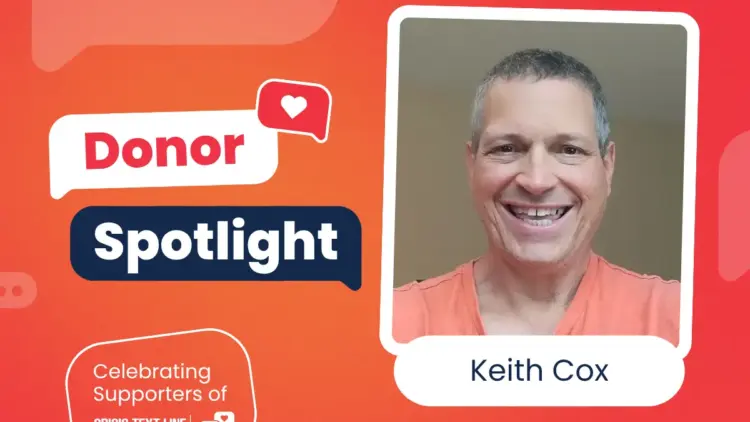
In a world where global challenges can often make individuals feel powerless, the urge to "do something" drives many to look for ways to contribute. For Keith Cox, that impulse has transformed into a profound commitment to mental health advocacy. This month, Crisis Text Line is shining a spotlight on Cox, recognizing his extraordinary dedication as both a financial donor and an active volunteer Crisis Counselor—a dual approach to philanthropy that bridges the gap between giving resources and giving of oneself.
A Lifeline in Critical Times
The urgency of mental health support is not an abstract concept for Cox; it is a reality shaped by a lifetime of observation and personal engagement. Reflecting on his motivations for supporting the organization, Cox notes that mental illness touches nearly everyone, directly or indirectly.
"Throughout my career and life, I’ve met many people struggling with mental illness," Cox shares. "It’s very real, and I’m sure everyone knows someone with mental health issues. Sadly, some people take their lives over it. Crisis Text Line is a vital lifeline for someone who is in crisis and may be considering suicide. I’m very happy to support the work the organization does, and not only am I a donor, I volunteer as well."
For millions of individuals facing overwhelming moments, Crisis Text Line offers free, confidential support available 24 hours a day, seven days a week. Operating via text message, the service provides a crucial bridge for those who may find it difficult or impossible to voice their struggles out loud to family members or friends. By keeping the service accessible at all hours, the organization ensures that no one has to face their darkest moments in isolation.
Witnessing the Impact Firsthand
What sets Cox apart as a supporter is his firsthand involvement on the front lines of crisis intervention. As a volunteer Crisis Counselor, he does not merely read about the impact of his contributions; he experiences it directly through the interactions he handles.
Recalling the moments that cemented his dedication, Cox describes taking back-to-back emergency service intervention calls involving individuals actively attempting suicide. Thanks to the existence of the text line, those individuals were able to reach out and connect with help in the nick of time.
What struck Cox particularly hard was realizing the age demographic of those reaching out. "I’ve also had minors that reached out with suicidal thoughts," he says. "If children are thinking this as well as adults, this is an epidemic, and it’s imperative to support them. I’m glad to be a part of that."
This dual perspective—seeing the operational needs of the organization as a donor while understanding the acute vulnerability of texters as a counselor—gives Cox a comprehensive view of why funding is so critical. Mental health service funding has faced significant pressures in recent times, even as public demand for these interventions has surged. For Cox, stepping up financially is a direct way to ensure that these vital services remain viable and free for anyone who reaches out.
Looking for the Helpers
Cox’s approach to charitable giving is guided by a philosophy deeply rooted in empathy and community action. When discussing the broader drivers behind his philanthropy, he invokes a classic piece of wisdom often cited during times of distress.
"I’ve always cared about what goes on in the world, and I always want to help," Cox explains. "As Mr. Rogers said, ‘When I was a boy and I would see scary things in the news, my mother would say to me, “Look for the helpers. You will always find people who are helping.”’"
This philosophy translates into active participation across multiple causes, though he singles out Crisis Text Line as holding a uniquely meaningful place in his philanthropic efforts. Given the severe toll that mental health challenges take on society, contributing to an organization that keeps life-saving communication channels open around the clock is, for Cox, a fundamental responsibility.
The psychological benefits flow both ways. While Cox provides essential support to distressed texters, the act of volunteering also bolsters his own well-being. In a culture where people frequently feel helpless in the face of widespread adversity, taking concrete action offers a powerful antidote.
"Everyone knows there’s a lot of bad in the world, and you feel helpless," Cox reflects. "You always hear people say—do something. And I’m one of those people that does something. I have dedicated my life to helping others as much as I can, both with time and donations. For me, it’s just the right thing to do."
Sustaining the Mission
Maintaining personal resilience while handling high-stakes crisis intervention requires intentional self-care. For Cox, grounding himself involves spending time in nature and engaging with his family. "Hanging out with my family. I love nature, and that’s a great way to relax, so I take a lot of walks in the woods," he says. Furthermore, he emphasizes that the deep sense of purpose derived from volunteering acts as a cornerstone for his own mental health, reinforcing the idea that making a positive difference in the world is mutually enriching.
As Crisis Text Line continues to process thousands of conversations daily with individuals navigating severe emotional distress, the reliance on community support remains absolute. Donors and volunteers form the backbone of the organization’s ability to respond to every text, ensuring that help is always just a message away.
Through his combined contributions of time, financial resources, and unwavering empathy, Keith Cox exemplifies the spirit of community care that keeps the lifeline open. For those considering following in his footsteps, Cox offers a straightforward encouragement: exploring the organization’s stories and impact reveals just how profound a difference a single contribution can make.