
Mindfulness, the practice of intentionally turning one’s attention inward to focus exclusively on the present moment, has long been celebrated for its profound ability to cultivate calm and relaxation in everyday life. However, emerging discussions among educators and child development experts highlight a critical secondary benefit: mindfulness plays an essential, evidence-based role in sharpening core executive functioning skills. By harnessing the power of mindful practices, parents, educators, and youth leaders can provide vital support to children and teenagers who need an extra boost in essential cognitive areas such as sustained attention, self-control, and working memory. As modern classrooms and households navigate increasing distractions, understanding the intricate link between mindfulness and cognitive development has become more important than ever.
The Link Between Mindfulness and Executive Functioning
Executive functioning skills represent the complex, brain-based abilities that individuals utilize daily to plan, initiate tasks, manage time effectively, and work through challenging situations. People rely on these cognitive processes constantly, often executing them so seamlessly that they require no conscious thought. That is the inherent elegance of strong executive functioning—when these mental systems operate efficiently, individuals can navigate obstacles and reach their personal goals almost instinctively.
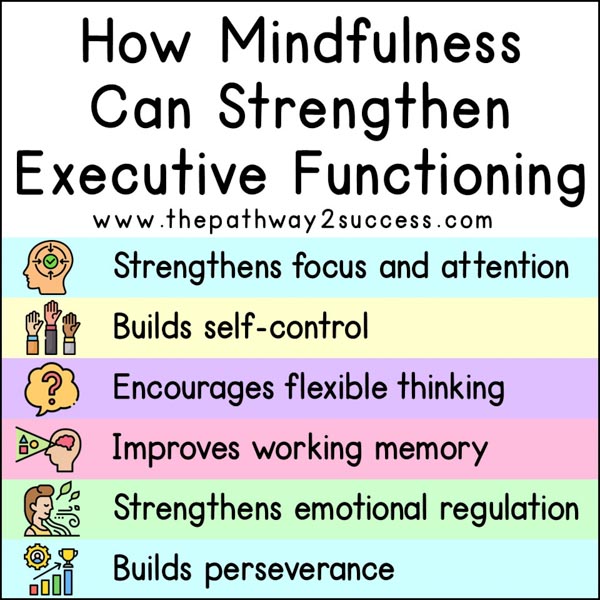
Research demonstrates that practicing mindfulness actively strengthens several distinct executive functioning components. Neurologically, this alignment makes intuitive sense. When an individual achieves a state of calm, the "thinking brain"—primarily associated with the prefrontal cortex—is activated rather than the primitive, reactive fight-or-flight response. This activation empowers children and adolescents to make more considered choices, maintain deeper focus, and apply sophisticated problem-solving strategies when confronted with difficulties. Because mindfulness offers a straightforward, meaningful, and engaging approach for young people of all ages, educators and specialists increasingly view it as a valuable, evidence-based strategy to integrate into daily routines.
Focus and Attention
Attention serves as the foundational cognitive capacity to concentrate on a specific person, task, or abstract idea over a designated period. Children and teenagers draw upon attention skills in virtually every aspect of their lives, ranging from engaging in a thoughtful, reciprocal conversation with a peer to maintaining unwavering concentration while solving a complex mathematical equation.
Mindfulness exercises provide direct, rigorous training for these exact focus and attention mechanisms. When an individual dedicates time to concentrating solely on the rhythmic sensation of breathing, they actively train the mind to anchor itself entirely in the present moment. With consistent practice, participants inevitably notice their attention beginning to drift toward extraneous thoughts or external stimuli—a completely natural occurrence. The central mechanism of growth lies in the gentle act of recognizing that wandering attention and guiding the focus back to the breath. Over time, this repetitive loop strengthens both general attention span and the overarching mindfulness practice.
Self-Control
Self-control is defined as the vital capacity to pause and reflect before executing a decision. It heavily relies on cognitive inhibition, allowing a person to check an immediate impulse rather than acting purely on instinct.
Mindfulness fundamentally supports the development of self-control by cultivating a reliable pause between a stimulus and a subsequent reaction. The more frequently an individual engages in mindful reflection, the more robust this inhibitory pathway becomes. Consider a practical scenario where a teenager walks past a school locker adorned with a celebratory balloon for a classmate’s birthday; an unmonitored first impulse might be to pop the balloon out of mischievous curiosity. Through established mindfulness practices, however, that same student gains the internal capacity to pause, take a centering breath, and let the fleeting impulse dissolve before taking action. The implications of this skill are profound, as effective self-control directly dictates an adolescent’s ability to balance short-term temptations with long-term aspirations.
Emotional Regulation
Emotional regulation encompasses the ability to accurately recognize, understand, and manage daily emotional states. This capability serves as a critical cornerstone for mental well-being, laying the psychological groundwork for how young people feel, think, and behave throughout their waking hours.
Engaging in regular mindfulness practices assists individuals in observing their emerging emotions with objective awareness, preventing feelings of being entirely overwhelmed by intense affective states. This enhanced self-awareness creates a stable psychological platform for managing reactions in socially and personally appropriate ways. For instance, if a teenager feels deeply disappointed and frustrated after a peer chooses a different partner for a group project, typical stress responses might manifest as crying, yelling, or complete emotional withdrawal. In contrast, incorporating a few mindful, deep breaths helps center the student’s nervous system, returning them to a state of composure where they can rationally problem-solve healthier avenues for moving forward.
Working Memory
Working memory refers to the mental workspace used to temporarily hold and manipulate information while simultaneously performing complex cognitive tasks. People rely heavily on working memory across various academic and daily contexts, such as processing multi-step verbal instructions, retaining narrative details within a complex story, and executing multi-stage math problems.
Mindfulness strengthens working memory by systematically reducing cognitive clutter. By clearing out extraneous thoughts and worries, the brain creates necessary mental bandwidth to store and process the critical information required in the immediate present. For example, a student attempting to follow a teacher’s multi-layered instructions for a morning assignment might otherwise feel paralyzed by an influx of racing thoughts. Morning mindfulness routines can provide such learners with a mental "clean slate," establishing optimal conditions for a productive and focused start to the school day.
Flexible Thinking
Flexible thinking represents the cognitive capacity to evaluate situations from multiple perspectives, consider alternative viewpoints, and adapt one’s mindset when confronted with novel or changing circumstances.
Mindfulness directly supports flexible thinking by fostering a non-judgmental acceptance of internal thoughts and external experiences. Through consistent practice, individuals learn to acknowledge and accept objective reality, even when those current circumstances prove challenging, unfavorable, or uncomfortable. For instance, when a young adult receives rigorous critical feedback on an essay they invested substantial effort into writing, defensive instincts often flare. However, applying flexible thinking nurtured by mindfulness enables the student to parse the feedback objectively, viewing constructive critique as a neutral pathway toward academic growth and personal development rather than a personal attack.
Perseverance
Perseverance is the steadfast ability to sustain effort and remain committed to a task, even when it becomes exceptionally difficult. It represents a vital disposition that individuals of all ages utilize to navigate hurdles and ultimately achieve long-term objectives.
Even within a simple mindfulness exercise, maintaining focus can present a genuine challenge. A participant’s mind naturally resists stillness, wandering toward alternative desires and distractions—a universal and expected part of the human experience. The true value of mindfulness practice emerges precisely from this struggle. By gently returning focus to the present moment over and over again, individuals practice the art of sticking with a difficult endeavor even when the temptation to quit arises. This sustained engagement mirrors perseverance in its purest, most applicable form.

Implementing Mindfulness Strategies in Educational and Home Environments
Before introducing structured mindfulness practices to children and adolescents, educators and caregivers find success by engaging learners in open discussions regarding the concrete benefits of the practice. Explaining that mindfulness serves as a practical tool to help them feel and perform at their absolute best establishes immediate relevance. Youth can understand mindfulness as an accessible strategy to calm their nerves before delivering a public speech in front of a classroom, or as an effective technique to center their focus and alertness prior to competing in an athletic event. While these specific scenarios provide clear illustrations, emphasizing that mindfulness is a versatile skill applicable to virtually any life circumstance helps solidify its long-term value.
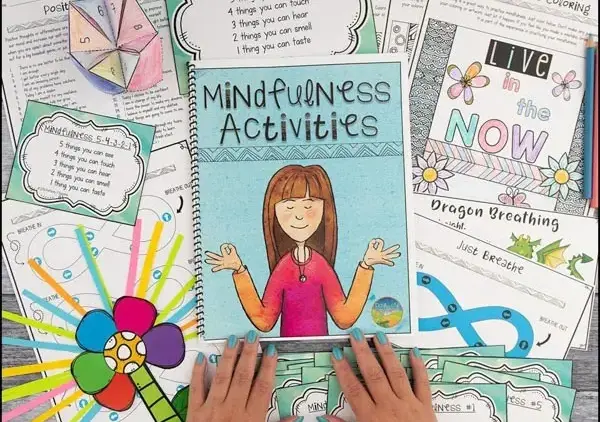
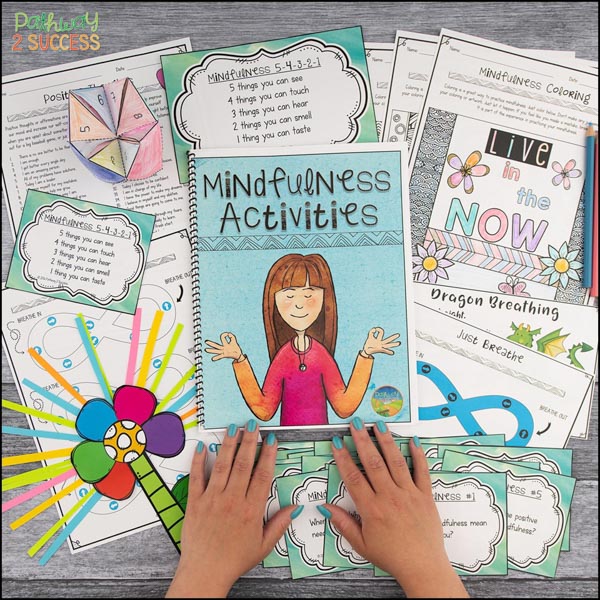
To integrate these concepts effectively, educators often rely on comprehensive mindfulness lessons and structured activities designed specifically for children and young adults. These resources frequently encompass hands-on exercises, creative crafts, discussion prompts, visual posters, and reflective printables that allow for repeated practice throughout an academic year.
Integrating literature offers another powerful avenue for exploration. Picture books and young adult novels provide natural narrative frameworks to discuss and reflect upon mindfulness concepts, proving remarkably effective tools even when utilized with older students. Similarly, teaching foundational mindful breathing techniques gives children and teens a portable strategy they can deploy in any environment. Simple practices, such as assuming a comfortable posture, closing the eyes, and observing the physical sensations of air entering the nasal passages and filling the lungs, anchor participants firmly in the present. When thoughts inevitably wander, the deliberate return to the breath reinforces cognitive control. More dynamic breathing exercises, such as visualization-based techniques, can also function effectively as intentional brain breaks between demanding academic tasks.

Additional modalities, including mindful coloring, gentle yoga and stretching routines, and structured journal writing, further reinforce these mental habits. Mindful coloring requires participants to direct their total attention toward the physical act of filling spaces with color, discouraging perfectionism and encouraging pure, present-moment awareness. Morning journaling provides a dedicated space for students to respond to reflective prompts and articulate their internal states. Furthermore, taking mindfulness outdoors—through nature walks, gardening, observing wildlife, or cloud-watching—leverages natural environments to maintain engagement and provide endless focal points for attention.
Finally, incorporating mindful affirmations and mindful observance exercises rounds out a comprehensive approach to cognitive development. By repeating positive, stabilizing phrases during slow breathing cycles, or by selecting a simple everyday object—such as a pen or a water bottle—and studying its distinct shapes, colors, and textures with complete concentration, participants actively flex and strengthen their underlying executive functioning muscles.



