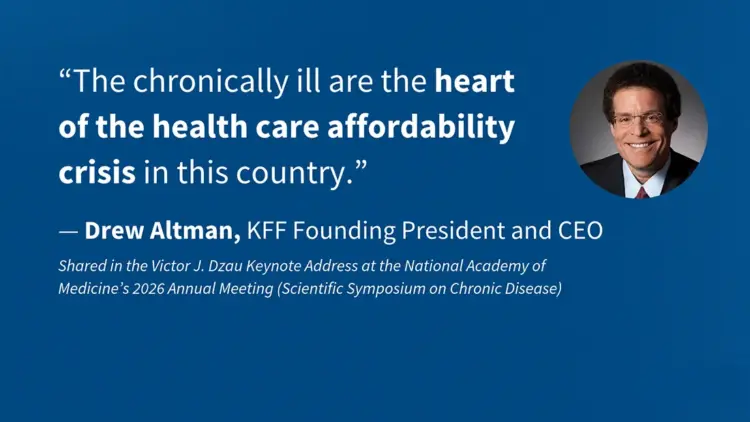
WASHINGTON — In a wide-ranging and deeply reflective keynote address at the annual meeting of the National Academy of Medicine (NAM), KFF founder and president Drew Altman placed chronic illness squarely at the center of the nation’s mounting healthcare affordability crisis. Delivering the inaugural Victor Dzau Keynote address, Altman used the fireside chat format to unpack the complex intersection of health policy, partisan politics, and the lived experiences of millions of Americans struggling to pay for their care.
Reflecting on a career spanning nearly four decades since founding KFF in the early 1990s, Altman addressed an audience of prominent scientists, medical professionals, and policy leaders. He noted that the organization he built has evolved into a unique public charity—functioning simultaneously as an independent policy research shop, a premier polling organization, and the nation’s largest dedicated health newsroom. Operating without ties to commercial insurers or corporate foundations, KFF’s mandate has long been to provide trusted, independent data while navigating the contentious waters of American health policy.
As the political landscape heats up ahead of upcoming midterms and the 2028 legislative cycle, Altman emphasized that healthcare policy debates are once again taking center stage, driven by voter anxieties over the cost of living and rising medical expenses. Against this backdrop, he outlined three major systemic challenges facing the nation, warning that chronic illness acts as the invisible catalyst compounding every single one of them.
The Looming Threat of Federal Spending Cuts and Coverage Losses
The first major challenge Altman addressed involves sweeping federal policy shifts, highlighted by the legislative package known informally as the One Big Beautiful Bill (OBBB), which enacted nearly a trillion dollars in federal health spending cuts over a ten-year period. These cuts were swiftly followed by the expiration and failure to extend the Affordable Care Act (ACA) enhanced premium tax credits.
Citing KFF’s widely cited analyses, Altman explained that the lapse in tax credits effectively doubled health insurance premiums for roughly 24 million enrollees. This shock forced millions to drop coverage entirely or transition into lower-tier plans burdened by massive deductibles averaging around $7,000 a year. For working-class Americans—such as independent rideshare drivers, salon workers, and agricultural laborers earning modest wages around $35,000 annually—such high deductibles render insurance functionally useless for routine care. Notably, KFF data underscores that approximately one-third of all farmers and ranchers secure their coverage through the ACA Marketplaces.
Altman projected that these combined policy measures will ultimately push roughly 14 million more Americans into the ranks of the uninsured over the coming decade, reversing years of coverage gains and driving the total uninsured population back toward the 40 million mark.
Drawing on his past experience as a state Human Services Secretary, Altman warned that state governments—particularly in politically progressive states—will attempt to backfill some, but far from all, of the lost federal dollars. Consequently, state budget shortfalls will force painful trade-offs, draining resources from public education, higher education, environmental protections, and correctional systems, all while state leaders generally avoid raising taxes. Furthermore, the single largest structural reduction—amounting to $330 billion over ten years—stems from newly implemented Medicaid work requirements, a politically popular yet heavily scrutinized policy mechanism.
Rebuilding Federal Agencies and Revitalizing Public Service
Turning to the second major institutional hurdle, Altman raised concerns over the structural health and stability of the federal agencies responsible for administering the nation’s health programs. Recalling his early career working for the agency that preceded the Centers for Medicare & Medicaid Services (CMS)—an agency he would later be asked to lead—Altman reflected on the profound impact of public service. He questioned how the nation can continue to inspire top-tier talent when public service is increasingly politicized or demonized, pointing to troubling trends such as the vast majority of public policy graduates bypassing government entirely in favor of corporate consulting firms.
Altman highlighted severe staffing reductions across federal health agencies, the dismantling of research and analytical bodies like the Agency for Healthcare Research and Quality (AHRQ), and the ideological warping of scientific missions. He noted the profound anxiety felt across the public health workforce, referencing the hundreds of calls he and his peers have received from federal career professionals displaced by recent political and structural storms. While CMS has largely insulated itself from these cultural and scientific clashes under stable leadership, the broader erosion of institutional capacity poses a severe long-term threat to the nation’s health infrastructure.
Untangling the Six Distinct Health Care Cost Problems
The third major challenge tackled by Altman centered on the national obsession with healthcare costs. He cautioned that policymakers, industry executives, and researchers often talk past one another because they are frequently addressing entirely different financial metrics.
According to Altman, the national debate is fractured across six distinct cost problems that frequently conflict with one another: overall national health expenditures measured as a share of GDP, the direct cost of care felt by everyday people, federal health spending, state health spending, employer-sponsored premium increases, and the elusive pursuit of healthcare "value."
While national health spending has hovered relatively stably at around 18% of gross domestic product—vastly higher than any other wealthy nation, driven primarily by exorbitant underlying prices rather than mere utilization—the political pressure driving voter frustration is entirely rooted in a different metric: affordability. It is the crushing out-of-pocket burden experienced by patients, rather than macro-level GDP figures, that transforms healthcare into a volatile electoral issue.
Chronic Illness at the Heart of the Affordability and Complexity Crises
Synthesizing these policy dilemmas, Altman delivered his central thesis to the National Academy of Medicine: the nation’s chronically ill population sits directly at the epicenter of both the affordability crisis and the broader administrative complexity of the healthcare system.
While critics or casual observers might argue that individuals with chronic conditions simply consume the highest volume of care, Altman argued that the fundamental obligation of any civilized healthcare system is to reliably care for its sickest populations—an obligation the U.S. system is currently failing to meet affordably. Strikingly, chronically ill Americans who also find themselves uninsured represent the most vulnerable demographic within the entire ecosystem, a population whose numbers threaten to swell further in the wake of recent federal spending cuts.
Restoring Trust in Science, Government, and Medicine
Concluding his keynote address, Altman turned to the corrosive effect of declining public trust across government institutions, the news media, the scientific community, and organized medicine. Restoring a shared baseline of trust in empirical information and scientific consensus is an absolute prerequisite for meaningful progress, he argued.
However, offering a note of cautious optimism derived from extensive KFF polling data, Altman pushed back against the narrative that the American public is completely consumed by misinformation and polarization. Polling indicates that the majority of citizens are not irretrievably radicalized by toxic social media echo chambers; rather, large segments of the population remain uncommitted and "up for grabs."
Crucially, polling continues to show that physicians, nurses, and pharmacists remain the most trusted messengers in American society. Altman closed by challenging the assembled medical and scientific leaders to leverage that enduring trust to bridge ideological divides, keep human needs at the center of discovery, and guide the nation through the difficult policy terrain ahead.