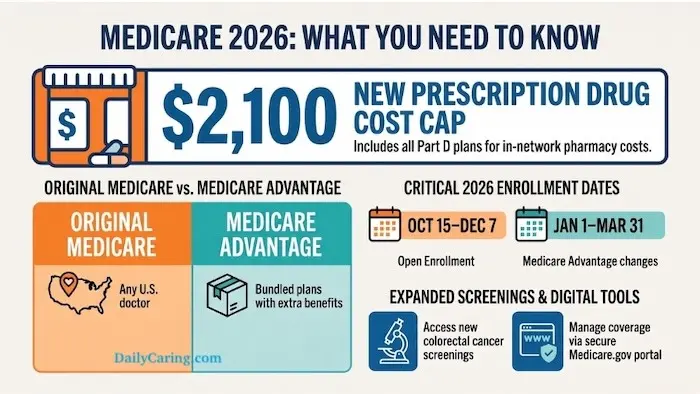
Managing prescription medications for older adults has long been a persistent financial strain for families and caregivers. Historically, navigating convoluted insurance coverage phases made long-term budgeting nearly impossible, leaving many seniors vulnerable to unpredictable pharmaceutical expenses. However, major regulatory shifts taking effect for the 2026 plan year are poised to bring substantial financial predictability to the prescription drug market, altering how Medicare beneficiaries and their caregivers plan for healthcare expenses.
Driven by the final implementation phases of the landmark Inflation Reduction Act, out-of-pocket costs for covered prescription drugs under Medicare Part D are now strictly capped at $2,100 annually. Alongside this historic ceiling, the maximum standard deductible for beneficiaries has been legally set at $615 for the year. These comprehensive updates mark a definitive turning point for eldercare financial planning, offering much-needed relief to millions of older Americans who rely on chronic medications.
The Permanent End of the Donut Hole
For well over a decade, one of the most widely criticized and financially destructive elements of Medicare Part D was the coverage gap, colloquially known as the "donut hole." During this frustrating phase, seniors who reached a specific cumulative spending threshold suddenly found themselves responsible for a massive percentage of their total drug costs. They were forced to shoulder these exorbitant out-of-pocket expenses until their spending finally crossed the threshold into catastrophic coverage.
As of 2026, the coverage gap is permanently gone. Under the updated regulations, the notorious donut hole no longer exists in the federal healthcare framework.

Understanding these structural Medicare Part D changes and associated prescription caps has become a mandatory component of comprehensive eldercare financial planning. Once an enrollee spends exactly $2,100 out of pocket on covered medications within a single calendar year, their Part D plan or Medicare Advantage plan is legally required to pick up 100% of the cost for the remainder of the year. There are no exceptions to this rule, and the previous catastrophic phase where patients remained responsible for a residual 5% coinsurance has been completely abolished. Once the threshold is met, the patient’s out-of-pocket cost drops securely to zero.
The Emerging Threat of Formulary Manipulation
Despite the undeniable financial protections offered by the new annual caps, healthcare advocates and financial planners warn that beneficiaries should not assume their current coverage is entirely safe. Insurance companies are businesses that must adjust to these mandated financial shifts, and they are certainly not absorbing the cost of the caps out of goodwill.
In response to the new federal rules, insurance providers have begun aggressively manipulating their approved drug lists, known as formularies. Many plans are actively shifting vital medications into higher pricing tiers or restructuring their tiers entirely to offset the mandated spending caps.
A medication that was fully covered or reasonably priced in previous years may be dropped entirely by a specific plan during the annual transition. Experts emphasize that beneficiaries and their caregivers must meticulously verify that their loved ones’ specific, necessary medications remain on their chosen plan’s official formulary during the Annual Enrollment Period. This step is critical because if a drug is ultimately excluded from the formulary, any money spent out of pocket on that specific medication will not count toward the newly established $2,100 annual cap.

Smoothing Expenses Through the Prescription Payment Plan
To prevent enrollees from facing immediate, burdensome financial hits—such as the standard $615 deductible—at the pharmacy counter right at the start of January, the federal government has mandated the continued operation of the Medicare Prescription Payment Plan. This opt-in program is specifically designed to help enrollees smooth their out-of-pocket prescription expenses evenly across the entire calendar year.
Instead of requiring a large, unexpected lump sum payment at the time of pickup, the program allows caregivers and beneficiaries to coordinate with their providers. The pharmacy bills the insurance plan directly, and the insurance plan subsequently sends the enrollee a manageable monthly bill for their distributed share of the costs. While optional, this mechanism serves as a vital tool for families trying to maintain a steady monthly household budget.
Premium Stabilization Measures
Another critical, though frequently overlooked, component of the 2026 Medicare Part D changes is the federal premium stabilization program. To prevent insurance companies from simply jacking up monthly premium prices arbitrarily to recoup the money lost from the new out-of-pocket caps, the law places strict federal limits on base premium increases, capping them at a maximum of 6% per year.
However, industry analysts note that this protective measure applies specifically to the base premium. Individual insurance plans will continue to see market fluctuations in their total premiums, making careful comparison shopping during open enrollment an absolute necessity for anyone looking to minimize their overall healthcare expenditures. Reviewing coverage options early in the season provides families with a distinct advantage in navigating the evolving insurance landscape.

What the New Limits Mean for Beneficiaries
Ultimately, understanding the mechanics of these updated Medicare prescription caps is vital for anyone managing senior care. The era of the unpredictable coverage gap has officially drawn to a close, replaced by a firm financial boundary that promises absolute coverage once the annual threshold is met.
However, the shifting tactics of insurance providers regarding formularies mean that vigilance is required now more than ever. Families must remain proactive, reviewing plan documents and verifying formulary inclusions to ensure that the transition to the new system
goes smoothly and that out-of-pocket spending remains accurately tracked toward the $2,100 limit.