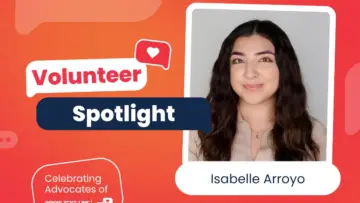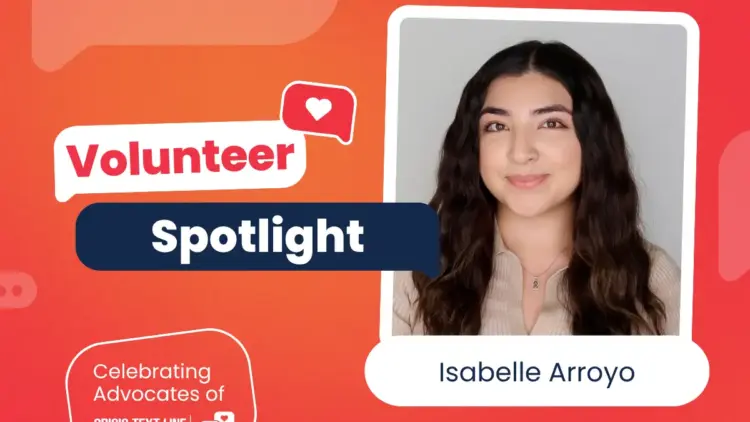
Sometimes a calling begins in the most ordinary place. For Isabelle Arroyo, it was a routine scroll through LinkedIn. That single moment of digital discovery led her to Crisis Text Line, where she now serves as a dedicated volunteer Crisis Counselor, answering texts from individuals navigating some of the most difficult and vulnerable moments of their lives.
In this month’s volunteer spotlight, Isabelle shares how her search for accessible, modern support led her to the organization, why she views her role as akin to “the best friend you hope would listen when you need them most,” and how she has learned that the smallest actions—a simple hello, a reassuring smile, or simply holding space and hope for someone else—can make all the difference.
How did you first hear about Crisis Text Line?
"I stumbled upon Crisis Text Line through LinkedIn," Isabelle explains. "What drew me in was how accessible it is. I admired that people can get support during a crisis, 24/7, without having to speak to someone out loud. I felt it was a resource that was desperately needed, and one that could reach anyone."
Did you ever use our service before becoming a volunteer?
"Honestly, I hadn’t," she admits. "Pero if I had known about this resource years ago, it’s a service I would have wanted to explore."
What moment or experience has reinforced your commitment to supporting people in crisis?
For Isabelle, the validation comes directly from the nature of the work itself. "The work itself is the reason I keep showing up," she says. "Supporting someone in their darkest moment can leave a lasting impression. We’re short-term support, but we can offer a safe space and, at times, a sense of light in a long tunnel."
She emphasizes the fundamental human need for validation and connection. "We all deserve to feel heard, cared for, and appreciated. Every time I log on for a shift, I remind myself of the smallest impact I can leave with someone. Holding onto hope for a person who needs it most keeps me going. I love being a voice for those who feel unheard."
What does a volunteer Crisis Counselor do that people might not realize?
Many outside observers may not fully grasp the day-to-day reality of text-based crisis intervention. Isabelle clarifies that the core mission is rooted in active, non-judgmental listening.
"We’re there to listen, so people can feel heard and free from judgment, and we share resources that can lead toward further support and healing," she notes. "I like to think of our role as the best friend you hope would listen when you need them most. Volunteers truly care about our texters, even though we may never meet. We also keep looking for ways to adapt and improve our support for everyone who reaches out."
How has volunteering changed you, personally or professionally?
The journey with Crisis Text Line has dovetailed deeply with Isabelle’s life path. "For most of my life, I knew I wanted to become a therapist. I’ve always had a caring heart," she reflects. "What I never expected was how much Crisis Text Line would shape me, both professionally and personally."
This experience has broadened her understanding of suicide prevention, reframing it away from exclusive institutional settings and toward everyday human interactions. "Suicide prevention comes in many forms," she says. "It isn’t only a big presentation or a large event. It’s sharing a hello, smiling at a stranger, and taking the time to get to know someone."
Ultimately, the act of showing up has transformed her worldview. "What I’ve learned is that people just want someone to show up for them. I do that as a Crisis Counselor, but now, most importantly, I do it as another human being. I’ve learned how to listen with empathy and how to be a light for someone. This role has helped me become a better, more positive person, and I hope to share that with everyone I meet."
Why is it important to you to support mental health and crisis intervention?
Cultural stigma surrounding mental health remains a significant barrier for many individuals seeking help, a challenge Isabelle confronts head-on through her advocacy and volunteer work.
"Many people are raised, without even realizing it, to feel stigma about their mental wellbeing," she observes. "In recent years we’ve barely begun to break through. Mental wellbeing matters as much as physical wellbeing, and people who are struggling often don’t have the strength to advocate for themselves. I take pride in doing that for those who can’t."
Looking forward, Isabelle maintains an optimistic outlook regarding societal shifts in how mental health is perceived and discussed. "My hope is that one day we’ll come together to understand how much mental wellbeing matters. I see the stigma starting to break, and I believe the work we do is the beginning of acceptance. We all deserve to be here, to flourish, and to find support when we need it."
She adds that the ripple effects of suicide prevention extend far beyond immediate interventions. "The impact of suicide reaches across generations, and even the smallest actions can be the reason someone stays. I hold onto that whenever I’m asked my ‘why.’"
What would you say to someone who wants to volunteer but worries they don’t have the right skills?
For prospective volunteers who might feel hesitant or intimidated by the responsibilities of crisis counseling, Isabelle offers reassurance rooted in her own transition into the role.
"Nothing new is ever not scary," she says. "What changes is that you go after it, adapt, and grow. Volunteering is the same. As long as you’re here to support people through a difficult time, you’ll be motivated to learn your role. You’ll be trained, and I promise you’ll grow into it, to the point that it’s something you look forward to."
She points out that the operational framework of Crisis Text Line is designed to foster community and continuous learning rather than solitary pressure. "The best part of Crisis Text Line is the support you receive. You’re not alone. There’s a welcoming community space where volunteers discuss, learn, and grow together, and a team of staff who are right alongside you during conversations and give feedback if you want it. No one expects perfection, only that you show up with empathy and compassion. Just try it for yourself. I look forward to seeing you here with me."
Beyond formal volunteering, Isabelle emphasizes that everyday empathy remains accessible to everyone. "Even if volunteering isn’t for you, you can play a role in suicide prevention any day, any time, anywhere. Be the stranger who creates change. You never know the impact you can have by simply caring."
If you are struggling or want to talk, text HOME to 741741 to reach a volunteer Crisis Counselor. The service is free, confidential, and available 24/7.