In September 2026, President Donald Trump announced a plan to distribute one-time $500 "refund checks" to approximately one million Americans across 30 states. According to the administration’s announcement, these payments are designed to reimburse unsubsidized consumers for excess user fees collected from HealthCare.gov insurers during the previous Biden administration.
The initiative impacts roughly 5% of all Affordable Care Act (ACA) Marketplace enrollees—specifically those who enrolled through HealthCare.gov in 2026 without receiving premium tax credits. The remaining 95% of enrollees will not receive any payment, nor will individuals who were enrolled in previous years but have since dropped their coverage or those living in states operating their own independent marketplaces.
While the administration has framed the payouts as a return of surplus funds, health policy experts and a detailed issue brief analyzing the mechanics of Marketplace user fees reveal a complex financial picture. The payments arrive as unsubsidized enrollees grapple with steep premium hikes and the expiration of enhanced federal tax credits, meaning the $500 checks will likely cover only a fraction of the mounting costs facing consumers.
To understand the origin of these funds, it is necessary to examine how Marketplace user fees are determined and collected. Under the ACA, marketplaces are authorized to charge participating issuers user fees to fund operational necessities such as eligibility determinations, enrollment processes, IT support, consumer outreach, and program integrity activities. The Department of Health and Human Services (HHS) collects these monthly fees from issuers offering plans on HealthCare.gov, including state-based exchanges that utilize the federal platform.
Insurers build these fees directly into their monthly premiums. While some of this cost is borne directly by enrollees, a substantial portion is effectively paid by taxpayers through advance premium tax credits. In states relying on HealthCare.gov, approximately 82% of premium dollars are covered by these federal tax credits. HHS adjusts user fee rates annually based on projected operating costs, premiums, and enrollment figures. States running their own independent marketplaces retain the discretion to set their respective user rates.
Historically, the federal government has not been required to return unused user fees to insurers, consumers, or taxpayers. No prior administration has attempted such a payout, and legal experts have noted that the specific statutory authority used to issue these $500 checks remains ambiguous. In past years, revenues exceeding actual spending have simply been carried over to subsequent plan years. Administrations have traditionally utilized these surpluses either to increase spending on operational improvements or to lower future user fees.
Because user fee rules are established far in advance through a lengthy rulemaking process, the policies governing the first year or two of any given presidential administration are typically shaped by their predecessor. The Obama, Biden, and first Trump administrations all issued rules at the tail end of their terms that directly impacted premiums and user fees in the early years of incoming administrations. However, while user fee percentages are locked in well ahead of time, administrations have historically possessed the agility to rapidly alter how those funds are deployed, particularly regarding consumer outreach and assistance programs.
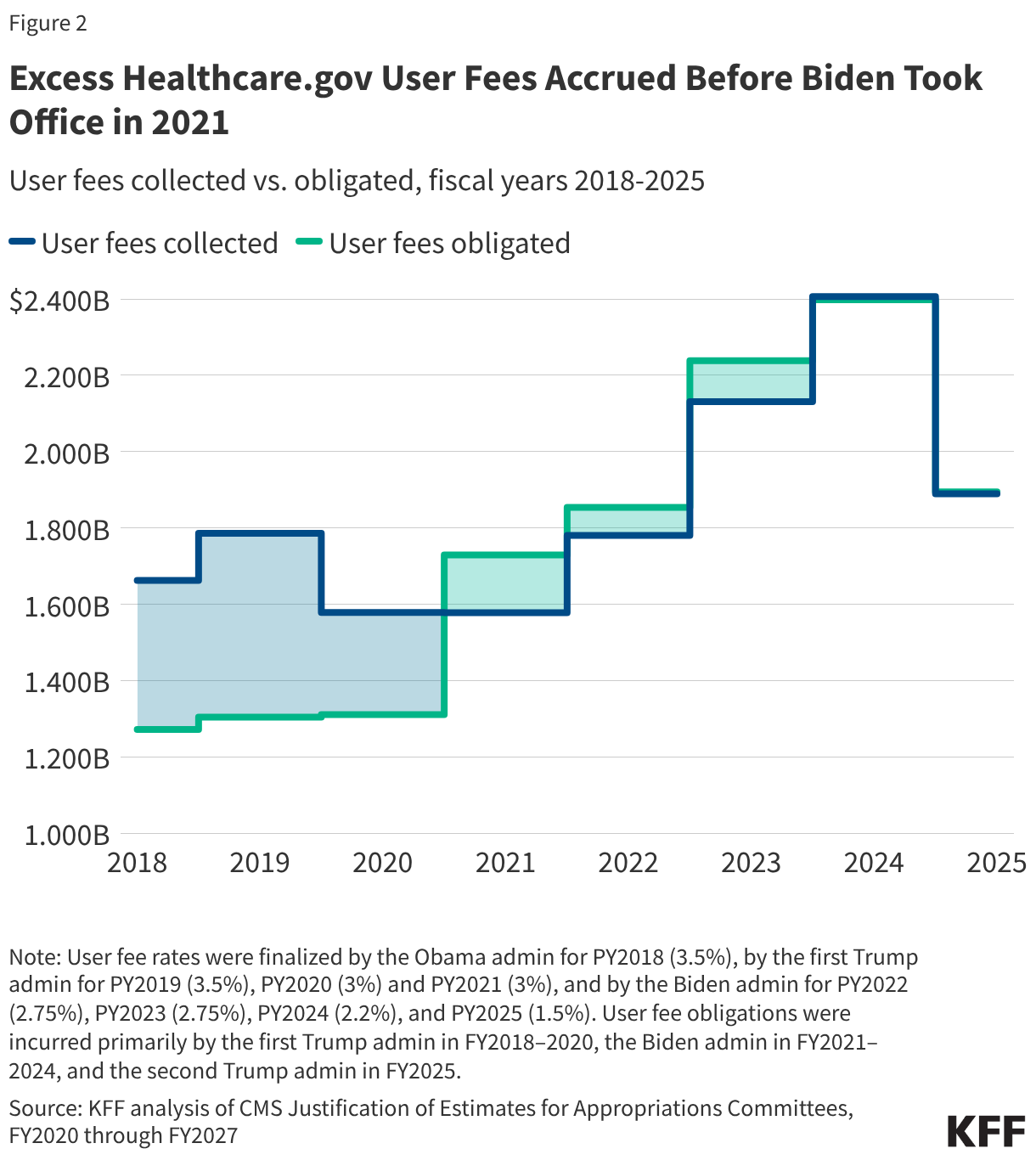
The Federally Facilitated Marketplace user fee has remained at or below 3.5% since the inception of the ACA marketplaces in 2014, eventually reaching an all-time low of 1.5% in 2025. Throughout the Obama administration and the early portion of Trump’s first term, the fee remained steady at 3.5%. The first reduction occurred for Plan Year 2020, when the Trump administration lowered it to 3.0%, citing increased operational efficiencies, streamlined IT functionality, and a more cost-effective approach to consumer outreach.
As the Trump administration prepared to leave office in January 2021, it lowered the projected 2022 user fee further to 2.25%. However, later that year, the incoming Biden administration revised the rate to 2.75% following updated analyses of contract costs, projected premiums, and enrollment trends. The Biden administration held fees steady for 2023 before lowering them across 2024 and 2025. In its final policy notices issued prior to leaving office in January 2025, the Biden administration set the 2026 user fee at 2.5%, factoring in the expected expiration of enhanced premium tax credits. Upon returning to office, the second Trump administration initially proposed maintaining that 2.5% rate before ultimately finalizing the 2027 user fee at 1.9%.
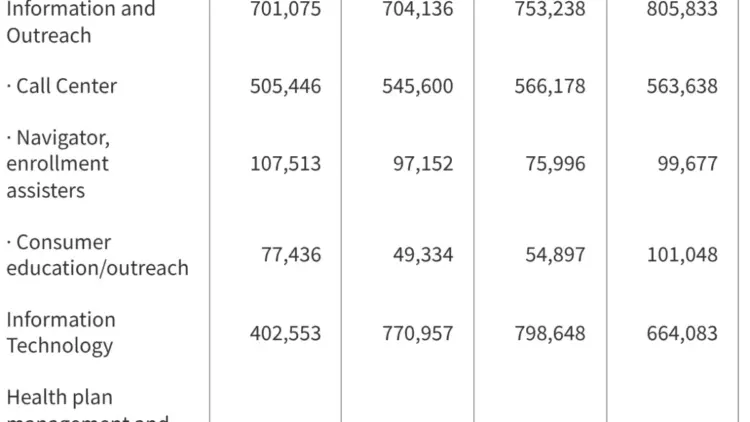
A review of federal budget justifications reveals significant fluctuations in how user fee revenue has been spent across different administrations, particularly regarding consumer outreach. Between fiscal years 2018 and 2020, the federal government collected more revenue than it spent, building a surplus under the first Trump administration. During this period, the administration significantly reduced funding for consumer information and outreach, including cuts to Navigator programs and enrollment assisters. Overall spending on outreach dropped by nearly 40% between fiscal year 2016 and fiscal year 2020.
Conversely, between fiscal years 2021 and 2023, the federal government spent more than it collected in user fees as the Biden administration ramped up consumer assistance efforts. Spending on consumer information and outreach surged from $503 million in fiscal year 2020 to $1.2 billion by fiscal year 2023. Although user fee percentages were trimmed during this period, total revenue collections climbed due to rapid enrollment growth fueled by enhanced premium tax credits. Spending and collections aligned more closely through fiscal years 2024 and 2025, though outreach spending began to recede again toward the end of that window under the second Trump administration.
Against this backdrop of fluctuating federal budgets, the announcement of the $500 checks has sparked intense discussion regarding their proportionality and practical impact. The administration has provided limited clarity on how the flat $500 figure was calculated. Because user fees are assessed as a fixed percentage of gross premiums—which vary widely based on consumer age, geographic location, and plan selection—the actual amount an unsubsidized enrollee contributes toward user fees differs drastically from person to person.
Consequently, the checks are not adjusted proportionately to what any individual recipient actually paid into the system. Furthermore, the surplus funds accumulated over multiple years were generated not just by the one million current enrollees receiving the checks, but by millions of past and present HealthCare.gov participants, as well as taxpayers who funded premium subsidies. Enrollees who no longer maintain coverage or who reside in states that transitioned away from the federal platform contributed to these funds without qualifying for the refund.
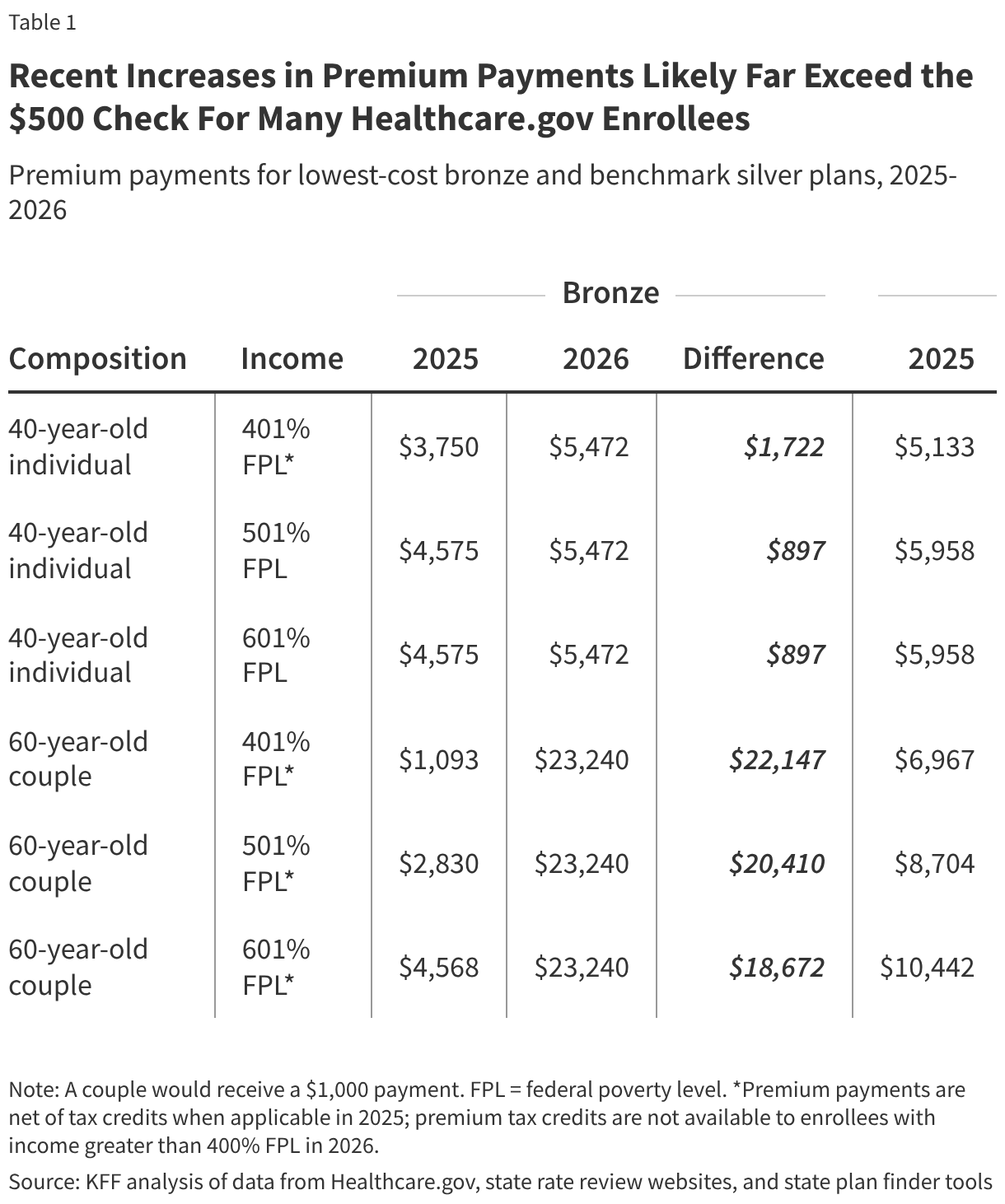
For those who do receive the checks, the $500 payout will likely be eclipsed by the financial pressures they face in the current insurance market. According to federal data, the average annual premium for HealthCare.gov enrollees not receiving tax credits rose from $6,660 in 2025 to $8,844 in 2026—representing an average increase of $2,184. For many households, the loss of enhanced premium tax credits means the actual jump in out-of-pocket costs is far steeper, particularly for older adults and families with higher coverage needs.
Projections indicate that unsubsidized enrollees in federal marketplace states will face continued premium growth into 2027. Average benchmark premiums for a typical 40-year-old are projected to climb by roughly 11% in 2027, translating to an additional $876 annually. Older enrollees, whose base rates are already substantially higher due to age-rating rules, could see silver plan premium increases exceeding $2,000 from 2026 to 2027 alone. Against these widening financial gaps, the one-time $500 reimbursement represents only a minor offset to the broader cost increases confronting consumers in the individual insurance market.