As the United States continues to grapple with complex financial pressures across its medical landscape, new federal projections indicate that national health care spending is on a rapid trajectory upward, expected to eclipse historic milestones over the next decade.
An updated chart collection and analysis released on the Peterson-KFF Health System Tracker explores how health care expenditures are projected to grow in the coming years, utilizing the latest National Health Expenditure (NHE) projections compiled by federal actuaries. According to the data, the financial footprint of the American health care system is expanding at a pace that will soon claim more than twenty percent of the nation’s entire economic output.
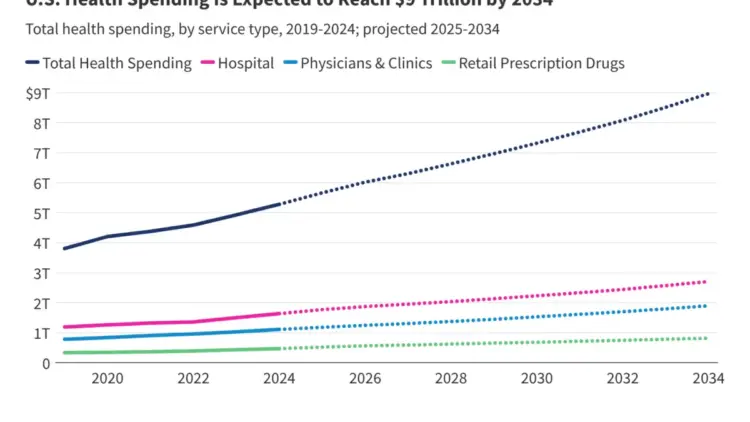
By 2026, total U.S. health spending is projected to reach an astonishing $6.0 trillion, accounting for approximately 18.7 percent of the overall economy. Within this massive total, hospital care is expected to make up the single largest share of spending, consuming an estimated $1.9 trillion as facilities manage ongoing operational costs, labor demands, and advanced medical technologies.
Looking further ahead, the financial trajectory accelerates even more sharply. By 2034, annual health spending in the United States is expected to skyrocket to $9.0 trillion. At that level, health care expenditures will make up over one-fifth of the entire U.S. economy, underscoring the mounting long-term financial commitments required to sustain the nation’s medical infrastructure.
Despite these staggering long-term totals, the data also points to periods of fluctuating growth rates in the near term. The annual percentage change in health spending growth is estimated to have moderated to 6.3 percent in 2026. Furthermore, this growth is expected to slow down even further by 2027, when the annual increase is projected to drop to 4.7 percent.
This projected deceleration in spending growth is not accidental; rather, it is tied directly to a confluence of upcoming policy shifts, legislative expirations, and expected changes in health care utilization across the population. Federal actuaries note that several specific policy changes will play a major role in curbing the pace of spending increases in the coming years.
Among these catalysts are anticipated modifications to the Medicaid program stemming from the 2025 budget reconciliation law. These policy adjustments are expected to alter enrollment dynamics and federal matching structures, thereby influencing overall outlays. Additionally, the scheduled expiration of the Affordable Care Act (ACA) Marketplace enhanced premium tax credits in 2025 will likely reshape insurance affordability and enrollment patterns, leading to downstream effects on health system utilization and financial flows.
On the federal program front, the historic implementation of the Inflation Reduction Act is also poised to exert a notable influence on national spending trends. Specifically, the legislation’s Medicare prescription drug provisions and manufacturer inflation rebates are expected to effectively slow the growth of Medicare prescription drug spending over the longer term. However, the analysis notes that these long-term savings will be balanced against higher overall rates of Medicare spending growth projected in the near term, driven by an aging population and increasing utilization of medical services by beneficiaries.
The comprehensive chart collection and accompanying breakdown are hosted on the Peterson-KFF Health System Tracker, a widely recognized information hub dedicated to continuously monitoring, analyzing, and assessing the performance, financing, and overall health of the U.S. health system.