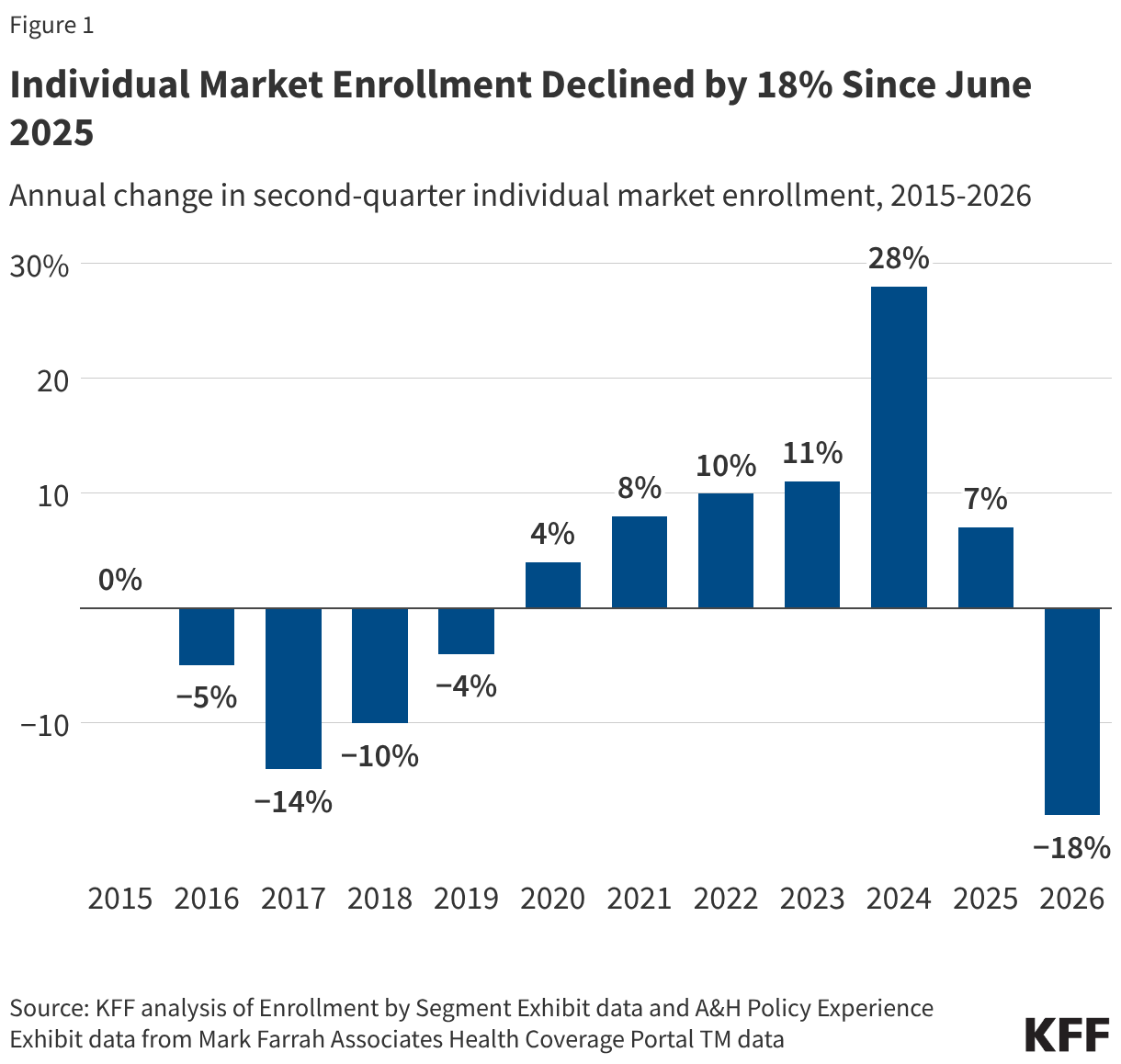
Enrollment in the individual health insurance market across the United States has experienced a steep and unprecedented decline, falling by 18% between June 2025 and June 2026. This vital sector of the American healthcare landscape is composed primarily of individuals who obtain coverage through the Affordable Care Act (ACA) Marketplace, alongside a smaller portion of consumers who purchase similar health plans directly off-exchange.
This drop represents a significantly sharper contraction in coverage than what had been captured by earlier preliminary reports. Previous data tracking ACA Marketplace enrollment trends indicated that effectuated enrollment had declined by 12% compared to the figures recorded in February. While fully updated, granular data specific to the ACA Marketplace population for the summer months are not yet finalized, comprehensive figures covering the broader individual market—where roughly nine out of every ten participants are enrolled via the ACA Marketplaces—reveal that the downward trend accelerated as the year progressed. Individual market enrollment dropped by 16% as of March before deepening to an 18% reduction by June, encompassing both on- and off-exchange insurance plans.
In total, health policy analysts estimate that individual market enrollment has plummeted by more than 4.6 million people over the course of a single year, shrinking from 25.2 million individuals in June 2025 down to 20.5 million by June 2026. This contraction coincides directly with the expiration of enhanced premium tax credits and several other consequential federal policy changes that policy experts and budget analysts had warned would inevitably lead to widespread coverage losses. Earlier this year, ACA Marketplace enrollment was documented to have fallen in every single state across the nation with the sole exception of New Mexico, though the magnitude of these localized declines varied widely from region to region.
The downward trajectory in individual market participation began during the 2026 ACA Marketplace Open Enrollment Period and maintained its momentum throughout the subsequent months. Initial plan selections and general sign-ups recorded during the 2026 Open Enrollment Period fell by 1.2 million people compared to the totals from 2025. However, raw plan selections often paint an incomplete picture because they frequently include applicants who ultimately fail to pay their initial monthly premiums, meaning their coverage never officially takes effect. Furthermore, returning subsidized enrollees benefit from a federally mandated three-month grace period in the event of nonpayment. Under this regulation, consumers who fail to make their scheduled premium payments are not immediately stripped of their coverage; instead, they are permitted to remain on their plans until the grace period officially elapses.
As a result of this regulatory grace period, enrollees who neglected to make their January premium payments were typically not recorded as officially terminated until after March 31. Crucially, when these terminations were processed, the coverage was terminated retroactively back to the end of January. Consequently, the effectuated ACA Marketplace enrollment for February—which is measured retrospectively only after the grace period officially closed on May 15, 2026—registered a dramatic 12% drop, tumbling from 21.8 million down to 19.2 million people.
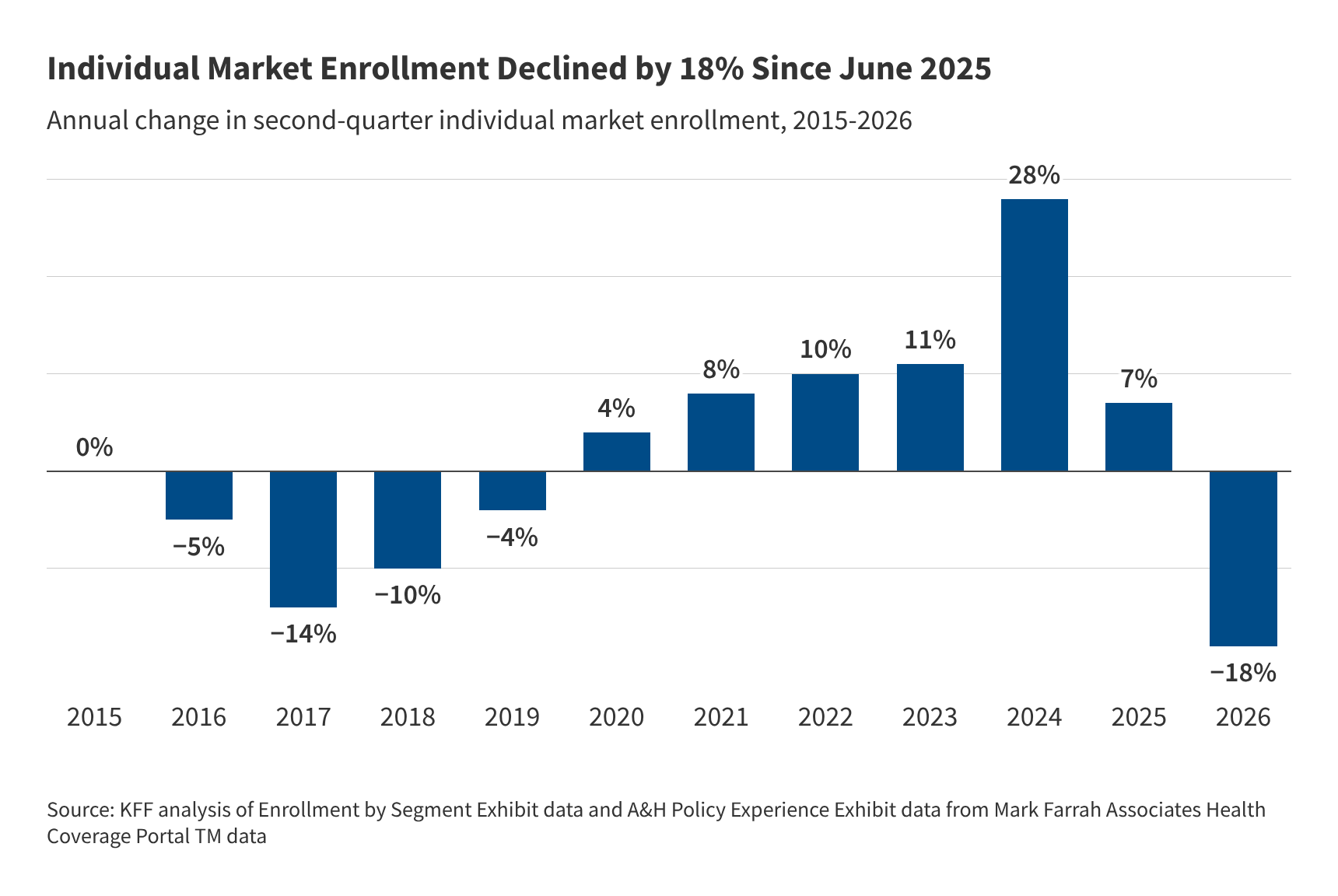
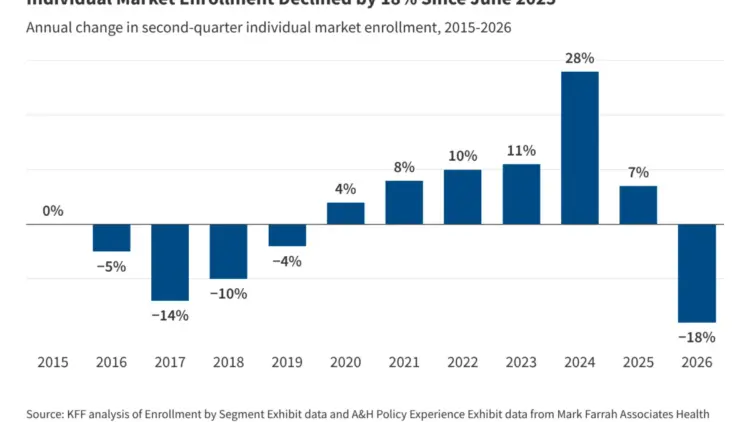
Year-over-year figures for March within the composite individual market demonstrated that this downward momentum showed no signs of slowing, recording a 16% decrease. By June, the year-over-year deficit had widened to 18% when compared with the exact same timeframe in 2025. Although these comprehensive tallies incorporate off-exchange coverage, the vast majority of individual market policies continue to be purchased on-exchange through the ACA Marketplaces. Off-exchange coverage, which is acquired directly through commercial insurers or independent brokers, does not grant consumers access to financial assistance in the form of premium tax credits, though it does afford insurance carriers greater flexibility regarding specific plan designs and structures.
These mounting declines are now closely approaching the earlier projections issued by the Congressional Budget Office (CBO), which estimated that the expiration of the enhanced tax credits would trigger a roughly 25% drop in total marketplace enrollment through the course of 2026. Furthermore, these empirical findings align closely with public opinion polling conducted by KFF among marketplace participants. In the KFF Follow-Up Survey of ACA Marketplace Enrollees, approximately one in six returning enrollees—representing 17% of respondents—frankly stated that they lacked confidence in their ability to afford their monthly health insurance premiums for the entirety of 2026. This financial vulnerability placed them at immediate risk of forfeiting their health coverage later in the year. Among all individuals who held Marketplace coverage in 2025, 22% reported that they had successfully transitioned to an entirely different source of healthcare coverage, while nearly one in ten, or 9%, acknowledged that they were now completely uninsured.
Industry observers warn that further enrollment erosion may persist through the remainder of this year and into upcoming plan years. The second-quarter data merely provide a mid-year snapshot of a volatile market, and enrollees who ultimately fall behind on their financial obligations during the latter half of the year remain vulnerable to losing their coverage. Moreover, these June enrollment figures do not yet account for the additional wave of coverage losses anticipated from subsequent announcements regarding plan cancellations, which materialized after the official close of the second quarter. Despite the severity of this year’s contraction, it is worth noting that total individual market enrollment remains higher than it was prior to the legislative introduction of the enhanced premium tax credits, sitting more than seven million higher—a change of 53%—than the figures recorded in June 2019.
Looking ahead, financial pressures are mounting as premiums are projected to continue climbing into 2027. Marketplace insurance providers have proposed a median premium increase of 15% for the 2027 plan year, marking the second consecutive year of double-digit rate hikes for consumers. On average, insurance companies found it necessary to raise their requested premiums by an additional four percentage points to proactively account for anticipated future enrollment declines and the subsequent formation of a sicker, higher-risk insurance pool in 2027. As vulnerable enrollees encounter these escalating costs during the upcoming ACA Open Enrollment Period in the fall, participation in the individual market is widely expected to contract further, potentially leaving even larger segments of the population without health insurance.
Methods
Data utilized for this analytical overview are derived directly from the Mark Farrah Associates Health Coverage Portal. Specific metrics from the "Enrollment by Segment" exhibit and the "Accident & Health Policy Experience Exhibit – by Domicile" were extracted and analyzed, with data accessed on September 23, 2026. The underlying dataset encompasses health plans that submitted the Exhibit of Premiums, Enrollment and Utilization, or alternatively the Supplemental Health Care Exhibit when the primary exhibit was unavailable, to the National Association of Insurance Commissioners alongside California health maintenance organizations regulated by the California Department of Managed Health Care.
To maintain analytical consistency, only insurance plans categorized as possessing a clear medical focus were incorporated into the study; specialty plans focused exclusively on ancillary or supplemental benefit packages were deliberately excluded. Additionally, enrollment figures originating from U.S. territories were set aside. To ensure maximum accuracy, enrollment counts were adjusted to remove any participants in the Children’s Health Insurance Program that might have been incorrectly captured under the umbrella of individual market enrollment for plans where such data were accessible within the Policy Experience exhibit.
Furthermore, enrollment figures for insurance plans that file the Supplemental Health Care Exhibit annually at the conclusion of the calendar year—such as traditional life insurance carriers that market individual health products—were adjusted using the established national growth rate from the end of the preceding year to accurately estimate second-quarter enrollment levels. The overall share of total individual market enrollment derived from the Supplemental Health Care Exhibit stood at 2.8% in 2025 and 1.5% in 2026. Among the subset of insurers that report their data on a quarterly basis, a distinct 5% drop in enrollment was documented between March and June 2026.
Mark Farrah Associates previously published a separate report estimating that total health insurance enrollment decreased by approximately 17.2% year-over-year during the second quarter of 2026. The KFF analysis diverges slightly by strictly isolating plans featuring a medical focus located within the United States while excluding territories, alongside implementing necessary statistical adjustments for annual filers and Children’s Health Insurance Program participants.