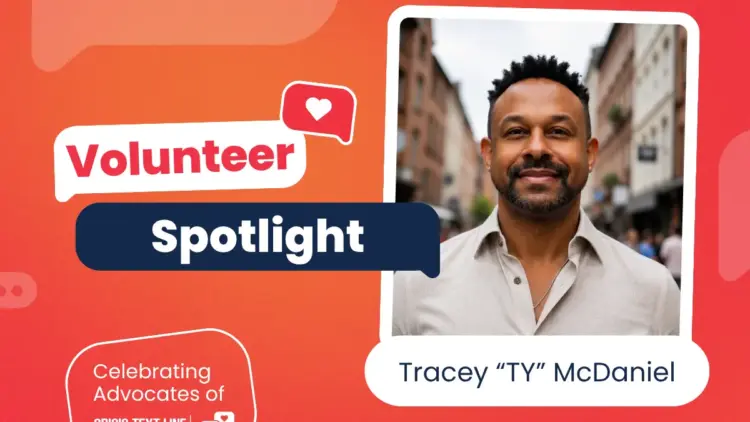
Behind every text conversation handled by Crisis Text Line is a volunteer Crisis Counselor who shows up to listen, offering a steady hand to individuals navigating their darkest moments. As part of its ongoing monthly series celebrating these advocates, Crisis Text Line is shining a spotlight this month on Tracey “TY” McDaniel. His deep commitment to crisis intervention started with a personal promise to a grieving friend and has since grown into a passionate mission to remind people that asking for help is an act of profound strength rather than a weakness.
McDaniel’s journey into crisis support began in the wake of an unimaginable tragedy. He first learned about Crisis Text Line after a dear friend tragically lost her son to suicide. Moved by the devastation of the loss, McDaniel made a solemn pact with her that he would help in any way he could. That promise ultimately led him to the organization, giving him a tangible opportunity to turn his commitment and empathy into direct action.
For McDaniel, the work is deeply personal. Unfortunately, he has been personally impacted by suicide more than once throughout his life. Those painful experiences have stayed with him, cementing his belief that he needed to find a way to get involved and make a tangible difference in the mental health space. He views the time he dedicates as an invaluable investment, driven by the knowledge that being there for someone during a moment of profound crisis can make all the difference in helping them see a way forward.
Understanding the Role of a Crisis Counselor
One of the common misconceptions about volunteering with Crisis Text Line, according to McDaniel, is the pressure to have all the answers. Many prospective volunteers hesitate to step forward because they worry they lack the professional training or psychological expertise to solve someone’s complex problems. However, McDaniel emphasizes that volunteers are rarely expected to fix a person’s life.
Instead, individuals reaching out to the service are rarely looking for someone with a manual of solutions. Most often, they are simply searching for a shoulder to cry on, a nonjudgmental person who will actively listen, and someone who can offer support, perspective, or gentle guidance. In many cases, a Crisis Counselor’s role is simply to act as a light at the end of the tunnel, validating the user’s feelings and reminding them that they are not alone in their struggle.
Translating Volunteer Experience to Daily Life
The impact of volunteering extends far beyond the virtual chat window, profoundly influencing McDaniel’s personal life and his career. As a people leader in his professional life, mental health and awareness are constantly at the forefront of his mind. The volunteer experience serves as a daily reminder that every individual deserves a measure of grace, understanding, and compassion.
To put this philosophy into practice, McDaniel makes it a point to check in with his direct reports on a weekly basis. These conversations are designed to give team members a safe space to share how things are going, not just regarding their professional workloads, but concerning their personal well-being. He has learned firsthand that sometimes simply asking someone how they are doing—and genuinely listening to the answer—can create a meaningful positive impact in their day.
A Lasting Memory of Support
Among the countless conversations McDaniel has engaged in as a counselor, one particular interaction stands out vividly in his memory. It occurred at the very start of a school year, when a young student reached out because they were suffering from intense bullying. Having experienced bullying himself during his own school years, McDaniel immediately recognized how all-consuming and isolating that environment could feel.
Taking a deep breath, he focused entirely on being a reliable shoulder for the student, creating a safe virtual space where they felt genuinely heard and understood. After listening to their experience and offering empathy, McDaniel gently encouraged the student to speak with a teacher or a school administrator, reassuring them that there was absolutely nothing to be embarrassed or ashamed of. That conversation has stayed with him ever since, reinforcing his personal understanding of how desperately young people need someone in their corner during moments of vulnerability.
The Growing Pressures on Modern Mental Health
McDaniel is candid about the state of mental health in contemporary society, noting that life can be extraordinarily difficult. In a rapidly changing world, homes, schools, and workplaces often generate an endless, relentless stream of stressors. The fundamental ability to truly disconnect and recharge has become increasingly elusive for many people.
With limited time and constant demands on personal energy and attention, combined with the profound impact of social media on how individuals view the world and themselves, the cumulative weight can become staggering. When these pressures pile up, they routinely leave people feeling overwhelmed, isolated, or hopeless. This reality makes accessible, nonjudgmental support systems more vital than ever, offering a sanctuary for those who are struggling or simply searching for guidance.
Encouraging Future Volunteers
For anyone considering volunteering with Crisis Text Line who might be holding back due to self-doubt, McDaniel offers a reassuring message. He stresses that if an individual has compassion in their heart and a genuine desire to help people, the necessary skills can be taught through the organization’s training programs. Volunteers are not expected to arrive knowing precisely what to say or how to navigate every intricate situation. The organization provides the comprehensive tools needed for success, leaving willingness to listen, learn, and be present as the most crucial qualifications.
Ultimately, McDaniel advocates for a cultural shift surrounding mental health. He maintains that mental health is every bit as important as physical health, and society must actively work to normalize asking for help. By encouraging people to comfortably say "I’m not okay," communities can dismantle the stigma that surrounds emotional struggles. As McDaniel emphasizes, seeking support is an unmistakable sign of strength rather than weakness, and no one should ever feel compelled to navigate life’s hardest moments in total isolation.