

The warning signs caregivers were long taught to watch for—such as glaring spelling errors, foreign phone numbers, or prizes that sound entirely too good to be true—have quietly and abruptly stopped working. As fraudsters adopt sophisticated tools to target older adults, families are discovering that standard advice is no longer enough to protect their loved ones.
The scenario plays out in living rooms across the country with alarming frequency. The phone rings a little after nine on a Tuesday night. An aging mother picks up the receiver to find her niece on the line, crying and panicked. The younger woman claims she has been in a severe car accident, urgently needs money wired right away, and begs her aunt not to tell her parents. The voice breaks in all the right places, and the narrative is just plausible enough to overcome initial skepticism. In reality, the entire emotional performance is completely fake.
Scenes like this are becoming standard across America, and if you are caring for an aging parent, you are frequently the first person they turn to—usually after the money has already vanished. It remains one of the hardest, least discussed aspects of modern caregiving: the uncomfortable reality that older adults have become the single most targeted and most expensive victims of online and telephone fraud in the United States.
The Advice We All Grew Up With No Longer Works
For generations, the rules for spotting a scam were simple and straightforward. People were told to watch out for clumsy misspellings, be suspicious of strange email addresses, and instantly delete offers that seemed too good to be true. If a message or an interaction looked sloppy, the standard guidance was to discard it and move on without a second thought.

Those traditional rules are now entirely obsolete. Generative artificial intelligence has fundamentally rewritten the economics of fraud, transforming what used to be crude, mass-produced emails into polished, deeply personal messages that are virtually indistinguishable from legitimate communications.
Today’s threats arrive in various forms: the automated text message about a missed package delivery, the voicemail mimicking a grandchild’s exact vocal cadence, or an email from what appears to be a trusted bank confirming a charge that was never actually made. Over the past eighteen months, all of these vectors have become dramatically more convincing.
Federal law enforcement agencies have taken notice. The FBI has issued warnings indicating that AI-generated content is now frequently difficult to identify, urging the public to stop assuming that a familiar voice on the line is genuinely who it claims to be. Criminals can now combine publicly available personal information about a target with the actual voice of that target’s relative through voice cloning technology, creating what fraud prevention experts describe as an industrial revolution for illicit operations.
Why Older Adults Bear the Brunt of Modern Fraud
Fraudsters naturally gravitate toward where the money and the trust reside. Older adults are statistically more likely to own their homes outright, possess accumulated retirement savings, answer telephone calls from unknown numbers, and maintain a baseline trust in institutions. Whether a caller claims to represent Medicare, the IRS, or a commercial bank, seniors are often inclined to believe the institution is exactly who it says it is. That potent combination makes older generations the highest-value targets a fraudster can find, and the national financial data reflects that harsh reality.

According to the FBI’s annual elder fraud reports, financial losses reported by adults aged sixty and older have surged into the billions of dollars, accompanied by double-digit annual increases in both total monetary losses and formal fraud complaints filed with authorities.
Furthermore, investigators emphasize that these figures represent only the reported incidents. The true financial toll is believed to be substantially higher because countless older victims never report what happened to them. Some individuals keep quiet out of a profound sense of personal embarrassment, while others do not realize they were targeted and exploited until weeks or months later, when a family caregiver finally connects the dots.
Why Warnings Alone Are No Longer Enough
When confronted with this escalating threat, most families respond in the only way they initially know how: through verbal warnings. Adult children sit their aging parents down, urge them to be careful, and perhaps forward a news article or an advisory bulletin about the latest seasonal scam. While this reaction stems from a place of responsibility, it routinely falls short. The issue is not that older adults are ignoring advice; rather, deep-seated fear, panic, and highly engineered, AI-driven messages easily overpower a simple list of theoretical rules.
A growing body of cybersecurity research points to a clear, consistent conclusion: the single most reliable defense against sophisticated phishing and social engineering is neither a casual warning nor passive security software. Instead, it is repeated, hands-on exposure to realistic scam scenarios within a controlled, safe environment.

Industry studies have demonstrated that individuals who practice identifying phishing attempts on a regular basis become significantly less likely to click on real threats when they encounter them in daily life. The capability to recognize a deceptive communication functions much like any other learned skill—it is built through active practice and tends to atrophy without use.
Major corporations have recognized and applied this principle for years. Corporate information technology departments routinely run mandatory phishing-practice drills for their employees, quietly sending simulated scam emails and providing immediate coaching to anyone who makes a mistake. However, retirees and older adults—the very demographic losing the highest sums of money to fraud—were historically never offered equivalent training. They were left to face the most sophisticated fraud operations in history armed with little more than paper pamphlets and good intentions.
Bridging the Gap in Family Security
To address this vulnerability, new educational platforms have emerged to adapt the practice-based methodologies long used within enterprise environments and rebuild them specifically for households. These systems are designed to place adults aged fifty and older at the center of the experience rather than treating them as an afterthought.
Instead of sitting through dry lectures, participants work through realistic scenarios drawn from expansive libraries covering various fraud categories, including fake delivery notifications, phony government alerts, romance schemes, and compromised account warnings. For each scenario, the reader must decide whether to trust, verify, or delete the communication, after which the platform immediately explains the specific indicators that gave the scam away.
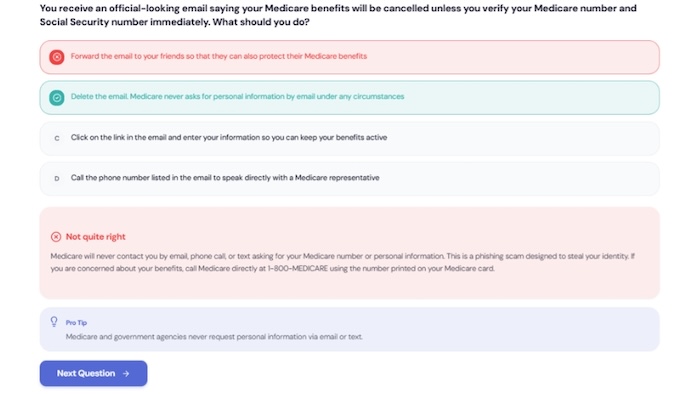
These practice sessions are designed to be brief and accessible, requiring only a few minutes to complete. The interfaces typically feature large, readable type and plain language free of technical jargon, eliminating the need to install complex applications. Because many adult children live geographically distant from their aging parents, modern family-oriented subscriptions allow multiple generations across different households to participate under a single account. This setup enables family members to share secure practice links and monitor overall readiness through shared dashboards without resorting to intrusive questioning.
While security experts emphasize that no single tool is a complete silver bullet against determined criminals, the underlying premise remains supported by extensive research: the most effective way to recognize a scam in the moment is to have already encountered and analyzed similar examples safely beforehand. For caregivers, these proactive practice tools offer a constructive method to support aging parents while reinforcing their confidence and independence rather than diminishing it.
Experts recommend that families establish open communication habits alongside these practice tools, discussing unexpected financial requests and maintaining a shared protocol for verifying unexpected contacts. As fraudulent tactics continue to evolve—growing increasingly adept at mimicking trusted institutions and family members—families who cultivate awareness and regular practice together remain better equipped to navigate the digital landscape safely.



