WASHINGTON — For decades, the rising cost of medical care has been a defining pressure point for the American economy, consistently outpacing growth in virtually every other sector. According to a comprehensive new analysis released by KFF, healthcare expenses continue to consume an ever-larger share of the nation’s gross domestic product, compounding financial pressures on households across the country.
The analysis reveals a stark economic reality for American families: the costs of essential health services and monthly health insurance premiums have climbed at a rate that far exceeds wage growth. While paychecks have struggled to keep up with the cost of living, the price of healthcare has marched steadily upward, outpacing general consumer price inflation by a wide margin over the past quarter-century.
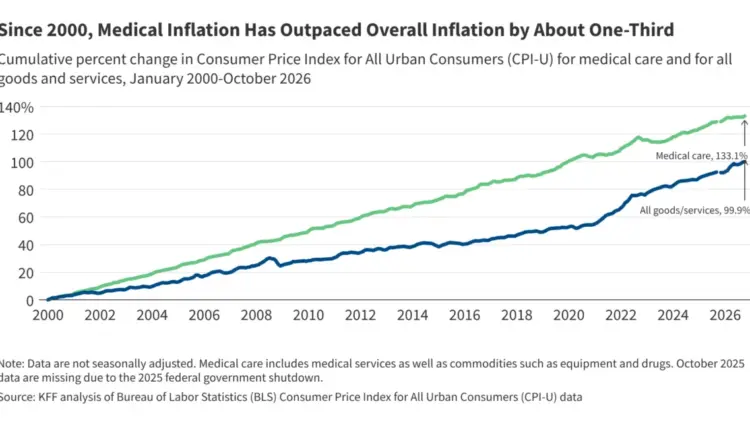
Between January 2000 and October 2026, medical care prices grew 33% more than overall consumer prices. This widening gap illustrates how healthcare inflation has uniquely strained household budgets, making routine medical visits, specialized treatments, and comprehensive insurance coverage increasingly difficult to maintain. Among the various components of the healthcare sector, the price of hospital services has experienced the fastest and most dramatic growth, driving much of the upward pressure on overall medical expenditures.
The KFF analysis was designed to provide a nuanced, detailed understanding of how healthcare price growth compares to price growth in the rest of the economy. By breaking down both short-term and long-term inflation trends, the research offers a clearer picture of the structural economic forces driving medical costs higher. Rather than viewing healthcare inflation as a series of isolated spikes, the analysis examines the persistent, systemic trajectory of medical pricing over time.
To conduct this evaluation, researchers primarily examined inflation in prices paid by urban consumers. The methodology relies heavily on data from the Consumer Price Index for All Urban Consumers (CPI-U), published monthly by the Bureau of Labor Statistics (BLS). By tracking these specific consumer metrics, the analysis captures how everyday Americans experience the financial burden of healthcare in urban centers, where a vast majority of the population resides and where medical pricing trends are often most pronounced.
This newly published examination is part of a broader, ongoing body of research hosted on the Peterson-KFF Health System Tracker. The Tracker serves as an authoritative information hub dedicated to continuously monitoring, analyzing, and assessing the performance, efficiency, and cost dynamics of the United States healthcare system. Through data-driven insights and public briefings, the platform aims to inform policymakers, researchers, and the public about the underlying economic drivers that shape the nation’s medical landscape.