Every year on February 25, advocates, audiologists, and patients around the globe observe International Cochlear Implant Day to celebrate the monumental medical advances and sophisticated technology that make cochlear implants profoundly effective for individuals experiencing severe or profound hearing loss. As medical technology continues to evolve, these devices offer renewed pathways to communication, connection, and a restored quality of life for people who have struggled with hearing difficulties for decades.
While the scientific achievements behind cochlear implants are widely recognized in the medical community, the human stories behind the technology reveal the profound emotional and personal transformations experienced by recipients. One such journey belongs to Teri Breier, who received a cochlear implant in March 2025, exactly four decades after acquiring her first pair of traditional hearing aids. Remarkably, it took Breier eight full years after she medically qualified for a cochlear implant to finally take that significant leap at the age of 60. Now, approaching a year of dramatically improved hearing, enhanced communication, and deeper human connection made possible by this life-changing technology, she frequently reflects on a singular question: why didn’t she do it sooner?
The simple answer, as Breier often explains, is that she simply was not ready until the moment arrived. Following a lifetime of relying on increasingly powerful traditional hearing aids to manage the slow, progressive creep of sensorineural hearing loss, she had long operated under the assumption that there would always be a more advanced, non-surgical option available just around the corner.
Early Detection and the Long Shadow of Stigma
Breier’s journey with hearing loss began inauspiciously during a routine school health screening in the first grade in 1971. That era predated widespread newborn hearing exams and the passage of the landmark Education for All Handicapped Children Act (EHA) of 1975, legislation that eventually evolved into the Individuals with Disabilities Education Act (IDEA) in 1990. Aside from basic monitoring of her condition, doctors prescribed no medical interventions, and educators offered no classroom accommodations for students facing similar challenges.
Throughout her formative years in elementary, junior high, and high school, Breier instinctively adapted to her environment by sitting near the front of every classroom to ensure she did not miss crucial instructions. Although she maintained strong academic performance, she found herself increasingly struggling to understand her teachers and follow spontaneous conversations with classmates. By the time she reached age 16, her hearing loss had progressed from mild to moderate. At that vulnerable stage in her adolescence, however, she remained fiercely resistant to being labeled as "the girl with the hearing aids," choosing instead to conceal her struggles.
Navigating College and Career While Hiding an Invisible Disability
As a college freshman, Breier managed to navigate the difficult acoustics of large lecture halls well enough to keep her grades high. However, upon returning to Los Angeles for the summer break, her grandmother insisted that she finally obtain hearing aids. Looking back, Breier acknowledges that wearing those initial devices made an immediate, monumental difference in her capacity to learn, understand, communicate, and connect meaningfully with her peers.
Nevertheless, the heavy burden of perceived social stigma and internalized shame prompted her to continue hiding her invisible disability from colleagues and acquaintances. She spent the first three decades of a demanding professional career in journalism, advertising, and marketing desperately trying to blend into the corporate environment. Eventually, she stepped away from the corporate world to establish her own independent enterprise as a freelance copywriting consultant.
As the years progressed, her hearing loss naturally worsened, transforming the mechanics of daily work and personal life into an exhausting exercise. Bluffing her way through professional interactions became increasingly untenable, and eventually, her beloved hobby as a choral singer was severely compromised. Deeply embarrassed whenever she misunderstood a spoken instruction or inadvertently sang out of tune, Breier began pulling back from social engagements, stepping away from the choir, and sliding into
a pattern of increasing isolation.
Finding Community and Advocacy Through HLAA
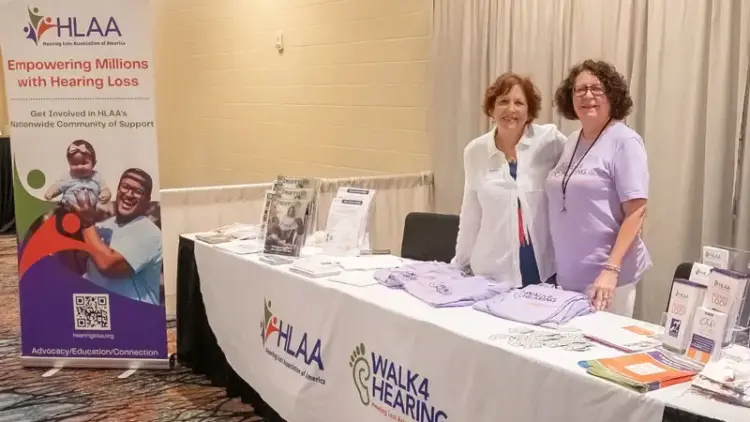
The turning point in Breier’s relationship with her hearing loss arrived in 2015 when she discovered the Hearing Loss Association of America (HLAA). By that time, she had invested considerable personal effort into inner healing, cultivated a stronger sense of self-confidence, and reached a mental space where she was finally ready to "own" her hearing loss openly. Her involvement quickly deepened as she assumed leadership roles in two consecutive HLAA chapters, building close friendships with other cochlear implant recipients who consistently offered encouragement and shared their own overwhelmingly positive experiences.
Though Breier began the formal medical qualification process for a cochlear implant as early as 2017, she chose not to proceed at that juncture. She was still managing to "get by" with her current setup, and she harbored deep-seated fears regarding the potential loss of her remaining residual hearing and her ability to enjoy music. Furthermore, she worried whether she could successfully maintain her freelance business through the extended downtime required for post-surgical recovery and intensive aural rehabilitation. Despite delaying the surgery, she maintained her active presence within the HLAA community, attending annual national conventions and volunteering enthusiastically for the Long Beach Walk4Hearing.
Momentum shifted definitively in 2023 when Breier accepted a staff position with the HLAA. Working daily alongside colleagues who wore cochlear implants provided the ultimate catalyst, inspiring her to take decisive action and stop missing out on the vibrant world around her.
A New World of Sound and Active Participation
Breier’s outpatient cochlear implant surgery paved the way for her "Activation Day" in April 2025. Fortuitously, she was able to comprehend speech from the very first moment the device was turned on, even though every single sound and syllable was initially overlaid by persistent robotic whistles and echoes as her brain struggled to interpret the incoming digital signals. Through consistent, dedicated aural rehabilitation practices, those disruptive artificial noises completely subsided within three months.
Since that milestone, Breier has successfully recaptured high-frequency sounds that had been entirely absent from her auditory experience since her twenties. She has rediscovered the simple daily pleasure—and occasional annoyance—of hearing birds singing outside her window. She can now effortlessly understand songs and commercials playing on her car radio and conduct phone conversations without relying on captions.
Her personal journey took another significant step forward when she was elected to serve as president of the HLAA Los Angeles Chapter, marking the latest chapter in her lifelong advocacy for hearing health. For Breier, the transformation feels like unlocking an entirely new world, allowing her to feel like her authentic self while actively participating in conversations, nurturing relationships, and engaging fully in everyday life.
While she currently remains bimodal—using a traditional hearing aid in one ear and her cochlear implant in the other—she continues to evaluate the possibility of receiving a second implant in the future. As she reflects on her path, Breier expresses deep gratitude for the technology that restored her connection to the world and, above all, for the role models within the HLAA who illuminated the path forward.