WASHINGTON — In a sweeping regulatory move that could fundamentally transform American democracy, resource allocation, and civil rights tracking, the U.S. Census Bureau has published a proposed rule that would strip race and ethnicity questions from the decennial census and radically narrow the definition of who is counted for congressional apportionment.
Published on September 10, 2026, the proposed rule introduces two entirely new parts to the federal regulations governing the decennial census of population and housing. If finalized and implemented prior to the 2030 count, the changes would prohibit the collection of data on race and ethnicity—along with sexual orientation—and would redefine the foundational concept of "usual residence." Under this narrowed definition, millions of noncitizen immigrants, including undocumented residents and lawfully present immigrants who lack lawful permanent resident status, or a green card, would be entirely excluded from the official apportionment base used to divide the 435 seats in the U.S. House of Representatives across all 50 states.
Furthermore, the proposal signals that the Census Bureau would rely on tax records to establish "usual residence," a shift that could inadvertently or intentionally omit individuals who do not file traditional tax returns from the national headcount. These prospective changes strike at the very heart of the decennial census, an enterprise established by the U.S. Constitution in 1790 with the explicit purpose of counting every person living within the borders of the United States to guarantee fair political representation and direct the distribution of federal funds.
The publication of the proposed rule opens a public comment period scheduled to run through October 13, 2026. Following this window, the Census Bureau is legally required to review and address public feedback before issuing a final rule. Should the administration push the measures through to finalization, legal challenges are virtually guaranteed. Moreover, any shift in the presidential administration ahead of the 2030 decennial cycle could introduce additional roadblocks to its implementation.
The Decennial U.S. Census
The decennial census stands as a cornerstone of American governance, constitutionally mandated to secure an accurate count of every person residing in the country. Initiated in 1790, the U.S. Census Bureau has executed this massive civic operation once every ten years—specifically on April 1 of years ending in zero—to ascertain the national population. Beyond dividing the House of Representatives among the states, these decennial figures dictate the annual allocation of hundreds of billions of dollars in federal expenditures.
Historically and practically, the decennial census remains the single source of comprehensive, block-level data regarding race, ethnicity, and other core demographic traits. Researchers, academic institutions, local governments, and advocacy organizations rely on these granular statistics to comprehend population distributions, construct nationally representative survey samples, weigh statistical data, and conduct deep research into the American workforce, economy, and housing stock. Crucially, the race and ethnicity metrics gathered by the census are vital tools for evaluating the real-world effectiveness of government policies, monitoring compliance with federal anti-discrimination laws, and measuring equity.
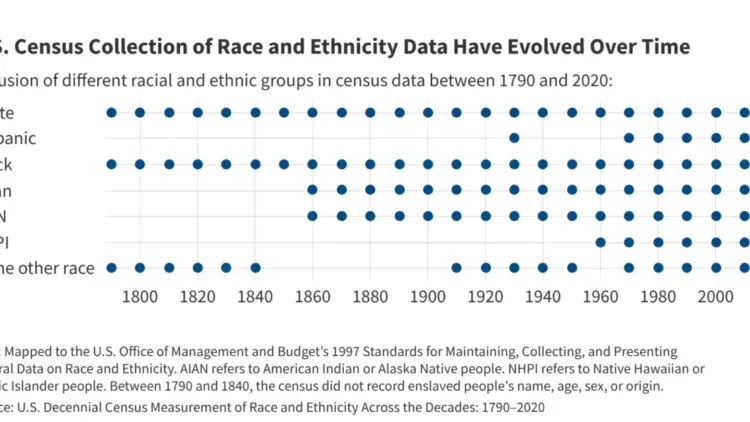
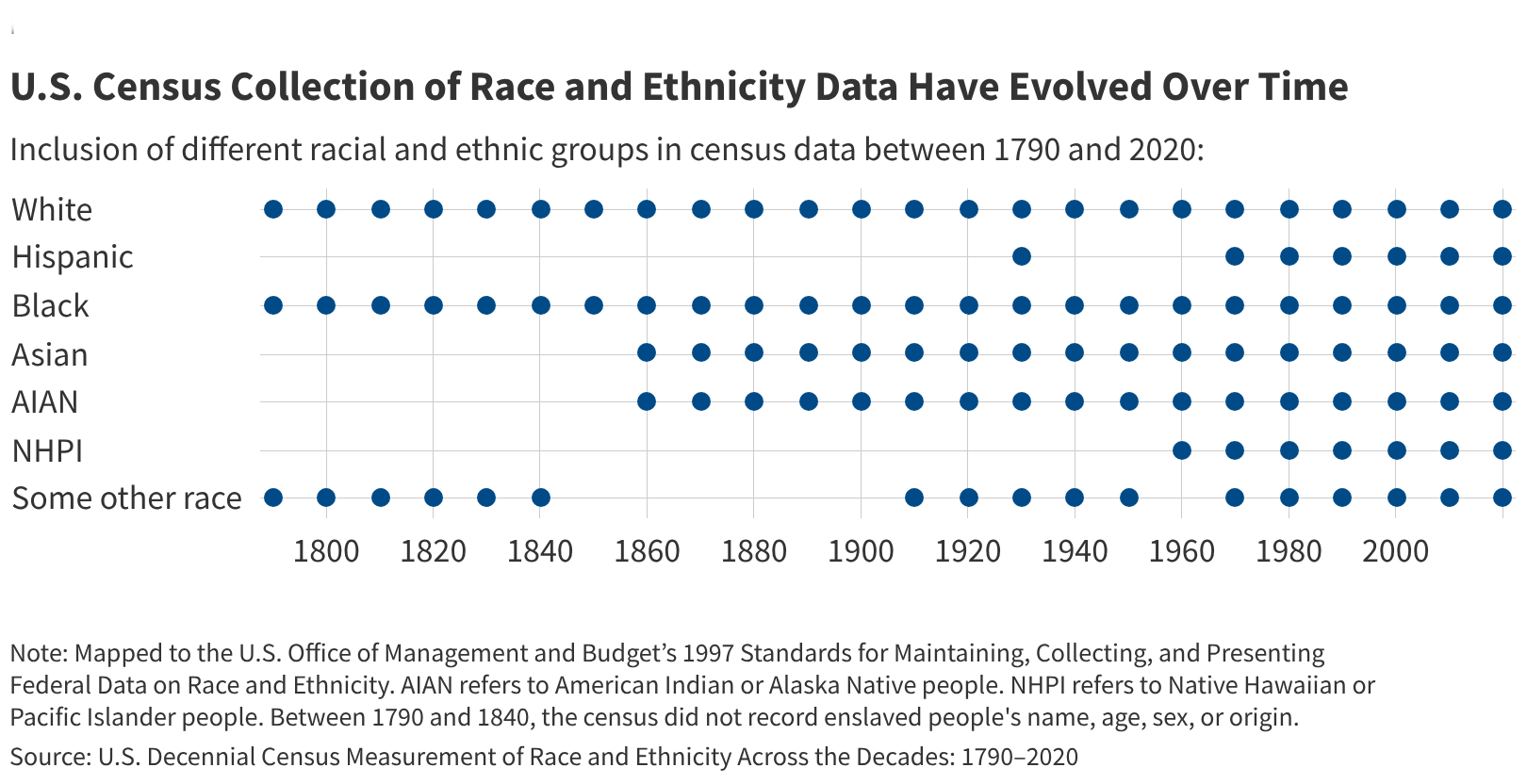
Since its inception, the census has consistently tracked race and ethnicity to inform policy and resource distribution. Over the centuries, these categories have evolved dynamically to reflect shifting social realities and the deepening diversity of the American populace. In 1977, the Office of Management and Budget (OMB) established standardized guidelines for collecting and reporting race and ethnicity data across the entire federal government, ensuring consistency.
These standards underwent a major revision in March 2024, when the OMB added a Middle Eastern or North African category, clarified rules for selecting multiple racial and ethnic identities, and mandated the collection of more detailed data to improve accuracy. However, the Trump administration subsequently extended the implementation deadline for these changes twice and ultimately scrapped plans to integrate the updated standards into the 2027 American Community Survey.
From its very first iteration in 1790, the decennial census has counted all people residing within the United States, regardless of their citizenship or immigration status. This practice aligns strictly with the text of the U.S. Constitution. Article I, Section 2 mandates an "actual Enumeration" of the population for apportionment, while Section 2 of the Fourteenth Amendment—which dismantled the historical Three-Fifths Compromise—specifies that representatives shall be apportioned according to the whole number of persons in each state.
Adhering to this constitutional mandate, the Census Bureau has always counted every single "person" who typically lives and sleeps in the U.S., never carving out noncitizens from the apportionment base. While former President Trump attempted during his first term to bypass this tradition by issuing an executive memorandum seeking to exclude undocumented immigrants from the 2020 apportionment count, timely legal challenges successfully blocked the policy from taking effect.
Implications of Proposed Changes
The potential exclusion of millions of noncitizen immigrants from apportionment counts carries profound consequences, chief among them a steep drop in federal funding and resources for states and localities with high immigrant populations. By redefining "usual residence" to shut out immigrants without lawful permanent resident status, the proposed rule will naturally shrink the recorded population of specific regions. Consequently, areas with dense immigrant communities will appear to have fewer residents, altering their demographic and income profiles on paper and drastically reducing their federal funding allocations.
Prior research emphasizes that beyond raw population totals, a state’s poverty rate and rural share heavily dictate federal funding flows, which frequently target low-income households and non-metropolitan districts. According to analyses by the Project on Government Oversight, more than 370 public programs relied on census metrics to disburse at least a fraction of over $2.2 trillion in federal funds during fiscal year 2023 alone. Health programs, notably Medicaid and the Children’s Health Insurance Program (CHIP), command the lion’s share of this funding.
The federal share of Medicaid and CHIP expenditures, determined by the Federal Medical Assistance Percentage, relies directly on a state’s per capita income derived from census figures. Slicing out noncitizens—who statistically skew toward lower income brackets—from the resident tally could depress the FMAP for states with large immigrant populations like Texas and Florida, while states like California might remain cushioned because their FMAP already rests at the statutory floor of 50 percent.
Beyond general funding formulas, the policy threatens to distort the geographic placement of vital health infrastructure. The Health Center Program utilizes census-derived data to pinpoint medically underserved areas, directly influencing where Federally Qualified Health Centers are built. Decennial figures also indirectly shape hospital placement; 36 states and the District of Columbia enforce certificate of need laws that rely on bed-need methodologies benchmarked to census data.
The elimination of race and ethnicity data alongside the purge of noncitizen immigrants would deal a severe blow to public health research and data integrity. Because the decennial census is the solitary source of block-level data on these variables, erasing it blinds researchers tracking health care disparities. Furthermore, omitting noncitizens means the census will fail to provide an accurate reflection of who actually populates the nation.
These adjustments will sever historical trend lines, making post-2030 data incomparable to earlier decades and hobbling researchers attempting to maintain nationally representative surveys. While the Census Bureau notes that it is not currently proposing restrictions on demographic questions within the American Community Survey or other non-enumeration vehicles, any future expansion of these rules would completely obscure the demographic realities of the United States.
The decision to halt the collection of race and ethnicity data will likewise send shockwaves through the political redistricting process, directly threatening the voting power of communities of color. Public Law 94-171, passed in 1975, legally mandates the Census Bureau to supply states with block-level demographic data so they can redraw congressional and legislative boundaries following every census. Simultaneously, Section 2 of the Voting Rights Act of 1965 outlaws racially discriminatory voting practices. Block-level data cross-tabulated by age and race have long served as the fundamental metric required to substantiate vote dilution claims in court.
Although the Supreme Court’s April 2026 ruling in Louisiana v. Callais significantly narrowed Section 2 by raising the evidentiary bar for plaintiffs—requiring them to demonstrate a strong inference of intentional racial discrimination alongside viable alternative maps—stripping away block-level racial and ethnic data altogether would effectively dismantle the infrastructure needed to identify vote dilution, construct fair minority-opportunity districts, and litigate future VRA disputes.
Finally, stripping millions of noncitizen immigrants from the population counts risks shifting congressional power away from immigrant-heavy states. Data from the Pew Research Center indicate that as of 2023, the U.S. was home to approximately 14 million undocumented immigrants and over two million lawfully present immigrants without green cards. Though these figures fluctuate, excluding this population from the apportionment base would trigger a clear redistribution of political power.
A previous Pew Research Center analysis evaluating President Trump’s 2020 proposal to omit unauthorized immigrants demonstrated that states such as California, Florida, and Texas would each have surrendered a congressional seat, while states like Alabama, Minnesota, and Ohio would have gained representation at their expense. As the October public comment deadline approaches, federal lawmakers, civil rights advocates, and state officials are bracing for what promises to be a high-stakes battle over the future of the American statistical landscape.