
Medicaid remains the cornerstone of long-term care financing in the United States, carrying the financial weight for more than two-thirds of long-term care services delivered in home- and community-based settings. Yet, a new comprehensive data note reveals that nearly 650,000 Americans are currently trapped on waiting or interest lists for vital home- and community-based services (HCBS), highlighting persistent structural strains even as sweeping federal policy changes and state-level budget pressures loom on the horizon.
Unlike traditional medical benefits, most home care programs are optional for states to provide under federal law. They are frequently administered through Section 1915(c) waivers and other mechanisms, granting states wide latitude to design a spectrum of benefits while simultaneously allowing them to cap enrollment. When the volume of individuals seeking care outstrips the available waiver slots authorized by a state, waiting lists naturally form. Recent KFF estimates indicate that over 5 million Medicaid enrollees utilize home care nationwide, with approximately half accessing these services through waiver programs.
The landscape for these programs is entering a critical juncture. Following the enactment of the 2025 reconciliation law, substantial changes to Medicaid are anticipated to reduce federal funding streams significantly. These shifts threaten to trigger coverage losses for current enrollees while imposing severe fiscal pressures on state budgets, healthcare providers, and individuals alike. Because home care represents a major share of overall Medicaid spending and operates largely on an optional basis, states searching for ways to balance budgets in the wake of reduced federal support may eye HCBS reductions. While cutting waiver slots could lead to ballooning waiting lists, any policy proposals aimed at rolling back benefits face steep political and practical hurdles. Advocates and policymakers alike note that individuals relying on these services frequently present complex, high-needs medical profiles, making broad restrictions difficult to implement.
Adding to the complexity are shifting federal immigration policies. Workforce stability remains an ongoing crisis within the sector, where roughly three in 10 direct care workers are immigrants. Federal policy adjustments regarding immigration risk exacerbating the already acute challenge of retaining and expanding a dependable care workforce, potentially compounding delays for individuals waiting for services.
Understanding the Data Behind Medicaid Waiting Lists
To capture the state of these programs before the full weight of the 2025 reconciliation provisions takes effect, the 24th KFF survey of state Medicaid officials offers an extensive look into home care administration. Conducted between April and August 2026 across all 50 states and the District of Columbia—with responses supplemented by Florida’s 2022 data and South Carolina’s 2025 data—the survey maps out the realities of waiting lists, target populations, and programmatic shifts.
However, health policy experts emphasize that waiting lists serve as an incomplete metric for gauging total unmet need. They do not function as universally comparable indicators across state lines or historical timelines. Instead, a waiting list reflects a complex mix of legislative choices, including the specific populations a state chooses to target, the range of services it finances, the overall resource allocation, and the local availability of direct care workers. Furthermore, waiting lists omit individuals who have unmet needs but live in states that do not utilize lists, as well as those who are unaware of available programs or face administrative hurdles when attempting to apply.
Comparing these lists across different state jurisdictions is notoriously difficult because states employ vastly divergent management philosophies. Some states maintain waiting lists that exclusively comprise individuals who have already been formally screened and verified as medically and financially eligible for waiver slots. Others include anyone who expresses interest, resulting in lists that mix eligible candidates with individuals whose actual eligibility remains undetermined.
Federal intervention is on the horizon. Beginning in 2027, states will face mandatory reporting requirements regarding waiting list numbers under a finalized federal rule governing access to Medicaid services. This data will encompass metrics such as the number of waiting applicants, screening statuses, average wait times experienced by newly enrolled individuals over the preceding year, the duration between service approval and actual delivery, and the percentage of authorized care hours successfully fulfilled. Even so, experts note that these forthcoming metrics will still leave blind spots, failing to capture the adequacy of state plan home care services, the comprehensiveness of care packages, or the frequency with which individuals receive authorized hours below their actual medical requirements.
How Many States Have Waiting Lists for Home Care?
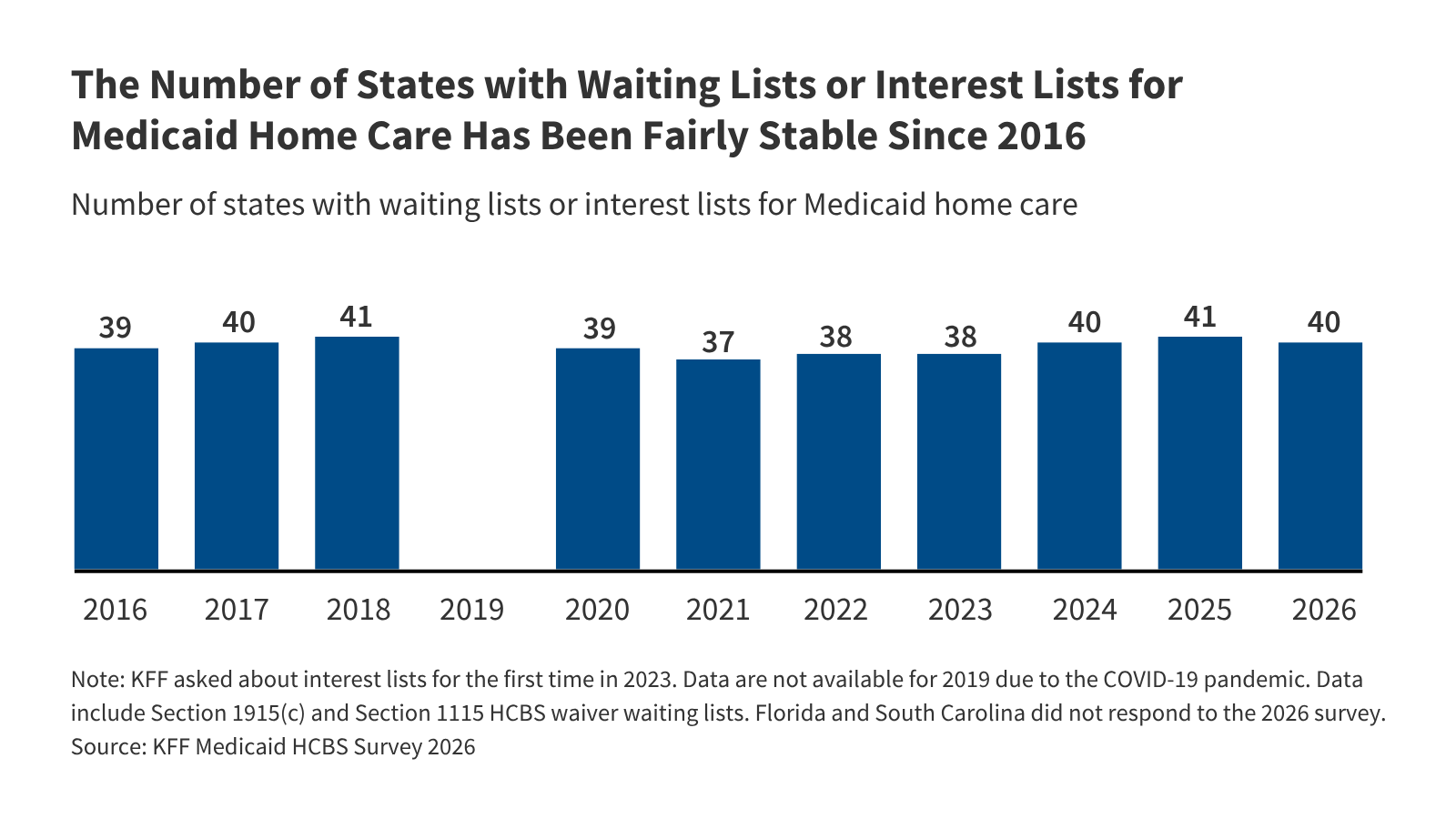
The broader macro-trend regarding the prevalence of waiting lists has remained remarkably steady over the past decade. Between 2016 and 2026, the number of states maintaining waiting or interest lists has hovered consistently between 37 and 41, settling at 40 states for the current reporting period.
Critics of the Affordable Care Act (ACA) have occasionally pointed to waiver waiting lists to argue that expanding Medicaid under the health law diverts critical fiscal resources away from older adults and individuals with physical disabilities. Yet independent research consistently demonstrates that ACA Medicaid expansion has actually improved health coverage stability for individuals managing chronic illnesses and disabilities. Furthermore, historical data confirms that waiting lists for home care predated the ACA expansion era by decades, having originated shortly after home care waiver authority was first incorporated into federal Medicaid statute in the early 1980s. Both expansion and non-expansion states alike utilize waiting lists to manage capacity constraints.
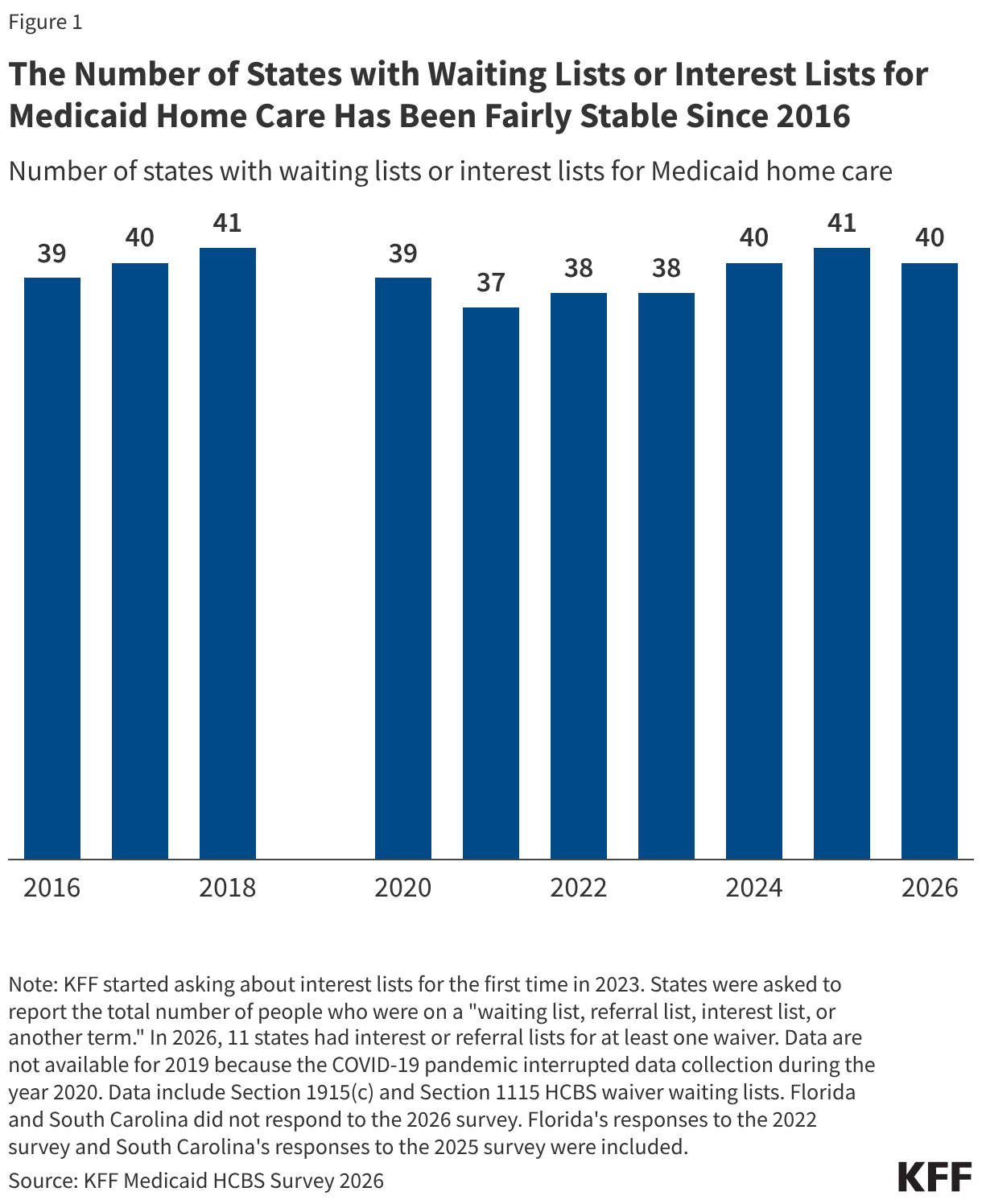
While the aggregate number of states with lists changed very little between 2025 and 2026, individual states experienced notable shifts. Seven states dismantled waiting lists across eight distinct waivers. Notably, Nebraska reported zero waiting lists entirely, while Oregon successfully eliminated a waiting list of 1,000 individuals from its Section 1115 waiver dedicated to older adults and people with physical disabilities. Conversely, only two states instituted new waiting lists across three waivers, highlighting that while total state counts remain stable, programmatic adjustments occur continuously at the local level.
How Many People Are on Waiting Lists for Home Care?
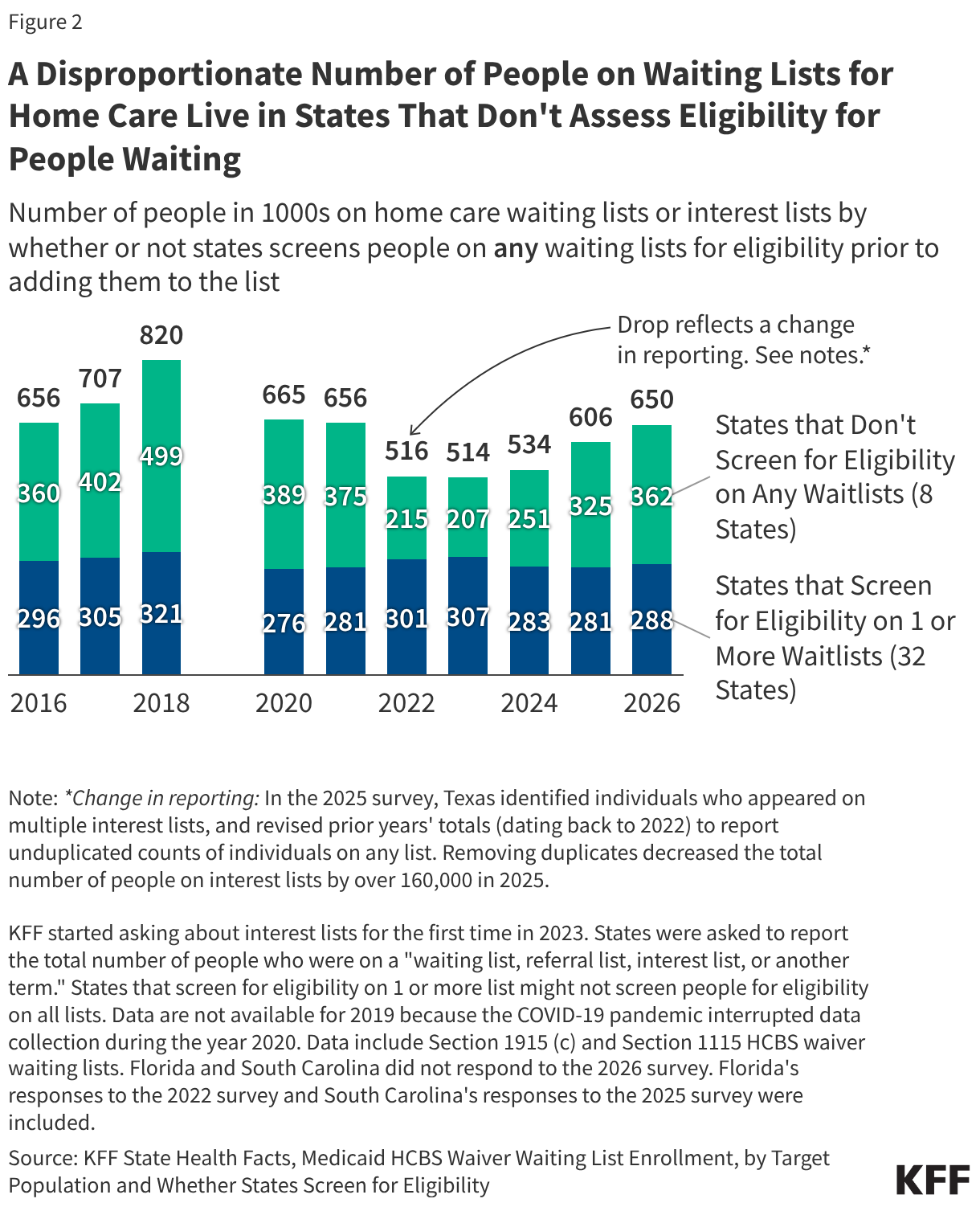
While the count of states maintaining lists remained stable, the actual volume of people waiting for care climbed. Between 2025 and 2026, total cumulative enrollment across waiting and interest lists increased by approximately 7%, pushing the national total to nearly 650,000 individuals.
An analysis of state-level trajectories shows that 32 states registered increases in their waiting or interest lists, while seven states recorded decreases. Administrative policy changes frequently drive these fluctuations. For instance, between 2018 and 2020, national waiting list figures dropped by 155,000—a 19% reduction—largely driven by Ohio’s implementation of a comprehensive waiting list eligibility assessment, which alone trimmed nearly 70,000 names from its rosters.
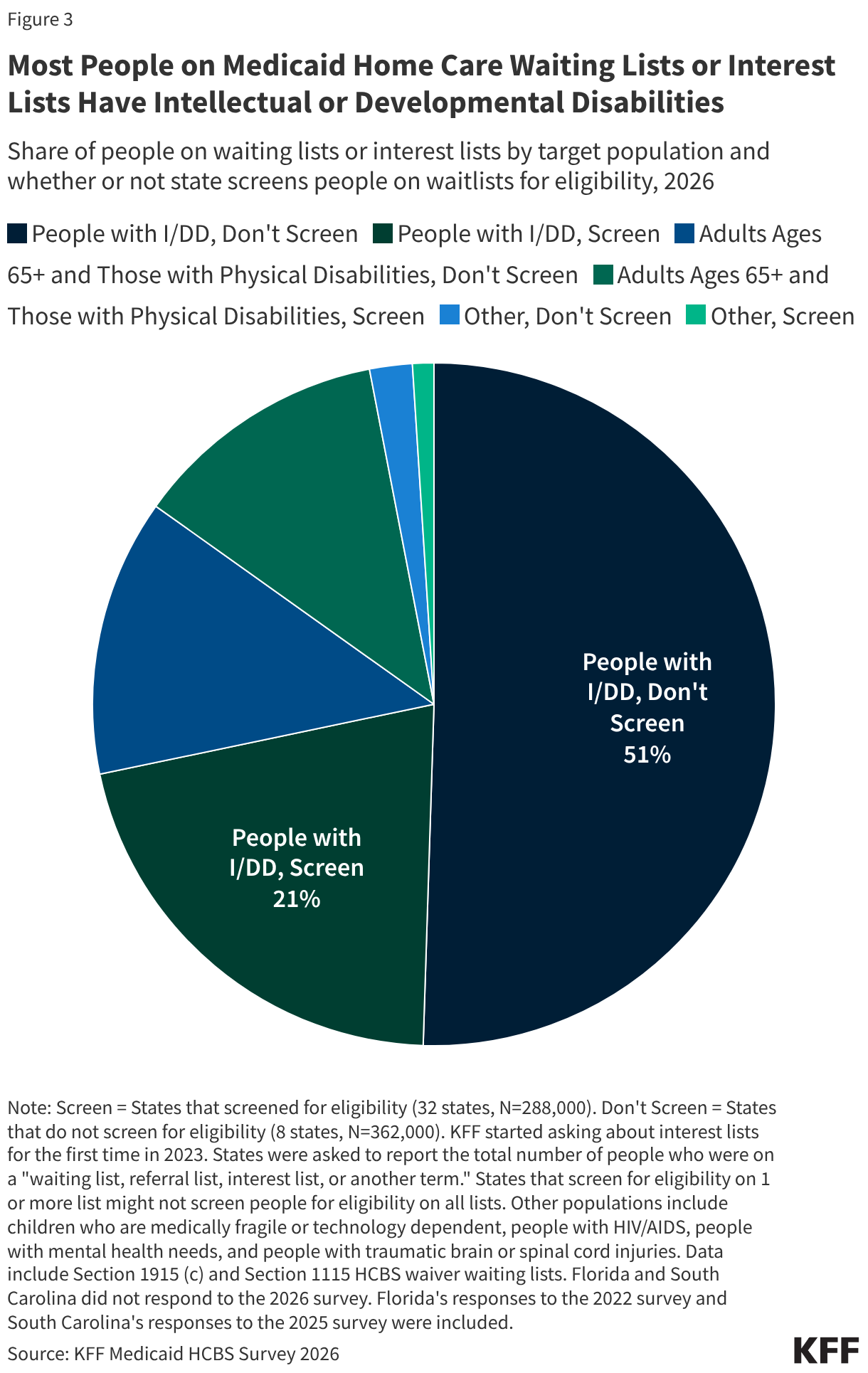
Screening practices continue to create vast disparities in how waiting list numbers are reported and understood. In 2026, 32 states with waiting lists actively screen individuals for waiver eligibility for at least one of their programs, though a subset of four states does not apply screening universally across all of their waivers. More strikingly, eight states—Alaska, Florida, Iowa, New Mexico, Oklahoma, Oregon, South Carolina, and Texas—do not screen individuals for eligibility on any of their home care lists. Despite representing a small fraction of the states, these eight jurisdictions account for over half, or 56%, of all people currently residing on home care waiting lists nationwide.
Qualitative interviews examining home care waiting lists reveal that when states operate on a strictly first-come, first-served basis without preliminary screening, families often register relatives—particularly young children with intellectual or developmental disabilities—long before care is clinically required. They do so in anticipation of future needs, knowing that comprehensive home care packages can take years to secure and may eventually offer essential supports such as supported employment, supportive housing, or round-the-clock supervision.
Who Is on Waiting Lists for Home Care?
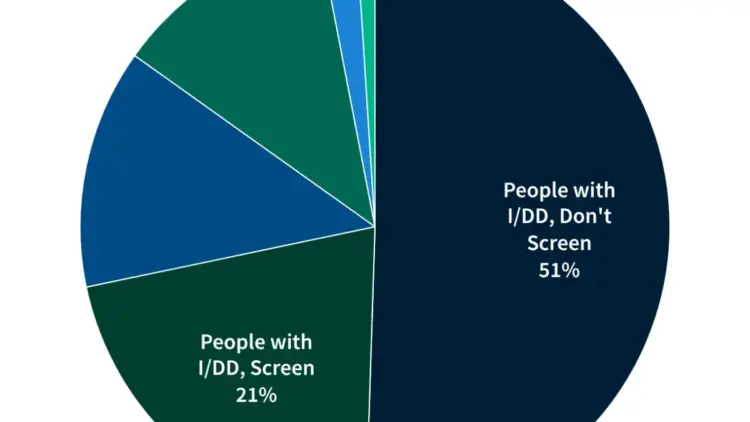
Demographic breakdowns of the waiting list population reveal a heavy concentration of individuals with specific diagnostic profiles. Most people waiting for services have intellectual or developmental disabilities (I/DD), a trend that is especially pronounced in states that do not perform pre-screening for eligibility. Within non-screening states, individuals with I/DD—including those with autism—account for 78% of all waiting list entries. By contrast, they make up 61% of waiting lists in states that actively determine eligibility prior to placement.
Across the entire country, individuals with I/DD comprise nearly three-quarters of the total waiver waiting list population. Older adults aged 65 and older, alongside individuals with physical disabilities, make up roughly one-quarter of those waiting. The remaining 3% includes medically fragile and technology-dependent children, individuals recovering from traumatic brain or spinal cord injuries, people living with mental illnesses, and individuals with HIV/AIDS.
This demographic makeup diverges sharply from the broader Medicaid population and even from the general population utilizing home care services. While individuals with I/DD represent the vast majority of waiting list registrants, they make up less than half of the beneficiaries actually served through 1915(c) waivers, which constitute the largest single vehicle for federal Medicaid home care spending.
How Long Are People on Waiting Lists for Home Care?
For those caught in the backlog, securing actual services requires immense patience. In 2026, individuals on waiting or interest lists gained access to services after an average wait time of 34 months, based on data reported by 35 of the 40 participating states. This figure represents an increase from the 32-month average recorded in 2025.
Wait times vary drastically depending on the target population. Individuals with I/DD face an average wait of 38 months. For other waiver categories, average waiting periods stretch from a relatively brief 8 months for medically fragile and technology-dependent children up to 65 months for specialized waivers targeting individuals with autism.
When examining living arrangements while awaiting services, data is missing for more than 425,000 of the nearly 650,000 individuals on waiver lists. However, among those whose living situations are known, the vast majority—95%, or 213,800 individuals—reside safely within community settings, while 5%, or 10,900 individuals, reside in institutional facilities. These proportions can skew significantly depending on the specific program; for example, within one California waiver designed for older adults and people with physical disabilities, nearly half of the 16,100 people on the waiting list currently live in institutional settings.
While enduring extended waits for specialized waiver benefits, many community-dwelling individuals remain eligible for alternative forms of home care delivered through standard Medicaid state plans. These state plan benefits often include personal care assistance with routine daily activities like bathing, dressing, or meal preparation, alongside specialized therapies and assistive technology. Federal rules prohibit states from using waiting lists to restrict access to these core state plan services, and over 80% of individuals on home care waiting lists qualify for such basic assistance.
Nevertheless, state plan services rarely match the comprehensive nature of waiver programs. Individuals relying solely on state plan options frequently receive fewer care hours or lack access to specialized supports such as adult day care or supported employment, leaving many families to navigate significant caregiving gaps while their names slowly move toward the top of state waiting lists.



