Editorial Note: On October 29, 2026, following the publication of initial policy briefs, a Massachusetts district court decision significantly altered aspects of the regulatory landscape outlined in this analysis. On July 1, 2026, the court struck down provisions included in the Centers for Medicare and Medicaid Services’ (CMS) implementing guidance that required individuals to satisfy a rigorous two-part test to qualify for a "medical frailty" exclusion from Medicaid work requirements. Under the original rule, enrollees needed to both possess a qualifying medical condition and prove that the condition impaired their ability to meet community engagement requirements.
As a result of the federal court decision, the impairment assessment is no longer required, meaning that simply having a qualifying condition—as identified by the state—is sufficient to qualify for the exclusion. While the Department of Health and Human Services (HHS) has stated its intention to appeal the decision, no formal appeal has been filed to date. Although this ruling could potentially allow more Medicaid enrollees living with HIV to qualify as medically frail, substantial administrative challenges remain, and state-level implementation variations mean that not all individuals with HIV are guaranteed an exclusion.
Additionally, in November, recognizing the tight timelines and severe implementation challenges confronting state agencies, CMS announced an optional six-month "hold harmless" period through June 30, 2027. During this window, states are still required by law to verify whether individuals meet work requirements or qualify for exclusions, but they "may suspend denials of eligibility and disenrollments when applicable individuals do not demonstrate compliance with community engagement." States faced a December 11, 2026 deadline to request this option, and jurisdictions nationwide have diverged sharply in their decisions on whether to adopt it.
The broader policy shift began on June 1, 2026, when CMS issued an interim final rule providing states with operational guidance for implementing Medicaid "community engagement" and work requirements mandated by the 2025 federal budget reconciliation law. The legislation requires states to condition Medicaid eligibility for enrollees covered through the Affordable Care Act (ACA) expansion—or under specific waivers—on meeting strict work rules or qualifying for statutory exemptions, including an exclusion for individuals who are "medically frail or otherwise" have "a special medical need."
In defining medical frailty, the initial CMS rule introduced a controversial two-part test requiring an enrollee to both present a qualifying condition and actively demonstrate that the condition impairs their ability to fulfill community engagement obligations. This departure caught many stakeholders and state officials by surprise. Early on, anticipating implementation models similar to Nebraska’s early
rollout, several states believed they would be permitted to exclude vulnerable populations based solely on the presence of a chronic diagnosis, with multiple states intending to grant blanket exclusions to all individuals living with HIV.
The regulatory friction sparked immediate legal retaliation. On June 29, 2026, twenty-four states and two state governors filed a lawsuit against CMS in the U.S. District Court for the District of Massachusetts, challenging several aspects of the regulation, including the requirement that a medical frailty condition must significantly impair an individual’s capacity to comply with community engagement mandates. The plaintiff states argued that this added administrative hurdle flatly contradicts the underlying reconciliation law, known as H.R. 1.
In their legal complaint, the states asserted that H.R. 1’s broad statutory exclusions were enacted for critical reasons, emphasizing that people with disabilities, patients undergoing active cancer treatment, and those grappling with other serious or complex health conditions should never be placed at risk of losing the continuous care necessary to maintain their health. Whether the federal court ultimately grants the states’ request to permanently enjoin and vacate the challenged provisions, including the two-part medical frailty test, remains an open question.
In the meantime, because Medicaid serves as the primary source of health insurance coverage for people living with HIV across the United States, these new regulatory mandates and subsequent state implementation decisions carry profound implications. The rules threaten to disrupt access to essential care for this vulnerable population and could severely undermine national efforts to combat and control the epidemic.
Medicaid Expansion as the Primary Coverage Pathway for People with HIV
Medicaid remains the single largest source of health insurance coverage for individuals living with HIV, playing a substantially larger role in covering adults with the virus than it does for adults without HIV. Nationwide, nearly half—specifically 46 percent—of people with HIV relied on coverage through the Medicaid program in 2023, according to federal behavioral and clinical surveillance data.
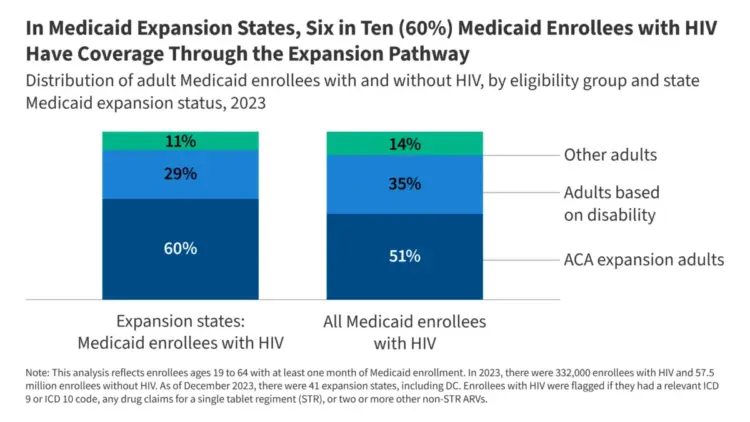
In states that elected to expand their Medicaid programs under the Affordable Care Act, expansion has become the predominant pathway to coverage for this population. By 2023, 60 percent of adults under the age of 65 living with HIV in expansion states obtained their coverage through the expansion pathway, directly subjecting them to the newly enacted work and community engagement requirements. Before states expanded Medicaid under the ACA, many individuals living with HIV lacked access to affordable healthcare coverage until their condition had progressed enough to qualify them for a permanent disability pathway. Consequently, many remained entirely uninsured—a dynamic that frequently delayed care until advanced illness set in, even though early coverage and treatment could have successfully warded off disability.
Hurdles in Qualifying for Medical Frailty Exemptions
The restrictive approach to determining medical frailty specified in the federal rule creates significant barriers for individuals with HIV seeking exemptions from work requirements. The regulation establishes a complex two-part test, classifying an individual as medically frail if they are blind or disabled, suffer from a substance use disorder, have a "disabling" mental disorder, experience a physical, intellectual, or developmental disability that limits their ability to perform one or more activities of daily living, or live with a "serious or complex" medical condition and can demonstrate that the condition directly impairs their ability to fulfill community engagement obligations.
While the rule explicitly lists HIV and AIDS as one of 19 example conditions that states may reasonably consider serious or complex, it simultaneously places a limiting caveat on the designation. Using HIV as an illustrative example, the guidance states that individuals with HIV or AIDS are medically frail only if they are determined to have a serious or complex medical condition that significantly impairs their ability to comply with community engagement rules, adding that this is less likely to be the case if the clinical acuity of their condition is well-managed and not severe.
Public health experts note the fundamental irony and danger of this standard: consistent access to antiretroviral medications, secured largely through Medicaid, is clinically necessary to manage HIV, prevent immune system collapse, avert severe illness, and ultimately save lives. To the extent that individuals with HIV lose Medicaid coverage due to work requirement enforcement—or simply because they fail to successfully navigate complex administrative reporting rules—their health status may deteriorate, driving them into more severe clinical states.
Overlapping Health Conditions and Co-morbidities
Despite the restrictive nature of the two-part test, many people with HIV may still qualify for a medical frailty exclusion if they present with overlapping chronic illnesses or co-occurring conditions that limit their functional capacity. Nearly three-quarters of people with HIV enrolled in Medicaid manage chronic health conditions other than HIV, compared to just 42 percent of Medicaid enrollees without HIV.
Furthermore, individuals living with HIV experience substantially higher rates of substance use disorders and mental health diagnoses than the general Medicaid population. Nearly one-quarter of people with HIV—23 percent—carry a substance use disorder diagnosis, compared to just 8 percent of Medicaid enrollees without HIV. Additionally, more than one-third, or 36 percent, of Medicaid enrollees with HIV have a diagnosed mental health condition, some of which meet the threshold for being considered disabling, compared to 16 percent of other Medicaid enrollees.
Disability rates are also markedly elevated within this cohort. Half of all likely Medicaid expansion enrollees living with HIV live with a disability, which includes functional impairments such as difficulty climbing stairs or dressing, or a formal stage III AIDS diagnosis.
Administrative Burdens and Verification Challenges
The federal rule requires state agencies to utilize existing claims and encounter data to automatically identify individuals who may qualify as medically frail. However, the regulation conspicuously fails to provide clear, standardized operational guidance on how states should assess whether a specific medical condition limits an individual’s ability to meet work and community engagement requirements.
States are tasked with maintaining an auditable list of diagnosis codes representing medically frail conditions, which may include HIV. However, state agencies retain broad discretion over the creation of these lists and may choose to incorporate only a fraction of available diagnostic codes for any given condition. For instance, Nebraska’s published list of ICD-10 codes, released prior to the state’s implementation of work requirements, included only a single code for HIV, a restriction that failed to capture all enrollees living with the virus.
Furthermore, the rule dictates that administrative diagnoses alone cannot suffice to determine medical frailty because of the statutory mandate to evaluate whether the condition impairs an individual’s capacity to work or perform community service. This requirement effectively eliminates the possibility of verifying medical frailty on an automated, ex parte basis, forcing state agencies to rely on alternative, more cumbersome verification mechanisms.
While the regulation suggests that states can utilize verifications from a broad range of treating medical providers—including clinical social workers—the administrative burden placed on clinics and clinicians is expected to be immense. The inclusion of clinical social workers could prove especially meaningful for patients with HIV, given that many receive comprehensive care through integrated clinics where support staff routinely assist with insurance navigation and compliance paperwork. However, the heavy reliance on data sharing, provider documentation, health screeners, and self-attestation raises acute privacy concerns and exacerbates historical barriers driven by social stigma.
Broader Public Health Implications
The dismantling of blanket state-level exclusions for people with HIV means that state Medicaid agencies and clinical safety-net providers will face severe administrative strain, escalating operational costs, and widespread coverage churn, disenrollment, or wrongful coverage rejections.
Previous research from KFF indicates that while roughly one-third of likely expansion enrollees with HIV were already working at least 20 hours per week and another 4 percent had dependents at home, the ongoing burden of documenting employment compliance or navigating complex medical frailty exemption processes threatens continuous coverage. Any disruption in insurance coverage risks immediate interruptions in life-sustaining medical treatment, which in turn elevates the clinical risk of disease progression, morbidity, mortality, and viral transmission.
Such outcomes directly conflict with federal public health targets outlined in the federal "Ending the Epidemic Initiative" and the strategic vision of the federal Ryan White Program. Public health data indicates that roughly four in ten new HIV transmissions originate from individuals who are aware of their HIV-positive status but are not currently retained in regular medical care. Treatment interruptions can also foster antiretroviral drug resistance, rendering future clinical management significantly more complex and expensive.
Moreover, if individuals with HIV lose their Medicaid coverage, many may be forced to seek alternative assistance through the federal Ryan White Program. This potential influx arrives at a precarious time, as state Ryan White programs across the nation are already grappling with severe budget crises driven by various funding pressures, turning potential Medicaid coverage losses into an unprecedented challenge for the nation’s HIV safety net.