In an era defined by rapid digital connectivity and shifting institutional landscapes, Americans navigate a complex and increasingly polarized ecosystem when seeking guidance on health, medicine, and wellness. Comprehensive polling data from KFF tracking health information, public trust, and emerging technologies reveal a profound reliance on traditional medical professionals coupled with deep-seated skepticism toward government health agencies, federal officials, and digital platforms. While doctors and health care providers remain the bedrock of reliable medical advice across demographic and political lines, public confidence in federal health leadership has fractured along partisan boundaries, creating an environment where health misinformation finds fertile ground in a "malleable middle" of undecided citizens.
Trusted Sources of Health Information
When it comes to finding reliable information about health issues, doctors and individual health care providers stand alone as the public’s most trusted source. A large majority of U.S. adults express at least "a fair amount" of trust in their personal physicians, a sentiment that transcends the deep political and cultural divisions currently marking American society. This universal reliance on personal care providers is mirrored across nearly every demographic group, including variations in age, gender, race, ethnicity, and education level.
In stark contrast, public trust in government health agencies and political officials is heavily divided. Roughly half of U.S. adults report trusting the Centers for Disease Control and Prevention (CDC) or the Food and Drug Administration (FDA) for reliable health information. However, trust drops significantly when looking at specific political figures. Fewer than half of the public express trust in state government officials, Health and Human Services Secretary Robert F. Kennedy Jr., or President Trump.
Partisanship heavily dictates these perceptions, particularly regarding political leadership. Approximately six in ten Republicans—rising to seven in ten or more among MAGA-supporting Republicans—place their trust in Secretary Kennedy or President Trump for reliable health information. Conversely, three in ten or fewer independents and Democrats say the same. Party lines also influence views on state government officials, where Democrats are more likely than Republicans to express trust. Meanwhile, trust in the CDC and FDA sees relatively similar shares across party identification, though individual providers remain the undisputed gold standard regardless of political affiliation.
Demographic nuances also shape where Americans turn. White adults and individuals with a college degree are more likely to express trust in their doctors or health care providers, a trend that may reflect underlying disparities in health care access. Education levels similarly influence trust in the CDC and state government officials, with college-educated adults displaying higher levels of confidence in these institutional bodies. Furthermore, White adults are more likely than their peers to express trust in Secretary Kennedy and President Trump for health guidance.
Confidence in Federal Health Agencies
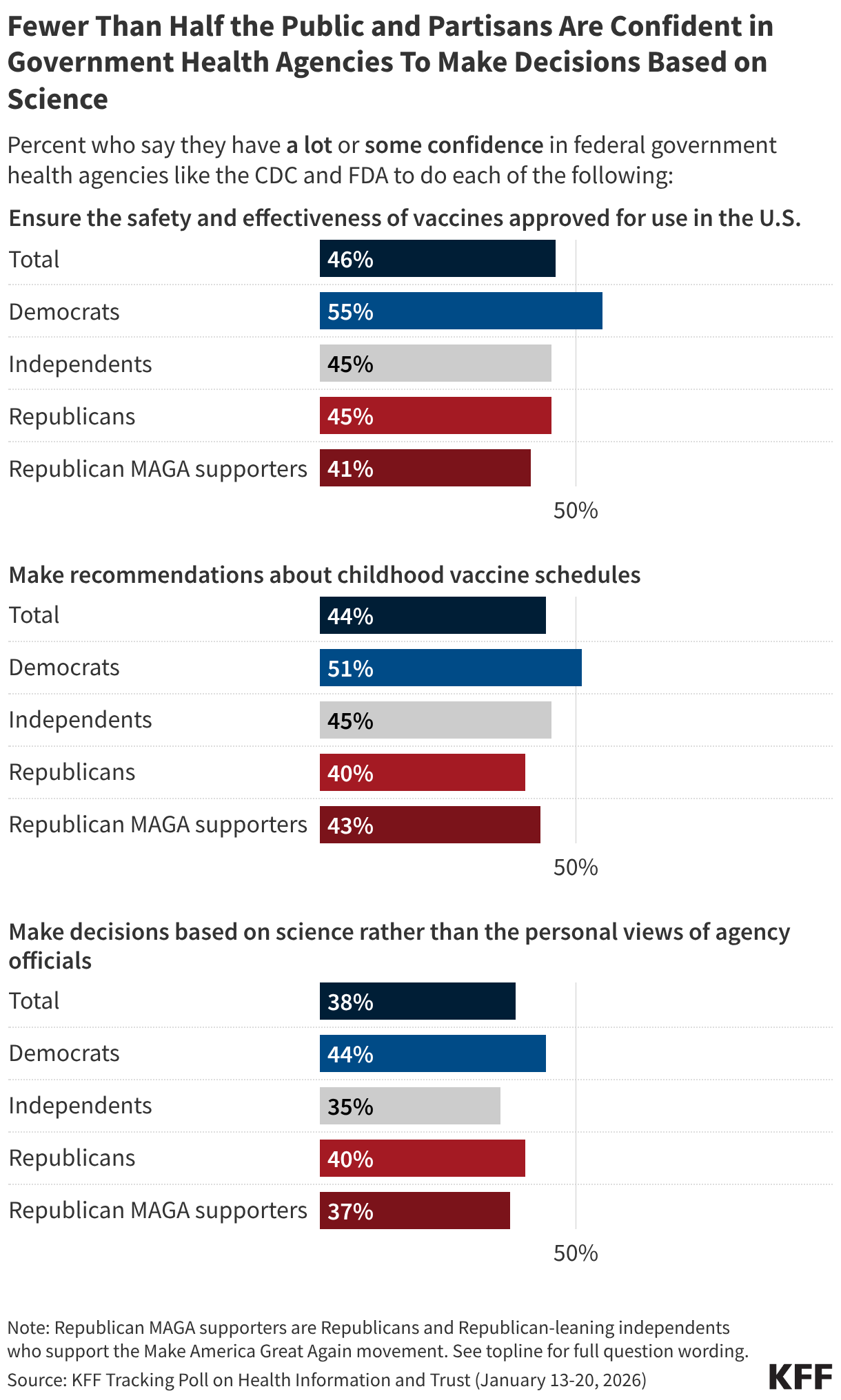
Beneath the question of where the public turns for information lies a deeper erosion of confidence in federal agencies to carry out their core responsibilities. Most of the public lacks confidence that agencies like the CDC or FDA can effectively manage key duties, such as ensuring vaccine safety and effectiveness or making objective recommendations about the childhood vaccine schedule.
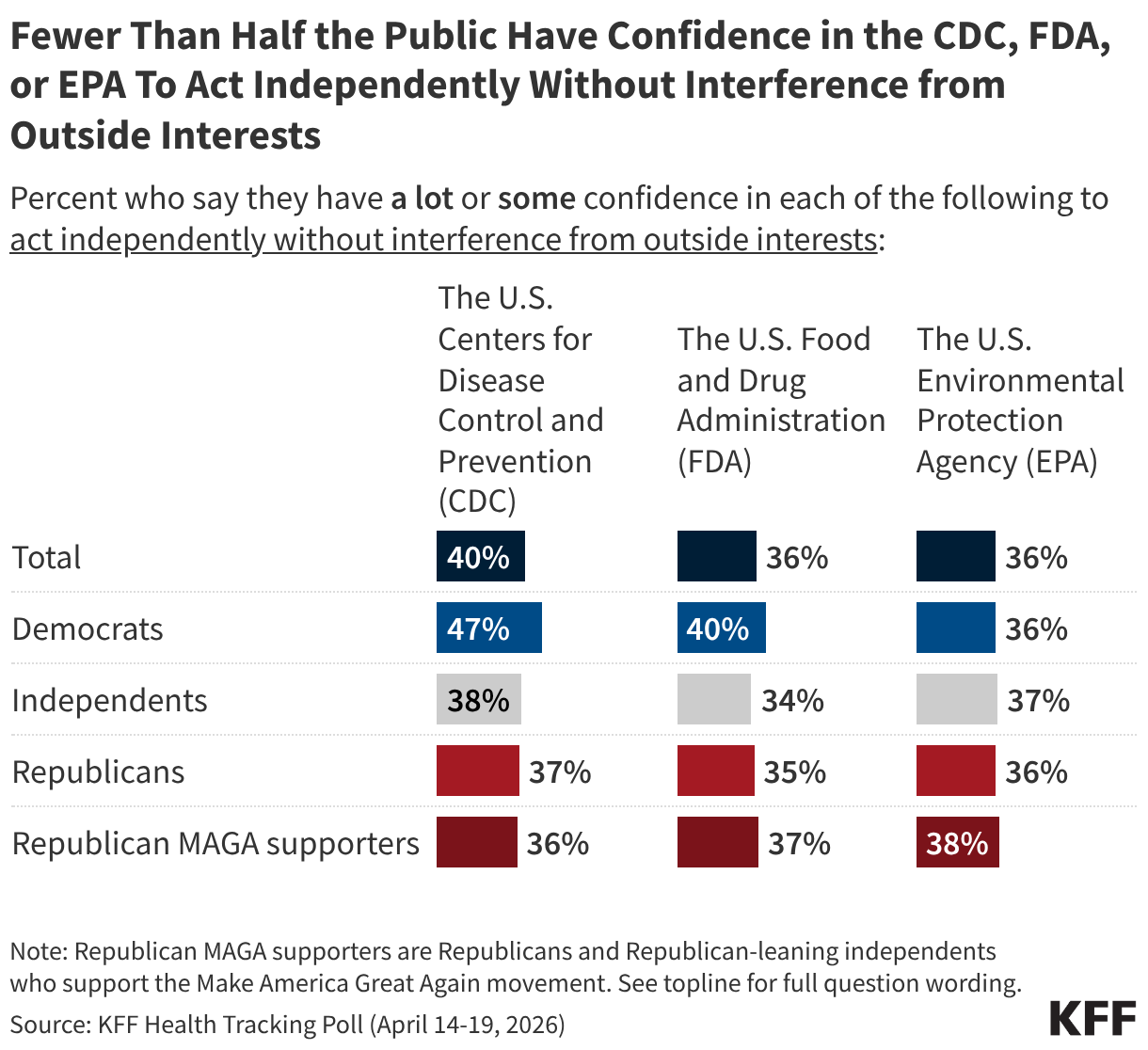
While Democrats are somewhat more likely than Republicans to maintain at least "some confidence" in government health agencies regarding vaccine oversight, skepticism remains high. Across the political spectrum, fewer than half of all adults express confidence that these federal bodies make decisions grounded strictly in science. Furthermore, less than half of the public and partisans express confidence in the CDC, FDA, or EPA to act independently without interference from outside interests. While Democrats show slightly higher confidence in the CDC’s ability to remain independent—with nearly half expressing trust—four in ten or fewer adults across the board believe the FDA or EPA operate free from external pressure.
This current climate of skepticism represents a sharp pivot from the early days of the COVID-19 pandemic. At the onset of the health crisis, high levels of bipartisan trust existed regarding information disseminated by the CDC. Over time, however, trust in the agency concerning COVID-19 and general vaccines declined amid widening partisan divisions, marked by steep drops among Republicans. Democratic trust in the agency has also declined significantly following political shifts, including the reelection of President Trump and the confirmation of Robert F. Kennedy Jr. as HHS Secretary. Today, just half of the public expresses trust in the CDC for reliable vaccine information, mirroring broader declines in trust across the FDA, state government officials, and local public health departments since 2020.
Among parents of children under age 18, pediatricians emerge as the single most trusted source of reliable vaccine information. Majorities also look to local public health departments, the CDC, and the FDA, while over half rely on friends and family. Far fewer parents express trust in Secretary Kennedy, pharmaceutical companies, or health and wellness influencers. Partisanship and political movements also leave an imprint here: while a majority of parents aligned with the Make America Great Again (MAGA) and Make America Healthy Again (MAHA) movements trust Secretary Kennedy on vaccines, even larger shares within those groups place their ultimate trust in their child’s pediatrician.
Social Media and Artificial Intelligence
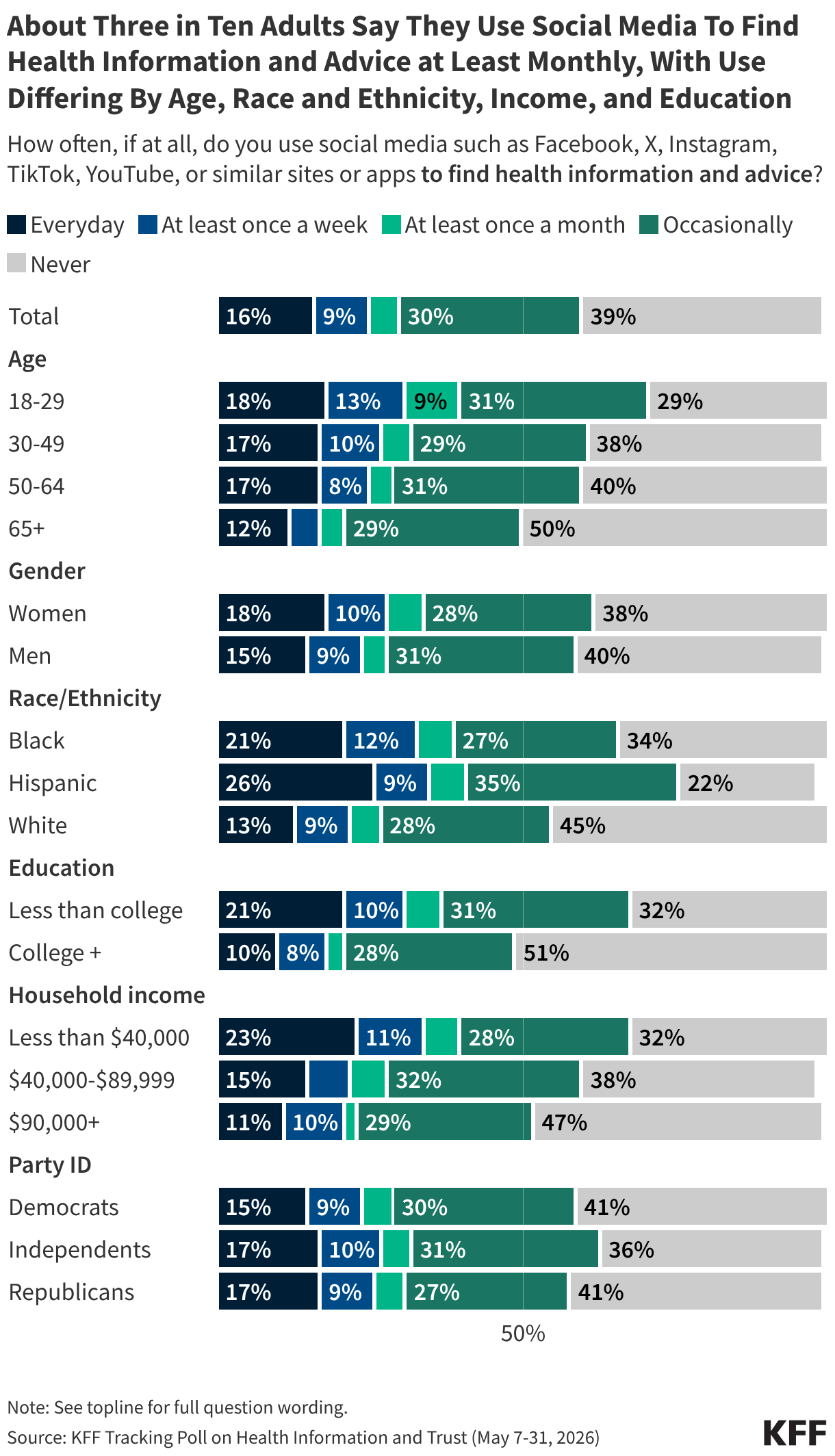
As traditional institutional trust shifts, Americans increasingly turn to digital landscapes for medical guidance. Roughly three in ten U.S. adults report using social media to find health information and advice at least monthly. This usage is particularly pronounced among younger adults, Black and Hispanic adults, lower-income individuals, and those with lower educational attainment.
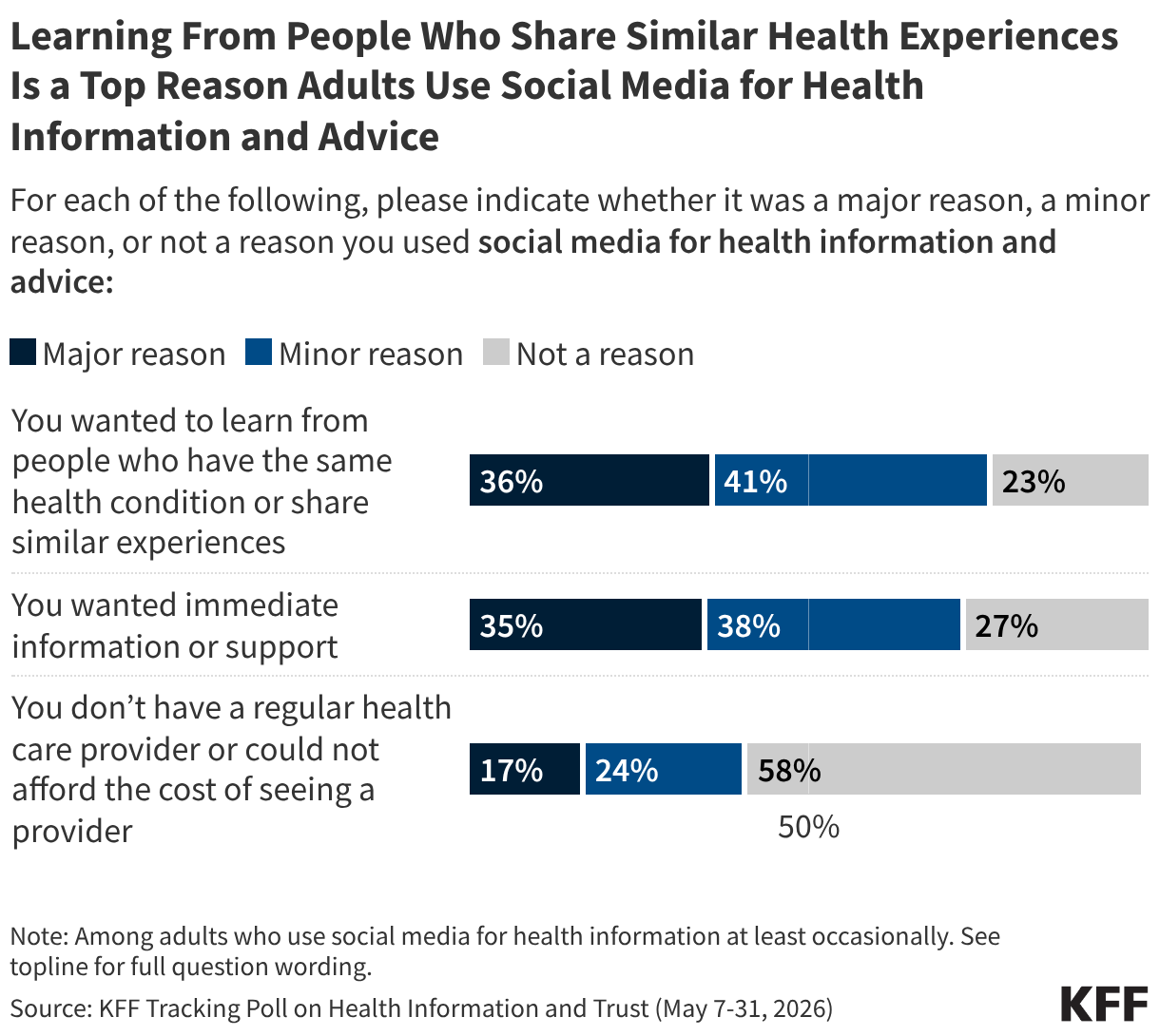
For many users, turning to social media is driven by a desire for community and immediate support. About one-third of adults who use social media for health information state that a major reason for doing so is wanting to learn from people with similar health experiences or needing immediate answers. Crucially, about one in six users cite difficulties accessing or affording traditional health care as a primary motivator for seeking guidance online.
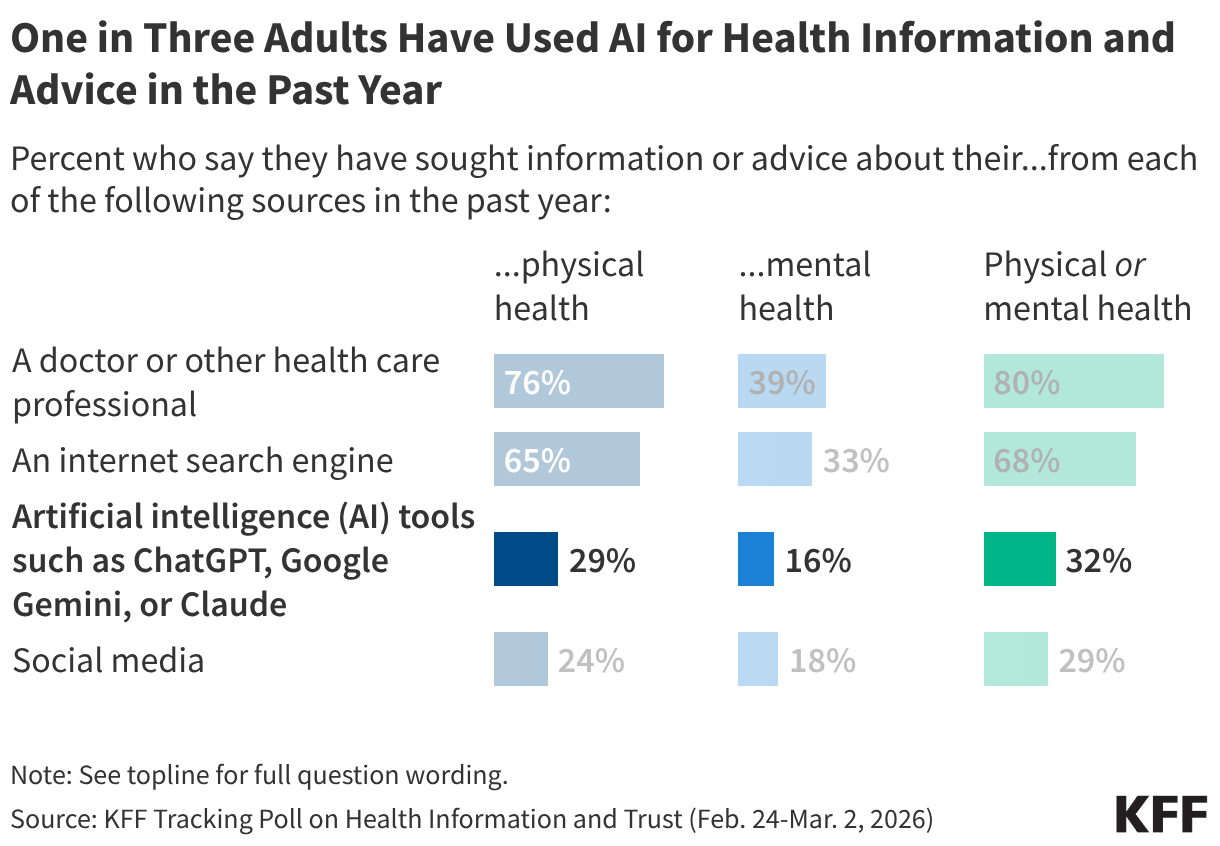
A parallel trend has emerged with artificial intelligence. Approximately 32 percent of the public reports turning to AI chatbots for health information and advice over the past year, rivaling social media as a resource, though still less common than relying on personal doctors or internet search engines. This includes roughly three in ten adults who have used chatbots for physical health inquiries and one in six who have turned to them for mental health guidance. Younger adults are more likely to utilize AI for these purposes, while uninsured adults and Black and Hispanic adults turn to AI for mental health advice at higher rates than insured adults and White adults.
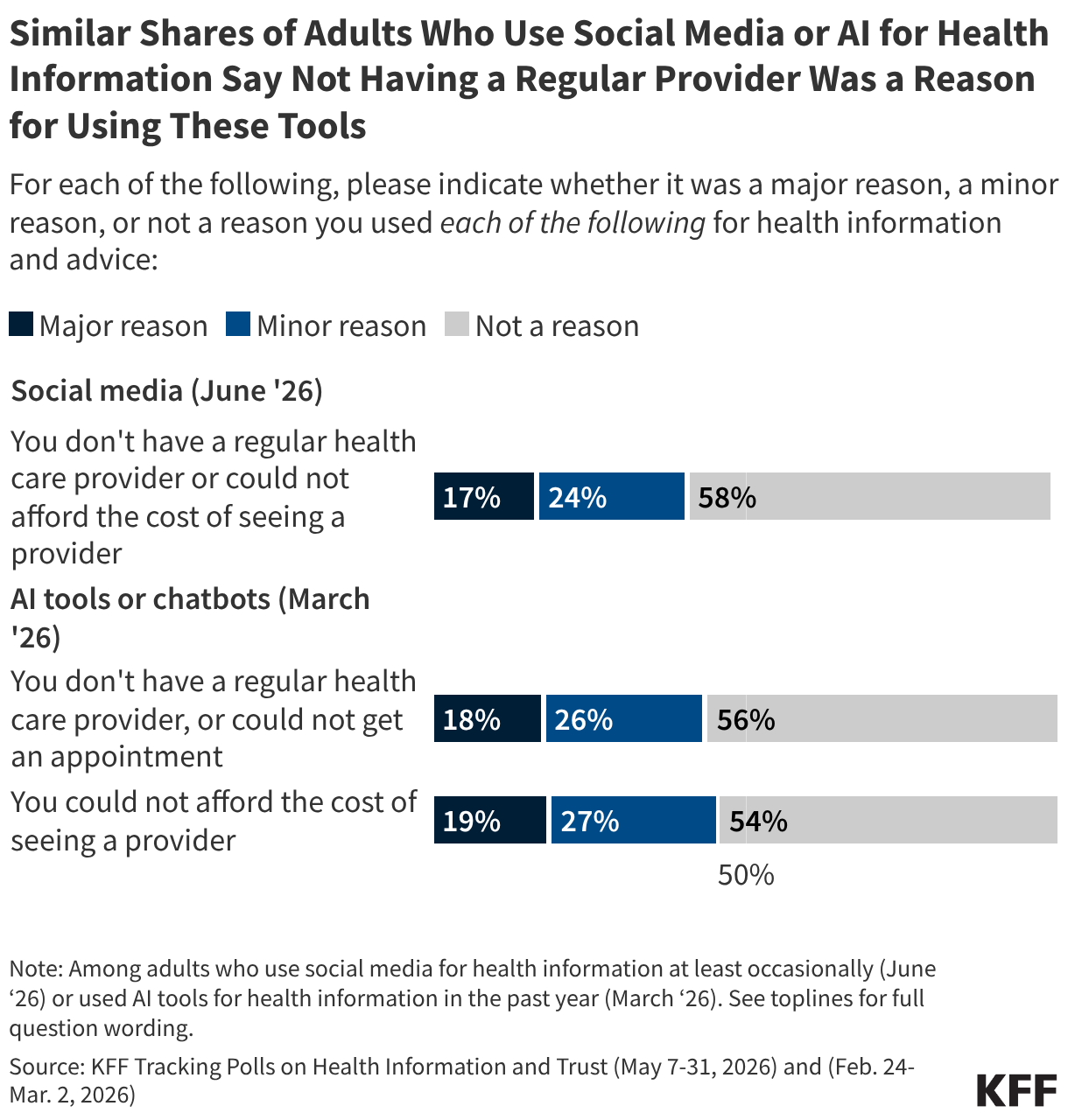
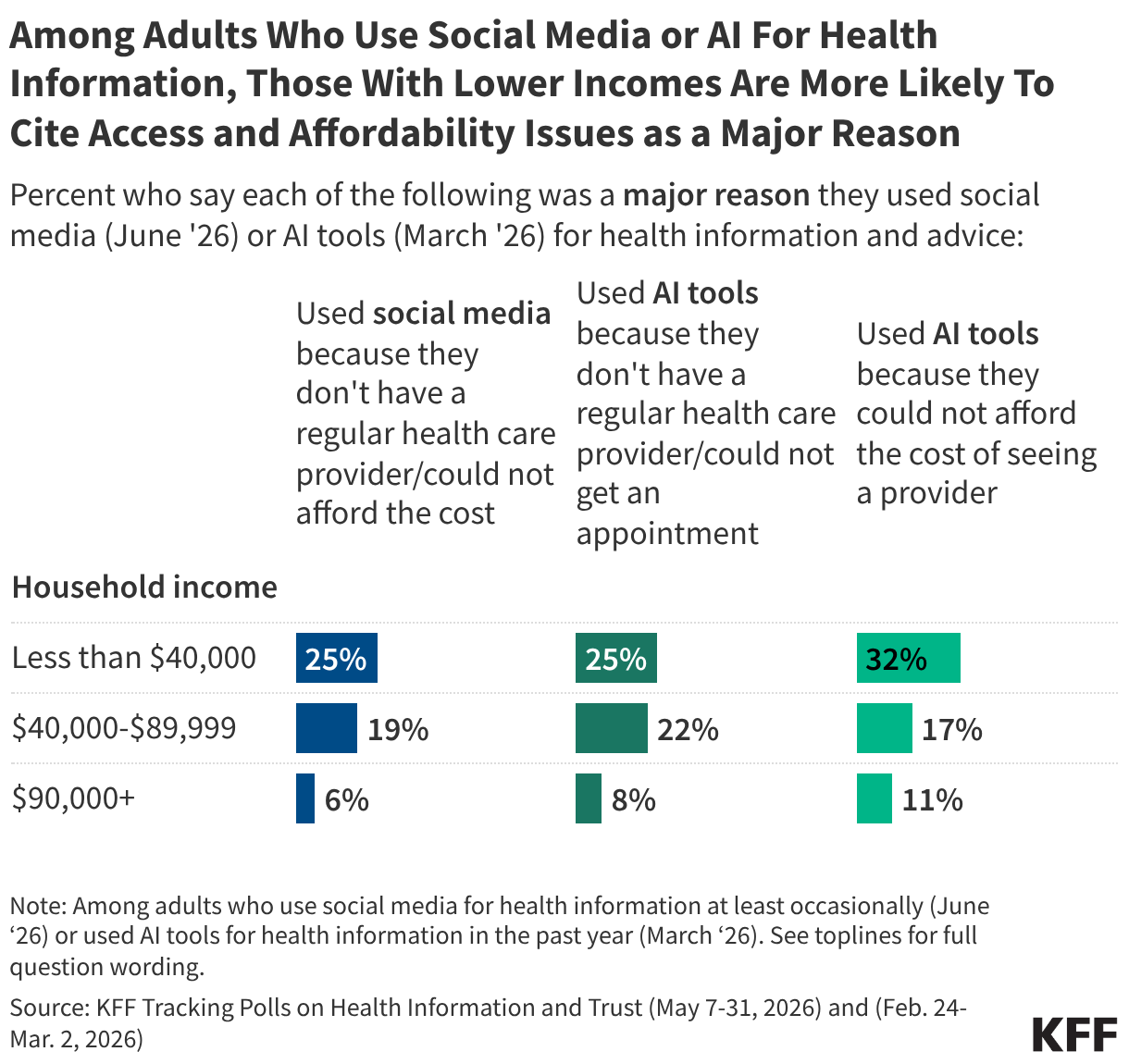
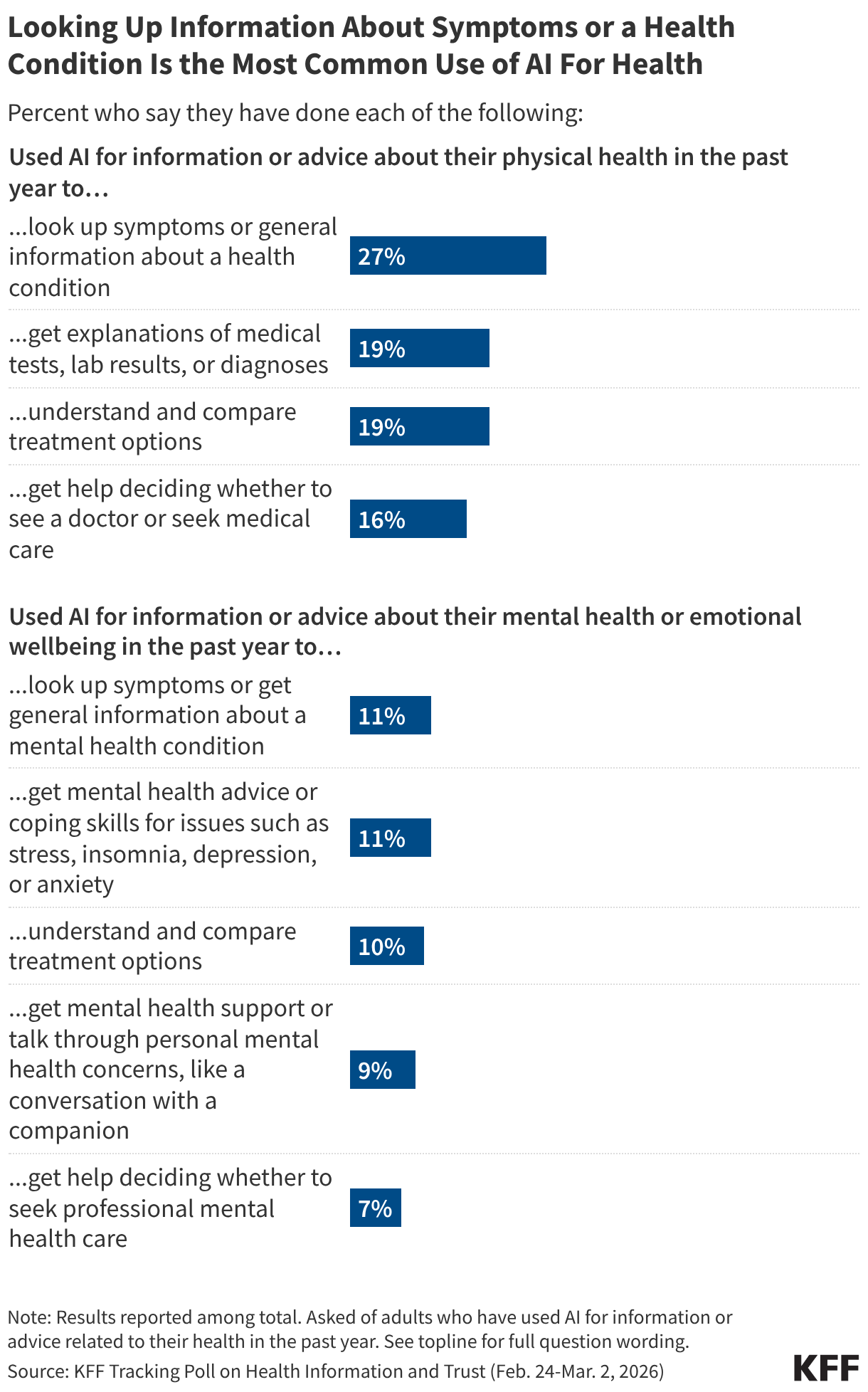
When using AI, people most commonly look up symptoms or general medical conditions rather than making definitive treatment decisions. Similar to social media users, those who utilize AI tools frequently cite the need for quick support or privacy, while one in five point to health care access and affordability barriers. Notably, while the general public expresses low trust in AI tools to provide reliable health information, those who actively use AI chatbots for health advice largely report trusting the tools to give them reliable information.
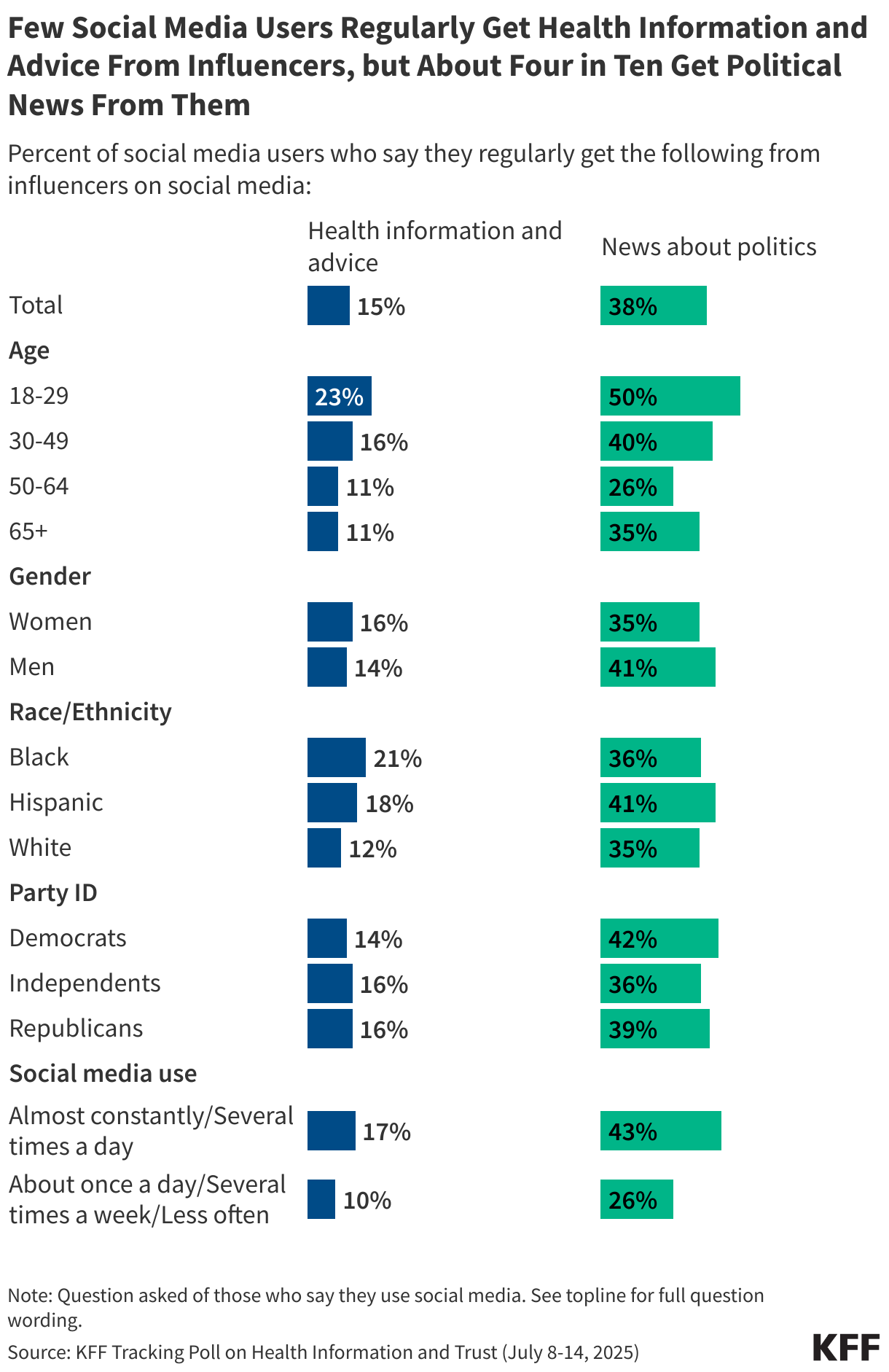
Despite high usage rates for digital tools, trust in health information found directly on social media platforms remains low, with fewer than half of users finding the content trustworthy. Younger users, however, tend to be more trusting of health content on platforms like TikTok, YouTube, Instagram, and Reddit compared to older generations. Furthermore, while four in ten social media users regularly turn to influencers for news and politics, only 15 percent rely on them for health advice, with reliance concentrated among younger adults, Black adults, and heavy social media users.
False or Unproven Health Claims
The coexistence of digital information-seeking and declining institutional trust has created a wide landscape for health misinformation. Exposure to unproven or false claims is widespread, yet relatively few adults express absolute certainty that these myths are true. Instead, a large portion of the public falls into what researchers term the "malleable middle"—individuals who view false claims as either "probably true" or "probably false." This widespread uncertainty spans topics ranging from COVID-19 and measles to broader vaccine myths and the purported causal link between taking Tylenol during pregnancy and autism.
KFF polling indicates that exposure to these claims fluctuates depending on the topic and the prominence of news coverage. For example, the claim regarding Tylenol use during pregnancy and autism—amplified during high-profile political press conferences—stands as one of the most widely recognized unproven claims tested in recent surveys. Across multiple evaluated myths, very few adults declare these assertions to be definitely true, but for most claims, at least half of the population remains on the fence in the malleable middle.
Belief in false health claims is heavily influenced by partisanship and educational attainment. Republicans and adults without a college degree are consistently more likely to believe or lean toward believing vaccine-related myths compared to Democrats and college-educated adults. Age, race, and ethnicity also play a role; adults aged 30 to 49 and Black adults are more likely to view certain vaccine-related falsehoods as true compared to older adults and White adults, respectively. Furthermore, individuals who frequently use social media or AI for health information, as well as those who lack a trusted regular health care provider, demonstrate higher susceptibility to misinformation.
Vaccine Attitudes and Safety Perceptions
Public attitudes toward vaccines reflect the broader interplay of trust, partisanship, and exposure to misinformation. A majority of U.S. adults—including majorities across political parties—express confidence in the safety of routine childhood vaccines such as the MMR, polio, and hepatitis B immunizations. Similarly, adults aged 50 and older display strong confidence in pneumonia and shingles vaccines. However, views on COVID-19 and flu vaccines remain sharply divided, with high confidence among Democrats contrasting with much lower trust among Republicans.
Among parents of children under 18, large majorities report keeping their children up to date on routine immunizations and express confidence in the safety of polio and MMR vaccines. Yet, polarization persists regarding seasonal and newer vaccine technologies. While about two-thirds of parents consider flu vaccines safe for children, fewer than half say the same about COVID-19 vaccines, with splits falling along partisan lines. Parents under age 35, Black parents, and supporters of the MAHA movement are also less likely to express confidence in routine childhood vaccine safety.
Approximately one in six parents report having skipped or delayed at least one routine childhood vaccine. Skepticism toward vaccine safety testing and federal recommendations is more common among younger parents and self-identified Republicans. Data indicates that parents who skip or delay vaccines are about twice as likely to believe false claims about measles and COVID-19 vaccines, highlighting the direct impact of misinformation on family health decisions.
Finally, newer medical technologies continue to face public uncertainty. Messenger-RNA (mRNA) technology, utilized in COVID-19 vaccines and several therapies under development, has frequently been the subject of misinformation. While few adults outright label mRNA technology as unsafe, the subject remains largely unfamiliar to the broader public, with roughly half stating they do not know enough about the technology to form an opinion.