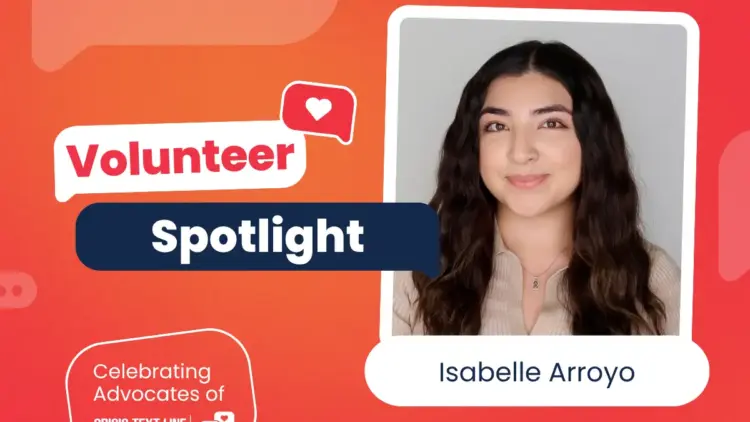
Sometimes a calling begins in the most ordinary place. For Isabelle Arroyo, it was a simple scroll through LinkedIn that ultimately changed the trajectory of her personal and professional life. That one digital discovery led her to Crisis Text Line, where she now serves as a dedicated volunteer Crisis Counselor, answering urgent text messages from individuals navigating some of the hardest and most vulnerable moments of their lives.
In this month’s volunteer spotlight, Isabelle shares the experiences that brought her to the platform, the philosophy that guides her interactions, and how she has learned that the smallest gestures—a simple greeting, a warm smile, or simply holding onto hope for someone else—can make all the difference.
Discovering Accessible Support
Reflecting on how she first encountered the organization, Isabelle explains that she stumbled upon Crisis Text Line while browsing LinkedIn. What immediately drew her attention was the exceptional accessibility of the service. She admired the fact that individuals experiencing a crisis could access vital support twenty-four hours a day, seven days a week, without the barrier of having to speak out loud on a telephone.
For many people dealing with acute distress, social anxiety, or unsafe environments, making a voice call can be an insurmountable obstacle. Isabelle recognized that text-based crisis intervention was a desperately needed resource in the modern world—one capable of quietly and effectively reaching anyone, anywhere.
Although she had never utilized the service herself prior to becoming a volunteer, Isabelle notes that if she had known about such an accessible resource during her own earlier years, it is undoubtedly a service she would have wanted to explore. Her introduction to the platform marked the beginning of a deep commitment to mental health advocacy.
The Motivation to Keep Showing Up
When asked what moment or ongoing experience reinforces her commitment to supporting people in crisis, Isabelle points to the fundamental nature of the work itself. Supporting someone through their darkest hour can leave a profound and lasting impression on both parties involved.
While Crisis Text Line provides short-term support, Isabelle understands that these brief digital interventions can offer a safe, non-judgmental space and, at times, a glimmer of light at the end of a long, dark tunnel. She firmly believes that every human being deserves to feel genuinely heard, deeply cared for, and appreciated.
Every time she logs on to begin a shift, Isabelle reminds herself of the profound, compounding impact that a small gesture can leave with a stranger. Holding onto hope for a person who lacks the strength to hold it for themselves is what keeps her moving forward. She describes herself as deeply passionate about being a voice for those who feel completely unheard by the world around them.
Demystifying the Role of a Crisis Counselor
The day-to-day responsibilities of a volunteer Crisis Counselor often involve nuances that the general public might not fully realize. Isabelle clarifies that their primary purpose is simply to listen actively and empathetically, ensuring that texters feel acknowledged and completely free from judgment. Alongside emotional support, counselors share practical resources that can guide texters toward further professional support and long-term healing.
To describe the essence of her role, Isabelle often uses a relatable analogy: she views a Crisis Counselor as the best friend you hope would listen when you need them most. Volunteers genuinely care about the wellbeing of their texters, even though they may never meet face-to-face. Behind the scenes, these volunteers also continuously look for ways to adapt, refine, and improve their support methods to better serve every single person who reaches out for help.
Personal and Professional Transformation
For the majority of her life, Isabelle knew that her ultimate professional aspiration was to become a therapist, driven by a natural inclination toward caring for others. However, she never anticipated the profound ways in which volunteering with Crisis Text Line would shape her, both professionally and on a deeply personal level.
Through her experiences on the platform, Isabelle’s perspective on suicide prevention has significantly expanded. She has come to realize that suicide prevention takes many different forms. It is not exclusively defined by large public presentations or major institutional events; rather, it often materializes in everyday micro-interactions. It lives in sharing a polite hello, offering a reassuring smile to a passing stranger, and taking the genuine time to get to know someone.
What Isabelle has learned most vividly is that people are rarely searching for complex solutions; more than anything, they simply want someone to show up for them. While she fulfills this need explicitly as a Crisis Counselor, she now carries that philosophy into her everyday life as a fellow human being. Volunteering has taught her how to listen with true empathy and how to serve as a beacon of light for individuals struggling in the shadows. She notes that the role has helped her evolve into a more positive, grounded person, qualities she strives to share with everyone she meets.
Breaking the Stigma of Mental Wellbeing
Supporting mental health and crisis intervention is a deeply personal mission for Isabelle. She points out that many people are raised—frequently without even realizing it—to carry a heavy stigma regarding their own mental wellbeing. Although society has begun to make tentative strides in recent years, there is still vast ground to cover.
Mental wellbeing is just as critical as physical wellbeing, yet individuals who are actively struggling often lack the internal strength required to advocate for themselves. Isabelle takes immense personal pride in acting as an advocate for those who temporarily cannot speak up for their own needs.
Her overarching hope is that society will eventually unite in a collective understanding of just how vital mental health truly is. She sees the long-standing stigma slowly beginning to fracture, and she believes that the day-to-day work performed by crisis intervention volunteers represents the foundational beginning of widespread social acceptance.
Every human being deserves the right to be here, to flourish, and to find accessible support during moments of acute vulnerability. Because the tragic impact of suicide ripples widely across families and generations, Isabelle holds fast to the knowledge that even the smallest, quietest actions can ultimately be the deciding reason someone chooses to stay. Whenever she is asked why she dedicates her time to this work, that conviction is what she holds onto.
Encouraging Prospective Volunteers
For individuals who feel a pull toward volunteering but worry they lack the proper skills or background, Isabelle offers reassuring perspective. She acknowledges that stepping into anything new is inherently daunting. What changes the dynamic, however, is the willingness to pursue a goal, adapt to new environments, and embrace personal growth.
Volunteering with Crisis Text Line operates on the exact same principle. As long as an individual arrives with a genuine desire to support people through difficult times, they will possess the innate motivation required to learn the role. Volunteers undergo comprehensive training, and Isabelle promises prospective applicants that they will naturally grow into the position until it becomes something they genuinely look forward to week after week.
One of the greatest strengths of the organization, according to Isabelle, is the robust support network provided to its volunteers. No one is ever left to navigate challenges alone. The organization fosters a welcoming, collaborative community space where volunteers can discuss experiences, learn continuously, and grow alongside one another. Furthermore, a dedicated team of professional staff members stands directly alongside volunteers during active conversations, offering real-time guidance and constructive feedback whenever requested.
The organization does not demand perfection from its volunteers; it simply asks that they show up consistently with empathy, patience, and compassion. Isabelle encourages anyone curious about the role to try it for themselves, noting that she looks forward to potentially welcoming new peers to the platform.
Even if formal volunteering ultimately proves not to be the right fit for everyone, Isabelle emphasizes that every individual still holds the power to participate in suicide prevention on any given day, at any time, and in any location. People have the capacity to be the stranger who creates meaningful, positive change in a fleeting moment. Ultimately, one can never truly measure the profound impact that can be achieved by simply choosing to care.