
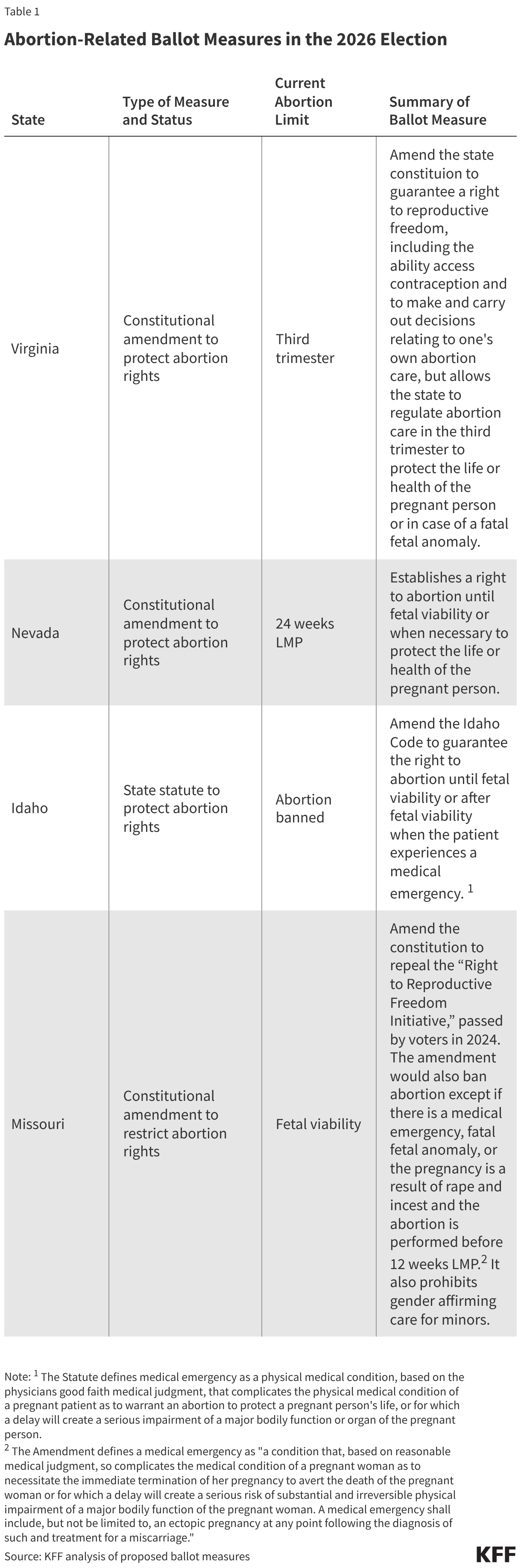
Since the United States Supreme Court handed down its landmark ruling in the Dobbs v. Jackson Women’s Health Organization case in 2022, state ballot initiatives have evolved into one of the most powerful and heavily contested tools in American politics. Advocates on both sides of the abortion debate have increasingly turned to direct democracy, aiming either to enshrine robust protections into state constitutions or to implement stringent limitations through legislative and citizen-referred measures. Successfully passing a ballot initiative that enacts a state constitutional amendment provides a much higher level of legal authority than standard laws enacted by state legislatures or rulings issued by state supreme courts. Over the past several years, voters in twelve states have approved ballot measures, primarily to safeguard reproductive rights within their borders. As the political landscape shifts toward the November 2026 midterm elections, voters in four states will once again face critical abortion-related measures at the ballot box.
Ballot Initiatives Seeking to Protect Abortion Rights
In the commonwealth of Virginia, the political battle lines are sharply drawn. Virginia currently stands as the only state in the American South that does not enforce a total ban on the provision of abortion or impose an early gestational limit, currently allowing the procedure up to the third trimester. Unless ongoing legal challenges succeed in blocking the measure, Virginia voters will decide this November whether to permanently enshrine these protections into the state constitution. Earlier this year, on February 6, 2026, Governor Spanberger signed legislation placing the Right to Reproductive Freedom Amendment on the ballot after it successfully cleared the state legislature in two successive legislative sessions, as required by Virginia law.
However, the pathway to the ballot has faced intense legal scrutiny. On March 3, 2026, a local county official filed a lawsuit seeking to block the measure, alleging that state election officials failed to properly distribute the constitutional amendment text to circuit clerks across all counties prior to certification. Although a district court judge subsequently dismissed the lawsuit with prejudice due to a lack of standing and because the underlying statute had been repealed, the Virginia Court of Appeals has faced further appeals challenging the measure’s placement. A separate lawsuit filed by medical advocacy groups and a local town council member similarly argues that the ballot language fails to accurately convey the legal impact of the amendment to voters. Despite these protracted legal battles, early voting in Virginia officially commenced on September 18, 2026.
If approved by voters, the Right to Reproductive Freedom Amendment would amend the state constitution to establish a fundamental right to abortion until the third trimester, alongside protections for contraception and fertility care. While the measure permits the commonwealth to regulate abortion procedures during the third trimester, it strictly prohibits outright bans if the life or physical or mental health of the pregnant person is at risk, or if the fetus is determined not to be viable. Supporters argue that passing the amendment will create durable, long-term protections that insulate reproductive healthcare access from future shifts in the political composition of the legislature or state courts.
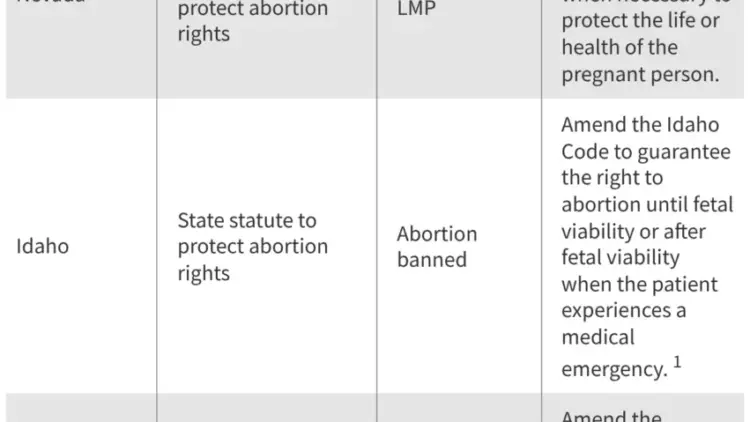
Meanwhile, citizens in Nevada are preparing to vote on the Reproductive Rights Amendment for a second time. Under Nevada law, citizen-initiated constitutional amendments must successfully pass in two consecutive general elections to take effect. Having been initially approved by voters in 2024, the measure returns to the ballot in November 2026. If passed, the amendment will guarantee all individuals the right to an abortion performed by a qualified health care provider up until fetal viability, or whenever necessary to protect the life or health of the pregnant patient, completely free from state interference.
Abortion is currently legal in Nevada up to 24 weeks of gestation, a status established by a 1990 voter-approved statute affirmation and reinforced by the 2019 Trust Nevada Women Act, which decriminalized medication abortion and removed mandatory informed consent laws. While the new constitutional amendment would codify protections well beyond existing statutes, any future legislative attempts to alter gestational limits would require direct approval from state residents rather than lawmakers. Furthermore, legal experts anticipate that if the amendment passes, advocates will immediately challenge Nevada’s revived parental notification law for minors, arguing it directly conflicts with the newly established constitutional rights.
In Idaho, the political climate reflects some of the strictest abortion regulations in the nation. The state currently enforces a near-total ban on abortion, with very narrow exceptions permitted only to prevent the death of the pregnant person or, during the first trimester, in reported cases of rape or incest. Seeking to dismantle these restrictions, a grassroots coalition known as Idahoans United for Women and Families organized a citizen-initiated statute known as the Reproductive Freedom and Privacy Act. Despite facing significant signature-gathering thresholds across multiple legislative districts, the Idaho Secretary of State officially confirmed in July 2026 that the initiative had gathered enough valid signatures to qualify for the November ballot.
The path to the ballot in Idaho was similarly fraught with fierce legal disputes over ballot wording. Organizers filed multiple lawsuits challenging the official short titles, financial impact statements, and explanatory statements drafted by the state attorney general and secretary of state, arguing that the language was politically biased and misleading. Following intervention by the Idaho Supreme Court, state officials were ordered to rewrite the ballot language to ensure a clear and concise presentation of the legal effects of both a "yes" and "no" vote. If passed by voters, the Act would establish a statutory right to reproductive healthcare, including abortion up to fetal viability and post-viability medical emergencies, alongside protections for contraception, fertility treatments, and prenatal care. However, political analysts note that because Idaho law permits the legislature to freely amend or repeal citizen-initiated statutes without restrictions, the law could face immediate legislative pushback even if approved by voters.
Ballot Initiatives Seeking to Curtail Abortion Rights
While several states are moving to protect access, Missouri presents a unique historical scenario where voters are being asked to reverse a recently enacted constitutional amendment. In 2024, Missouri voters approved Amendment 3, the Right to Reproductive Freedom Amendment, which successfully overturned the state’s previous total abortion ban by establishing a constitutional right to abortion until fetal viability. Following its passage, healthcare providers quickly filed lawsuits that successfully struck down the state’s total ban, though various regulatory hurdles, such as mandatory waiting periods and facility rules, remained subjects of ongoing litigation.
In response, anti-abortion state legislators and advocacy groups drafted a counter-measure for the 2026 ballot, also designated as Amendment 3, which seeks to completely repeal the protections put in place just two years prior. The 2026 initiative would re-impose a comprehensive ban on abortion with limited exceptions for medical emergencies, fatal fetal anomalies, and early-stage pregnancies resulting from rape or incest. It also includes parental consent requirements for minors, blocks public funding for abortions, and explicitly authorizes the legislature to enforce stringent licensing, inspection, and physician-credentialing rules on clinics.
The 2026 repeal initiative has also drawn intense legal challenges. The American Civil Liberties Union of Missouri filed a lawsuit arguing that the proposed ballot language was deceptive, failed to inform voters that a "yes" vote would repeal existing rights, and violated state rules by combining multiple unrelated subjects, including a ban on gender-affirming care for minors. The Missouri Western District Court of Appeals ultimately ruled that the original summary was inadequate and certified revised language for the November 2026 ballot. This marks the first time in U.S. history that voters will decide whether to repeal a state constitutional amendment specifically protecting abortion rights.
The Complex Reality of Existing Restrictions Following Constitutional Amendments
The ongoing legal battles in Missouri mirror experiences in other states where voters previously approved constitutional protections, such as Arizona and Ohio. In these states, while courts quickly moved to block pre-existing total bans and major gestational limits following the passage of new constitutional amendments, challenges to secondary regulations—such as mandatory waiting periods, telemedicine restrictions, and facility-specific rules—have proven considerably more complex and drawn out.
In Arizona, where voters passed Proposition 139 in November 2024 to establish a constitutional right to abortion until viability, state courts subsequently struck down a 15-week gestational ban and blocked several other restrictions, including telemedicine prohibitions and mandatory waiting periods. Nevertheless, other regulations remain firmly in place, such as prohibitions on public funding for abortion through state programs and statutory requirements that restrict the provision of abortion care exclusively to licensed physicians. Legal groups continue to challenge these remaining physician-only restrictions in court.
Similarly, in Ohio, where voters overwhelmingly approved Issue 1 in November 2023 to secure comprehensive reproductive rights, courts issued permanent injunctions blocking the state’s restrictive six-week abortion ban. Yet, state laws requiring parental consent for minors and barring public funding continue to be enforced, while other administrative documentation requirements wind their way through the judicial system.
Options for Future Citizen-Referred Ballot Measures Are Limited
The broader landscape for direct democracy regarding abortion access remains heavily constrained across the United States. Citizens possess the legal mechanism to propose constitutional amendments via ballot initiatives in only seventeen states. Among states currently enforcing total or near-total bans on abortion, Arkansas and Oklahoma permit citizen-initiated constitutional amendments but have yet to successfully place a protective measure before voters. In Arkansas, an ambitious effort to secure a ballot spot was rejected by state officials over signature-gathering technicalities, a decision later upheld by the Arkansas Supreme Court. Meanwhile, a similar citizen-led effort in Oklahoma was withdrawn before signature collection could begin.
Other states have encountered high electoral hurdles. During the 2024 elections, abortion rights amendments failed to reach the required thresholds in Florida, Nebraska, and South Dakota. While Nebraska voters approved a competing measure restricting abortion after the first trimester and South Dakota’s measure fell short, Florida’s initiative garnered 57 percent of the vote. Because Florida state law requires a demanding 60 percent supermajority threshold for constitutional amendments to pass, the popular vote fell just three percentage points short, leaving supporters to weigh future attempts to overturn the state’s strict six-week ban.
Conversely, in states where abortion access is already heavily protected by statute or judicial precedent, very few possess the formal mechanism for citizen-initiated constitutional amendments. Observers note that in the current political and legal climate, the introduction of new citizen initiatives aimed at weakening existing abortion protections in these sanctuary states remains highly unlikely. As the November 2026 midterms approach, the eyes of the nation remain fixed on Nevada, Virginia, Idaho, and Missouri as crucial testing grounds for the future of reproductive rights in America.



