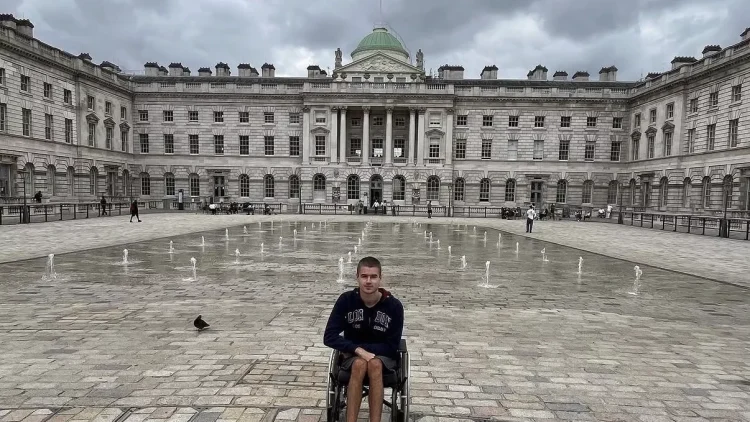
In 2016, Liam Virgo was an active, healthy 13-year-old living an ordinary childhood. Within days, however, his life altered drastically when a sudden neurological breakdown left him completely paralyzed, unable to speak, and confined to a hospital bed. Diagnosed with a severe case of Functional Neurological Disorder (FND)—a condition he describes as his brain’s internal software suddenly crashing without warning—Virgo faced years of complex recovery and severe physical limitations. Today, he has transformed that experience into a campaign of advocacy and urban exploration, documenting his travel experiences across more than 120 towns and cities throughout the United Kingdom and sharing practical insights with global accessibility platforms like WheelchairTraveling.com.
Virgo’s journey offers a unique vantage point on both the personal realities of living with a sudden, severe disability and the practical state of physical accessibility across modern and historic urban environments. By sharing his path from being bedbound in a hospital room to navigating major UK metropolitan centers, Virgo aims to reframe public perceptions surrounding wheelchair use, raise awareness about FND, and highlight the systemic infrastructure barriers that still prevent full societal inclusion for disabled individuals.
A Sudden Diagnosis and the Reality of Functional Neurological Disorder
The onset of Virgo’s condition in 2016 was as swift as it was disorienting. At 13 years old, he experienced a complete shutdown of his body’s motor and verbal functions over a matter of days. He described the initial phase of the condition as feeling like a prisoner within a body that had ceased to respond to his mind’s commands. The sudden loss of mobility and speech was accompanied by a severe cognitive overload, leaving him hospitalized for months under intense medical observation.
During the early stages of his hospitalization, Virgo experienced profound cognitive disruption. For approximately six months, his mind essentially switched off, leaving him unable to recognize people, surroundings, or basic objects. He noted that life prior to the onset of the disorder became largely a blur, while the initial months following his diagnosis remained mostly unremembered due to the severity of the neurological trauma.
The physical manifestations of his FND rendered him completely bedbound and unable to sit upright without experiencing extreme pain. Standard seating equipment and adaptive mobility gear proved unusable during this period, as his body could not tolerate any position other than lying flat in a specialized hospital bed. For an extended period, his physical environment was confined entirely to his immediate clinical surroundings, with no suitable wheelchair options available to accommodate his condition.
Motivation as Medicine: The ‘London Dream’
Confronted with the overwhelming reality of severe physical impairment, Virgo sought a psychological anchor to help sustain him through his medical care. That anchor emerged in the form of a personal goal: visiting the city of London. What initially began as a simple desire to visit the capital quickly evolved into a core component of his long-term rehabilitation strategy.
Virgo made a firm promise to himself during his darkest moments in the hospital that if he could recover enough physical function to leave his bed, he would travel to London. This goal, which he referred to as his "London Dream," provided a focal point for his physical therapy and cognitive rehabilitation. Rather than viewing his grueling daily exercises as a repetitive chore, having a concrete destination transformed his recovery into a clear, purposeful mission.
The physical turning point arrived three years after his initial diagnosis. Following extensive medical work and physical adaptation, Virgo reached a state where he was well enough to sit in a customized wheelchair for the first time. Transitioning into the chair marked a monumental shift in his independence, serving as the physical mechanism that enabled him to finally fulfill his goal of exploring London.
Navigating the Capital: Urban Accessibility and Practical Insights
Upon reaching London, Virgo began documenting the realities of navigating one of the world’s major historical capitals from a wheelchair user’s perspective. While London is an ancient city defined by historical architecture, Virgo noted that ongoing modernization efforts are steadily transforming it into one of the most accessible major cities in the United Kingdom.
During his exploration of the capital, Virgo paid close attention to how modern infrastructure integrates with historical built environments. He observed that while newly constructed areas and public developments frequently incorporate universal design principles, older historic districts present distinct navigation challenges. His ground-level observations highlighted the evolving nature of London’s transit, pedestrian pathways, and public facilities, offering a realistic look at what disabled visitors must navigate when touring the city.
Accommodation and Dining Insights from the Ground
A crucial element of Virgo’s travel experience was identifying accessible accommodation and dining infrastructure capable of supporting a full-time wheelchair user. During his stay in London, Virgo resided at the Park Plaza County Hall, located near the South Bank and Waterloo transport hubs. He selected the location for both its physical accessibility features and its proximity to major cultural destinations.
Virgo noted that the hotel offered spacious accessible rooms designed to provide ample maneuvering room for a wheelchair. Key physical features included step-free access throughout the main lobby and elevator systems, alongside roll-in wet rooms equipped with fixed grab rails to ensure safety and independence. He emphasized that supportive and accommodating hotel staff played an equally important role in ensuring a stress-free environment during his stay.
When navigating London’s food and beverage landscape, Virgo discovered a clear structural divide between modern architectural projects and historical properties. Dining establishments situated within contemporary developments—such as the South Bank, Central London, Canary Wharf, and Stratford—generally offered seamless, step-free entrances and accessible indoor layouts, particularly among larger corporate and chain venues.
Conversely, independent restaurants and venues located within historic buildings frequently presented structural barriers. The most common physical obstacle encountered was the presence of a single entrance step, which, despite its small size, presents an insurmountable barrier for an unassisted wheelchair user. To mitigate these infrastructure gaps, Virgo recommended that disabled travelers call venues directly prior to visiting or examine entrance conditions in advance using tools like Google Street View.
Beyond London: Expanding Horizons Across 120 Cities
While reaching London represented the fulfillment of Virgo’s primary rehabilitation goal, it ultimately served as the starting point for a much broader journey of physical recovery and geographical exploration. Having successfully regained his voice and developed the physical capacity to travel via wheelchair, Virgo expanded his travel ambitions beyond the capital.
Since his initial recovery milestones, Virgo has traveled to more than 120 towns and cities across the United Kingdom. His travels have taken him to major metropolitan areas, historic regional hubs, and coastal locations, including Manchester, Leicester, Birmingham, Leeds, Liverpool, Edinburgh, Cardiff, and Brighton. Each destination provided additional opportunities to evaluate local public infrastructure and promote adaptive travel solutions.
Looking toward the future, Virgo aims to expand his travel scope beyond the borders of the United Kingdom. His next major objective is to undertake international travel to Cyprus, a journey intended to help him connect directly with his family heritage while continuing to push the boundaries of his personal mobility.
Reframing Disability and Advocating for Universal Inclusion
Through his personal account and ongoing travel advocacy, Virgo seeks to challenge prevailing societal attitudes regarding physical disability and mobility equipment. He strongly rejects the notion that a wheelchair represents a limitation, arguing instead that adaptive equipment serves as a primary tool for freedom, independence, and personal mobility.
Virgo emphasizes that the fundamental barriers facing disabled individuals stem not from their medical diagnoses or mobility devices, but rather from built environments that fail to prioritize inclusive design. Inaccessible infrastructure—such as steep outdoor steps, broken public elevators, and architectural layouts that omit step-free access—continues to represent the primary obstacle to community integration and independent travel.
By continuing to document his journeys and share detailed travel reviews online—primarily through his Instagram account, @liamloveslondon—Virgo aims to elevate public understanding of Functional Neurological Disorder while lobbying for broader accessibility improvements across public infrastructure. His ongoing efforts highlight the crucial role that motivation, adaptive technology, and inclusive urban planning play in empowering individuals with complex neurological conditions to live full, independent lives.