Vermont has officially made history for its medical and patient advocacy communities. On May 13, 2026, the Vermont Legislature successfully passed H.46, landmark legislation establishing a dedicated Rare Disease Advisory Council (RDAC). Governor Phil Scott signed the bill into law, ensuring that the estimated 64,000 Vermonters currently living with rare conditions will finally have a permanent, formalized voice within state government operations.
The newly created council is designed to bridge the persistent communication gap between the rare disease community and state policymakers. A Rare Disease Advisory Council is an official state advisory body—established either through state legislation or executive authority—that brings together a diverse coalition of patients, family caregivers, healthcare providers, specialized researchers, and industry stakeholders on a regular basis. By fostering ongoing dialogue, these councils are tasked with identifying complex systemic challenges and developing practical, targeted solutions that directly affect the state’s rare disease population.
With the enactment of H.46, Vermont has officially joined a rapidly expanding national movement aimed at guaranteeing that rare disease communities secure an enduring seat at the table in state capitals across the United States. While the rare disease community is remarkably diverse, it is united by a complex and unique set of administrative, financial, and medical hurdles. These obstacles are frequently exacerbated by well-intentioned public policies that fail to account for the day-to-day realities and specialized needs of patients and their primary caregivers.
By serving as an official advisory body, the Vermont RDAC is uniquely positioned to address these disparities. The council is structured to reflect the specific landscape of the state, incorporating key institutional appointees from prominent regional organizations, including the Vermont Pharmacists Association and the Vermont Medical Society. Furthermore, housing the RDAC directly within the Vermont Department of Health grants the council vital administrative backing, giving members direct access to agency resources and professional staff whose daily work intersects with the rare disease sector. Among its extensive authorities, the council holds the formal power to conduct public hearings, gather comprehensive testimony, and formally receive comments from individuals directly impacted by rare conditions in order to uncover and address critical gaps in state health services.
A Victory Years in the Making
This monumental policy victory did not materialize overnight. Instead, it was the culmination of a rigorous, multiyear grassroots campaign spearheaded by the Vermont RDAC Coalition. Organized primarily under the guidance of the National Organization for Rare Disorders (NORD), the coalition brought together an alliance of passionate patients, dedicated family members, frontline clinicians, and specialized advocacy organizations who shared a single, unifying vision: to give Vermonters impacted by rare diseases a formal, permanent voice in state governance.
The foundation for this legislative triumph was laid in January 2024, when the coalition convened for its very first official meeting. From that moment forward, NORD worked closely with regional advocates to design and execute a highly coordinated grassroots strategy designed to build political momentum for an independent Vermont RDAC. Over the course of the subsequent two years, members of the coalition traveled extensively across the state. They dedicated their time to sharing deeply personal stories, providing expert legislative testimony, engaging in direct meetings with state lawmakers, participating in organized advocacy days, and raising public consciousness through coordinated Rare Disease Day activities.
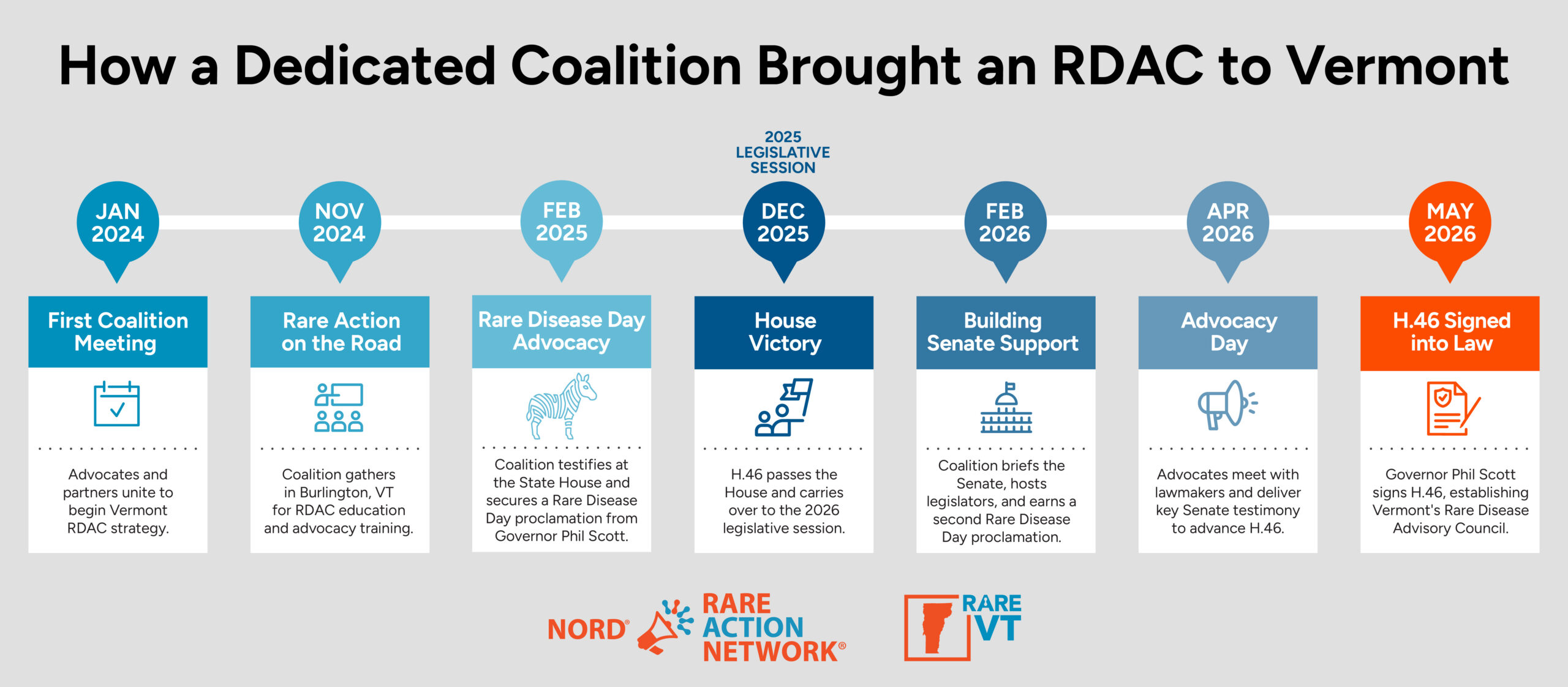
The persistence, resilience, and sustained dedication of the coalition finally culminated on that decisive day in May 2026 when Governor Scott signed H.46 into law. Leaders of the movement note that the passage of the bill was not the result of a single advocacy day or one pivotal conversation in the halls of the statehouse. Rather, it was the direct product of years of consistent community engagement, meticulous policy collaboration, ongoing legislative education, and deep relationship-building forged between advocates and elected officials. Together, the members of the coalition demonstrated the undeniable power of a unified grassroots movement, ultimately securing a formal state investment in the health, well-being, and future of Vermont’s rare disease community.
Personal Stories That Drove Change
At the very heart of this historic legislative victory are the courageous individuals who chose to step forward and share their lived experiences with rare diseases directly with lawmakers. Personal testimony possesses a unique and transformative power in the legislative process; it humanizes complex policy debates, translates abstract statistics into compelling narratives, and vividly illustrates the human impact of government decisions on individuals, families, and local communities. By speaking openly about the hurdles they face, these advocates helped state legislators comprehend the profound challenges experienced by people living with rare conditions and their caregivers, making a clear and undeniable case for why a formal voice in state government is so desperately needed.
Reflecting on their experiences testifying in support of H.46, several members of the Vermont RDAC Coalition shared how the advocacy process impacted them personally. Sarah E. recalled the initial apprehension of addressing state leaders, noting that the experience ultimately revitalized her lifelong commitment to service.
"While it seemed daunting to hold the attention, even briefly, of our state’s leaders, giving my testimony on rare disease to the House Human Services committee in February of 2025 was an enriching and empowering experience that reignited the passion for helping others that I’ve always held close to my heart," Sarah said. "The encouragement from the committee for our participation is something everyone deserves to feel, and I believe it’s important that individuals understand their value in our communities on every level."
For Katie P., the journey of sharing her personal story proved to be a powerful exercise in vulnerability and self-discovery.
"The most memorable part of sharing my testimony was knowing how much I have grown as a person, knowing how much my story could have encouraged someone else, and allowing myself to be vulnerable," Katie reflected. "I felt nervous before I spoke, but as I spoke, I felt confident and knew how much I had changed. Once I started speaking, most of my fears fell to the side and I felt empowered. My biggest takeaway is that using your voice is powerful and that sharing your testimony is freeing, courageous, and from that we can create connections and inspire others."
Sharon R., who lives with the rare autoimmune condition Pemphigus Vulgaris, found that speaking before the Vermont State Senate Health Committee offered an unexpected opportunity to deepen the conversation with lawmakers.
"Speaking before the Vermont State Senate Health Committee was empowering for me as a person with a rare disease," Sharon shared. "My favorite part was when I had finished my two-minute prepared statement, and they said to me, ‘Tell us more.’ So I did!"
Take Action Today
The successful passage of H.46 serves as a powerful testament to the fact that sustained, grassroots advocacy can drive meaningful, systemic change within state government. Organizers emphasize that individuals do not need to be professional policy experts or seasoned lobbyists to make a tangible difference in the lives of rare disease patients. There remain numerous ongoing opportunities for community members to lend their time, unique talents, and voices to support the continued growth and protection of the rare disease community across Vermont and the broader nation.