Vermont has officially made history for its medical and patient communities. On May 13, 2026, the Vermont Legislature successfully passed H.46, landmark legislation that establishes an official Rare Disease Advisory Council (RDAC). The new law marks a monumental turning point for the estimated 64,000 Vermonters living with rare diseases, guaranteeing them a permanent and formal voice within the state’s government structures.
The passage of H.46 positions Vermont alongside a rapidly expanding national movement dedicated to ensuring that the rare disease community is no longer overlooked in policy decisions. A Rare Disease Advisory Council functions as an official state advisory body—created either through legislation or executive authority—designed to bridge the gap between affected individuals and government leaders. By bringing together a diverse coalition of patients, family caregivers, healthcare providers, medical researchers, and various industry stakeholders on a regular basis, these councils identify systemic healthcare challenges and help develop practical, state-level solutions.
The rare disease community is characterized by its incredible diversity and a uniquely complex set of medical, financial, and emotional challenges. These hurdles are frequently exacerbated by public policies and healthcare frameworks that fail to account for the specialized needs of patients and their caregivers. By acting as an official conduit to state government, the newly established Vermont RDAC will work to dismantle these barriers, improve healthcare delivery, and streamline access to necessary resources.
Each state-level RDAC possesses a unique structure, membership composition, and operational scope tailored to its local population. Vermont’s version has been carefully designed to effectively represent its citizens through specific structural elements. Crucially, the council’s membership will include official appointees from esteemed local organizations, including the Vermont Pharmacists Association and the Vermont Medical Society, ensuring that frontline medical professionals have a direct hand in shaping policy recommendations.
Furthermore, the Vermont RDAC will be housed directly within the Department of Health. This strategic placement grants the council immediate access to vital agency resources, administrative backing, and staff members whose daily professional focus aligns closely with the rare disease landscape. In addition to these institutional advantages, the council is endowed with a broad range of operational abilities, most notably the power to conduct public hearings. Through these hearings, the council can actively receive comments from individuals and families affected by rare diseases, allowing them to pinpoint critical gaps in state services and advocate for targeted improvements.
A Victory Years in the Making
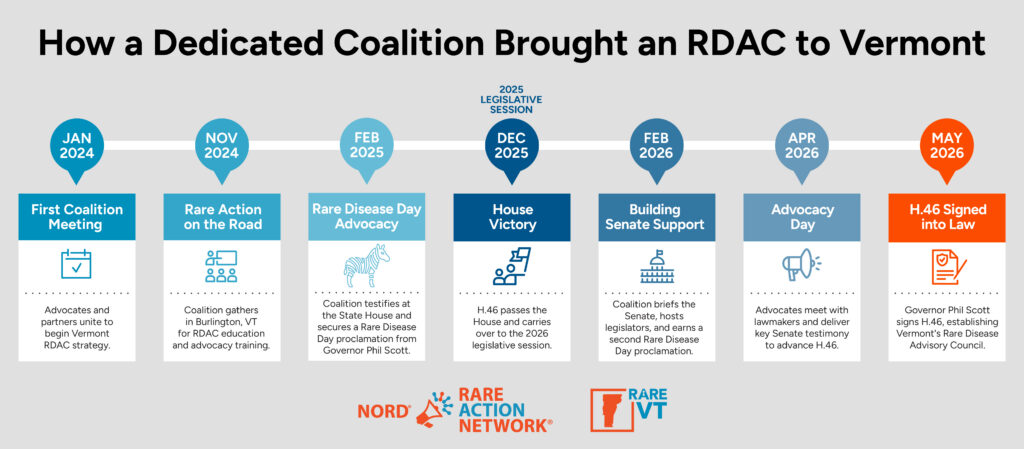
This legislative triumph was far from an overnight success; rather, it was the culmination of a rigorous, multiyear campaign spearheaded by the Vermont RDAC Coalition. Organized by the National Organization for Rare Disorders, the coalition brought together a dedicated network of patients, families, caregivers, clinical professionals, and advocacy organizations. Despite coming from various backgrounds, this diverse group was united by a single, powerful goal: to ensure Vermonters impacted by rare diseases finally secured a formal, influential voice in state government.
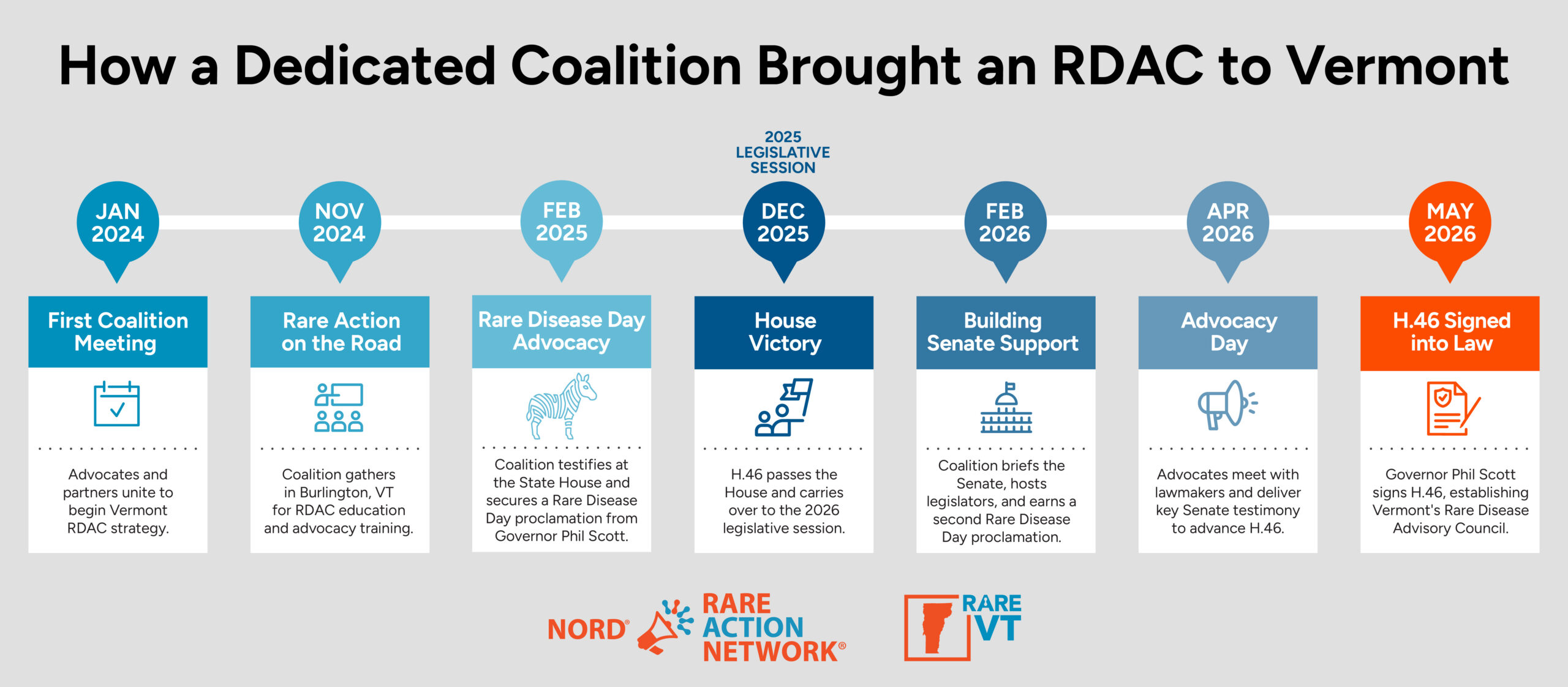
The journey toward legislative success began in earnest with the coalition’s inaugural meeting in January 2024. From that moment forward, the National Organization for Rare Disorders worked hand-in-hand with local advocates to develop and execute a comprehensive, coordinated grassroots advocacy strategy. Over the course of the following two years, coalition members became familiar faces at the state capitol and across local communities. They traveled extensively throughout Vermont to share their deeply personal stories, provide critical legislative testimony, meet face-to-face with lawmakers, participate in dedicated advocacy days, and raise public awareness through coordinated Rare Disease Day activities.
The unwavering persistence and sustained effort of the coalition ultimately reached their peak on May 13, 2026, when Governor Phil Scott formally signed H.46 into law. Leaders of the movement note that the passage of the bill was never the result of a single advocacy day or one pivotal conversation in a lawmaker’s office. Instead, it was the direct product of years of consistent engagement, collaborative education, and meticulous relationship-building carried out by coalition members and their institutional partners. Together, these individuals demonstrated the undeniable power of a unified grassroots movement, securing a permanent, formal investment in the health and well-being of Vermont’s rare disease community.
Personal Stories That Drove Change
At the absolute center of this historic legislative victory are the courageous individuals who chose to step forward and share their harrowing, often isolating experiences with rare diseases directly with lawmakers. In the realm of public policy, personal testimony possesses a unique and transformative power. It bridges the gap between cold statistics and human reality, painting a vivid picture of how legislative decisions directly affect individuals, households, and entire communities. By speaking candidly about their daily struggles, advocates helped state legislators truly understand the systemic barriers faced by those living with rare diseases and their caregivers, underscoring why a formal government voice is so desperately needed.
Reflecting on their experiences testifying in support of H.46, members of the advocacy coalition shared profound insights into what the process meant to them personally and how it galvanized the broader legislative movement.
Sarah E. recalled the initial apprehension of addressing state leaders, noting that the experience ultimately revitalized her lifelong commitment to service. While acknowledging that it initially felt daunting to capture the attention of Vermont’s political leaders, she described giving her testimony to the House Human Services committee in February 2025 as an enriching and empowering experience. According to Sarah, the process reignited the passion for helping others that she had always held close to her heart. She emphasized that the active encouragement shown by the committee is something every citizen deserves to experience, reinforcing the belief that individuals must understand their intrinsic value within their communities on every level.
For Katie P., the journey of sharing her personal story proved to be a transformative exercise in vulnerability and self-discovery. She noted that the most memorable aspect of delivering her testimony was recognizing how much she had grown as a person, realizing the potential for her story to encourage others, and permitting herself to be vulnerable in a public space. Although nervousness preceded her remarks, Katie found that confidence quickly took over once she began speaking, washing away her fears and leaving her feeling profoundly empowered. Her primary takeaway from the experience was the realization that using one’s voice is a potent act, and that sharing a personal testimony is both freeing and courageous—a catalyst for forging deep human connections and inspiring others to action.
Sharon R., who lives with the rare autoimmune condition Pemphigus Vulgaris, found her moment before the Vermont State Senate Health Committee to be remarkably validating. Speaking about her condition was deeply empowering, but the most memorable moment occurred right after she concluded her prepared two-minute statement. Rather than moving on to the next agenda item, members of the committee looked at her and explicitly asked her to tell them more about her life and experiences. Encouraged by their genuine interest, she gladly continued, highlighting the receptiveness and empathy she encountered among state lawmakers.
Continuing the Momentum
The successful passage of H.46 stands as concrete proof that sustained, community-driven grassroots efforts can successfully drive meaningful systemic change in public health policy. Proponents of the legislation emphasize that individuals do not need to be career policy experts or lobbyists to make a lasting difference in their state. The multiyear battle to establish Vermont’s Rare Disease Advisory Council has shown that the shared experiences, time, talents, and voices of everyday citizens are powerful enough to alter the legislative landscape and create a more inclusive, supportive healthcare future for all residents.