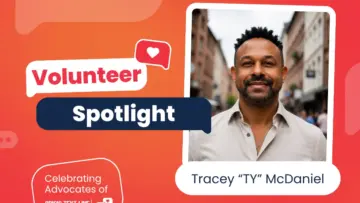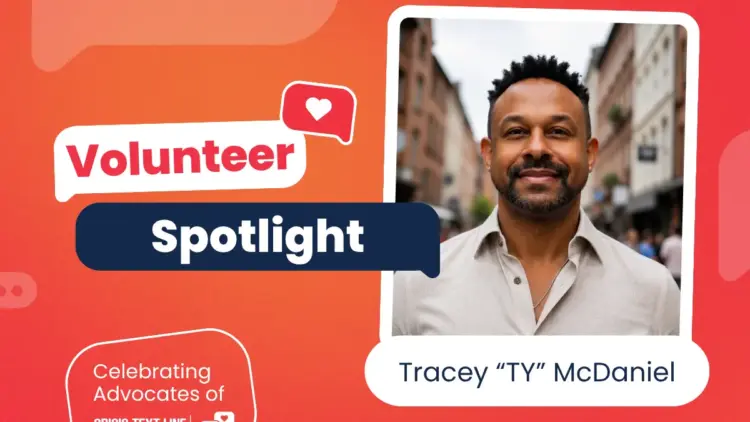
Behind every text conversation handled by Crisis Text Line is a volunteer Crisis Counselor who has chosen to show up, listen, and offer a safe space to someone navigating their darkest moments. This month, the organization is putting its monthly volunteer spotlight on Tracey “TY” McDaniel. His commitment to the platform began with a deeply personal promise to a grieving friend and has since grown into a broader mission to remind people that asking for help is an act of profound strength rather than a sign of weakness.
A Promise Forged Through Personal Loss
TY’s journey with Crisis Text Line did not begin out of a casual interest in community service; it was rooted in an unimaginable tragedy. He first learned about the organization after a close friend tragically lost her son to suicide. In the wake of that profound loss, TY made a solemn pact with her: he would step up and help in any way he could.
That commitment ultimately directed him toward Crisis Text Line, providing a structured and impactful way to turn his promise into meaningful action. For TY, supporting individuals in crisis is intensely personal. Unfortunately, he has been personally impacted by suicide more than once throughout his life. Those painful experiences have stayed with him, instilling a deep-seated conviction that he needed to find a tangible way to make a difference. He views the time he volunteers as an absolute privilege, believing that if simply being there for someone during a moment of crisis can make even the smallest difference, the investment is entirely worthwhile.
Understanding the Role of a Crisis Counselor
When individuals think about crisis intervention, they often picture professionals rushing to fix immediate problems or offering complex psychological advice. However, TY points out that the reality of volunteering as a Crisis Counselor is quite different and often misunderstood by the general public.
Volunteers are not expected to act as miracle workers or solve someone’s problems single-handedly. In fact, very few people reach out to Crisis Text Line expecting a counselor to possess all the answers. Instead, texters are usually looking for a nonjudgmental person who is willing to listen—someone who can offer genuine support, a fresh perspective, or gentle guidance. Often, the core role of a Crisis Counselor is simply to serve as a beacon of light at the end of a dark tunnel, reminding vulnerable individuals that they are not alone in their struggles.
Translating Volunteer Work into Everyday Leadership
The impact of volunteering extends far beyond the confidential virtual chat rooms, profoundly shaping how counselors navigate their personal and professional lives. As a people leader in his professional career, TY finds that his work with Crisis Text Line keeps mental health and awareness constantly at the forefront of his mind.
This perspective influences how he manages his team daily. TY routinely checks in with his direct reports on a weekly basis, creating a dedicated space for them to discuss how things are going—not just regarding their work deliverables, but in their personal lives as well. Through his experiences counseling strangers in distress, he has learned a valuable lesson: simply asking someone how they are doing, and then genuinely listening to the answer, can completely change the trajectory of their day. Volunteering continually reminds him that every human being deserves a baseline of grace, understanding, and compassion.
Remembering the Texters: A Safe Space for Youth
While thousands of conversations flow through Crisis Text Line, certain moments leave an indelible mark on the counselors who answer the call. For TY, one memory stands out vividly from the start of a school year.
A young student reached out to the platform because they were suffering from intense bullying. Having experienced bullying himself during his own school years, TY intimately understood how all-consuming, isolating, and overwhelming that pain could feel. Taking a deep breath, he focused entirely on being a reliable shoulder to lean on, creating a secure environment where the student felt truly heard and validated.
After spending time listening and establishing rapport, TY encouraged the student to speak with a teacher or a school administrator, gently reminding them that there was absolutely nothing to be embarrassed or ashamed of. That specific interaction has stayed with him over the years because he understood, on a deeply personal level, how desperately that young person needed an ally in their corner during a moment of profound vulnerability.
The Modern Landscape of Mental Health Stressors
Reflecting on why he remains dedicated to supporting mental health initiatives and crisis intervention, TY refuses to sugarcoat the realities of modern life. He points out that living in contemporary society can be extraordinarily difficult, with homes, schools, and workplaces often functioning as an endless stream of compounding stressors.
In today’s fast-paced environment, the ability to genuinely disconnect, decompress, and recharge has become increasingly elusive. People face constant demands on their limited time, energy, and attention, while the pervasive influence of social media fundamentally shapes how individuals view the world and themselves. When all of these pressures accumulate over time, they can easily leave people feeling overwhelmed, isolated, and stripped of hope.
This accumulation of modern stress is precisely why TY believes that having someone available to listen without judgment is so vital. By acting as a safe space for those who are struggling or simply looking for guidance, a crisis counselor can help someone navigate a fleeting moment of despair. Knowing that another human being is listening can sometimes be the singular push a person needs to survive a difficult moment and recognize that a viable path forward still exists.
Encouraging Future Volunteers
For individuals who feel called to volunteer with Crisis Text Line but hesitate because they worry they lack the proper credentials or skills, TY offers a reassuring message rooted in accessibility. He emphasizes that if a person has compassion in their heart and a genuine desire to help others, the necessary technical skills can be successfully taught through training.
Prospective volunteers do not need to arrive with all the answers or a blueprint for handling every conceivable crisis. Crisis Text Line provides comprehensive training tools to prepare volunteers for success. Ultimately, what matters most is an authentic willingness to listen, an openness to learn, and the dedication to simply show up for someone when they need support the most.
Normalizing the Conversation Around Mental Health
Summarizing his overarching philosophy on mental health, TY stresses that emotional well-being is every bit as critical as physical health. He advocates for a cultural shift that normalizes the act of asking for help, arguing that society must actively encourage people to say the words, "I’m not okay."
Asking for support, he insists, is an undeniable sign of strength rather than a weakness. No individual should ever feel compelled to navigate the most difficult, painful moments of their lives entirely alone.
For anyone currently struggling and in need of immediate support, Crisis Text Line operates 24 hours a day, 7 days a week, providing free and confidential assistance. Individuals can reach a live volunteer Crisis Counselor by texting the keyword CONNECT to 741741.