The architecture of U.S. foreign assistance has undergone a profound structural transformation following sweeping directives enacted during the second administration of President Trump. These changes fundamentally reshaped the nation’s global health engagement, marked notably by the dissolution of the U.S. Agency for International Development (USAID) and the consolidation of remaining foreign health initiatives under the purview of the State Department. Following months of transition and uncertainty, the State Department officially launched the America First Global Health Strategy (AFGHS) in September 2025. This strategic blueprint outlines a paradigm shift in how the United States intends to execute its international health commitments, moving away from traditional development paradigms toward a framework anchored directly by bilateral agreements negotiated country by country.
Under this renewed model, the U.S. government has pursued Memoranda of Understanding (MOUs) directly with partner nations receiving foreign health assistance. To date, 36 such bilateral agreements representing a combined commitment of $26.7 billion have been signed, establishing joint financing priorities where the U.S. commits $15.9 billion and partner governments match with $10.3 billion in co-investments. While implementation plans for these foundational MOUs continue to develop—with government-to-government funding agreements designated as the primary mechanism—the State Department has concurrently introduced a complementary competitive funding mechanism. Known as the Advancing Global Health Annual Program Statement (AGH/APS), this open-ended framework is designed to solicit applications and accelerate the realization of AFGHS objectives.
Announced in March 2026, the AGH/APS framework represents a vital window into the mechanics of post-USAID foreign assistance. The State Department anticipates deploying up to $4.5 billion through this mechanism, subject to congressional funding availability, structured across four distinct funding windows stretching from March 2026 through February 2027. Individual awards under the program range widely from $500,000 to as much as $250 million over a five-year lifecycle. Certain allocations are integrated directly into a nation’s overarching MOU funding envelope, while others operate independently. Eligible applicants span a diverse coalition of stakeholders, including U.S. and foreign private for-profit enterprises, academic institutions of higher education, faith-based and secular non-governmental organizations, Public International Organizations, and foreign governmental institutions.
To better understand the operational reality of U.S. global health diplomacy under the AFGHS, policy analysts have scrutinized the initial round of AGH/APS award opportunities, known as addenda. By evaluating how capital is directed across specific target nations and broad global health programming areas, observers can construct a clearer picture of how American foreign investment will function in the evolving international development landscape.
Analyzing the Funding Architecture and Early Addenda
As of November 2026, the State Department’s Bureau of Global Health Security and Diplomacy has released 12 addenda across three funding rounds, creating pathways for up to 122 potential awards totaling $1.43 billion. This initial tranche accounts for approximately 32 percent of the anticipated $4.5 billion AGH/APS funding ceiling. These opportunities are strategically divided between country-specific initiatives and broader, cross-cutting area-specific solicitations.
The funding rollout has been sequenced through several defined windows. Window 1, spanning March 5 to May 31, 2026, authorized up to $542.65 million across 21 potential awards. Window 2A, running from June 2 to July 31, 2026, provided up to $295 million designated for 39 awards. Window 2B, open from July 1 through September 15, 2026, introduced up to $315.4 million across 25 awards. Window 3, active from August 15 to October 30, 2026, targeted up to $277 million through 37 awards, while a final Window 4 is slated to run from mid-November 2026 through January 2027.
Collectively, the initial set of addenda divides anticipated resources evenly between localized implementation and thematic priorities. Country-specific addenda account for roughly 51 percent of the announced funding, totaling up to $730 million, while area-specific addenda represent the remaining 49 percent, amounting to up to $700 million. These solicitations outline precise programmatic objectives, target populations, and geographic parameters designed to address critical vulnerabilities in partner states.
Country-Specific Commitments and Transition Goals
The country-specific addenda released to date focus heavily on turning bilateral MOU frameworks into operational reality across several key nations, primarily aiming to accelerate transitions toward sustainable, locally managed health systems by 2030.
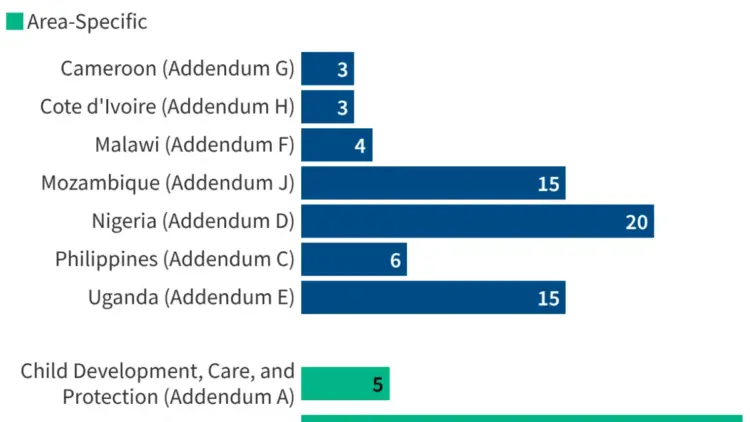
Among these, the largest single country allocations target Nigeria and the Philippines. Addendum D allocates up to $200 million across 20 potential awards in Nigeria, focusing on expanding access to integrated, affordable health services through public, private, and faith-based facilities, alongside strengthening health financing and insurance access for women and children. Similarly, Addendum C provides up to $200 million across six awards in the Philippines, leveraging partnerships with both U.S. and Filipino entities to scale up digital health infrastructure, laboratory networks, and supply chain innovations while advancing the adoption of U.S. technological standards.
Mozambique is another major focal point under Addendum J, which commits up to $180 million across 15 awards. The initiative is designed to bolster health systems at national, provincial, and community levels, protecting hard-won gains against infectious diseases including HIV, tuberculosis, and malaria, while improving maternal and neonatal outcomes and enhancing biosecurity readiness.
Other targeted bilateral agreements reflect more focused regional strategies. Uganda’s Addendum E provides up to $60 million across 15 awards to support sustainable community-based health financing, power solutions for health facilities, and supply chain accountability. Malawi’s Addendum F directs up to $35 million across four awards to sustain national gains in vaccine-preventable diseases, maternal and child health, and disease surveillance. Cote d’Ivoire’s Addendum H allocates up to $50 million across three awards to accelerate its transition to an accountable, government-led health system. Finally, Cameroon’s Addendum G provides $5.4 million across three awards to strengthen integrated disease surveillance and emergency outbreak response using a One Health approach.
Thematic Priorities and Area-Specific Strategies
Alongside bilateral country programs, the area-specific addenda address transnational health security, nutrition, and systemic resilience. These solicitations target critical global health challenges that transcend national borders.
The largest area-specific commitment is found in Addendum B, which dedicates up to $290 million across 10 awards for rapid outbreak response. This funding mechanism is structured to enable immediate surge capabilities, early containment, and coordinated cross-border mitigation during the nascent stages of infectious disease threats.
Neglected Tropical Diseases (NTDs) represent another major thematic pillar. Addendum K commits up to $162 million across 25 awards to accelerate the elimination and interruption of transmission for priority NTDs. This initiative targets high-burden settings across the Western Hemisphere, Africa, and Asia, focusing on individuals at highest risk of infection.
Nutrition programming is prioritized under Addendum L, which provides up to $115 million across 12 awards to reduce maternal and child mortality and combat malnutrition in high-burden environments across Africa and Haiti. Meanwhile, Addendum A allocates $52.65 million across five awards to child development, care, and protection systems globally, aiming to prevent family separation and address early childhood malnutrition during the critical first thousand days of life.
Finally, Addendum I dedicates $80 million across four awards toward innovations in population-based surveys and surveillance. This initiative is intended to assist partner nations in establishing self-run health data strategies, generating timely and actionable epidemiological data that improve domestic health outcomes while mitigating health risks to the United States.
As the annual program statement process continues toward its final funding windows, the broader global health community is closely monitoring how these competitive awards will interact with the overarching bilateral MOUs. While no official awards have been publicly announced yet, the comprehensive structure of the AGH/APS framework offers a clear window into the strategic priorities guiding U.S. foreign health assistance in the post-USAID era.