
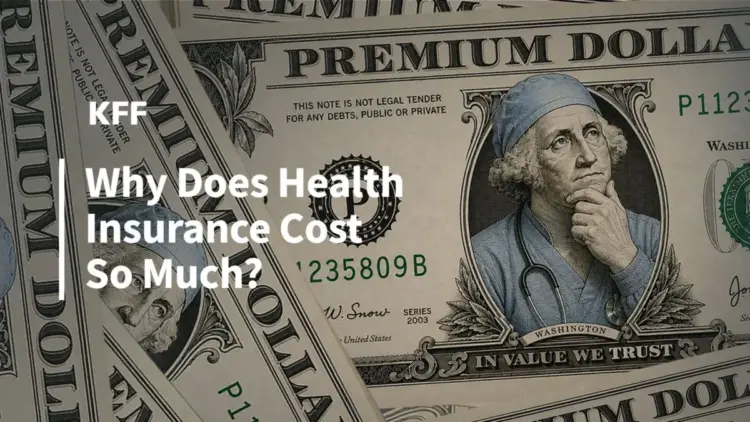
The escalating cost of health insurance premiums has become an unsustainable burden, placing immense financial strain on employers and consumers across the United States. Year after year, working families and businesses alike watch as the price of maintaining coverage climbs steadily higher, eating into household budgets and corporate bottom lines. While public frustration is frequently directed straight at insurance companies, a closer look at the mechanics of the American health care system reveals a more complex reality. According to policy experts, it is not simply insurer margins or administrative bloat driving the crisis, but rather the underlying cost of health care itself—chiefly the price of hospital care.
A recent analysis by Larry Levitt, Executive Vice President for Health Policy at KFF, sheds light on the intricate web of hospital consolidation, employer demands, and insurer leverage. The findings challenge the simplistic narrative that health insurance companies are the sole architects of the nation’s soaring medical bills, pointing instead to structural dynamics that make controlling prices remarkably difficult for insurers, employers, and policymakers alike.
The Political Crossfire: Who Bears the Blame?
Are insurers at the root of our health system’s problems? The answer is complicated, and the political fallout is deeply contentious. Leaders from across the political spectrum have frequently targeted health insurance companies, attempting to lay the blame for high patient costs and system inefficiencies squarely at their doorsteps.
Former President Donald Trump has repeatedly criticized the industry, claiming that the Patient Protection and Affordable Care Act "enabled large insurance companies to get rich." He has voiced intentions to halt payments to major insurance firms and instead redirect those funds directly to individuals, empowering them to purchase health coverage independently.
At the same time, prominent Senate Democrats have staked out their own reform agendas, releasing legislative goals aimed at overhauling the health care marketplace. Their platform explicitly promises to develop policies that lower overall costs, simplify the process of obtaining and utilizing coverage, and rein in what they characterize as shameless profiteering by corporate insurance companies.
This bipartisan frustration raises a fundamental question for patients and lawmakers alike: Exactly how much blame do insurers genuinely deserve for high health care costs and widespread consumer frustration?
The Role of Insurers: Administrative Overhead and Patient Friction
To understand the public’s grievances against insurers, one must examine the tools insurance companies traditionally use to manage financial risk and health care utilization. Practices such as prior authorization requirements, strict claim denials, and narrow provider networks are frequently deployed by insurers to keep spending under control. However, these mechanisms often come at a direct cost to patients, creating administrative hurdles, delaying necessary treatments, and impacting the overall quality of care. Furthermore, insurers add administrative overhead to premiums, a tangible cost that consumers see directly on their monthly bills.
Yet, policy experts emphasize that these factors only tell part of the story. The undeniable fact of the matter is that surging underlying health care costs—spanning hospital care, physician and clinical services, retail prescription drugs, and other vital medical expenditures—represent the single biggest driver of increasing insurance premiums.

Faced with these escalating medical bills, insurers essentially act as pass-through entities. They must pass those massive costs along to their customers through higher premiums and out-of-pocket expenses, or else risk declining profit margins and, ultimately, financial insolvency.
The Trillion-Dollar Problem: Hospital Care Leads the Surge
U.S. health spending has risen sharply over recent decades, reaching an astounding $5.3 trillion by 2024. This massive financial footprint touches nearly every sector of the American economy, but certain components stand out as primary catalysts for growth.
Hospitals account for the largest single share of national health spending, and they have driven roughly 40 percent of the total cost growth in recent years. While expenses associated with physician services and retail prescription drugs are also steadily climbing, they represent a comparatively smaller share of total health expenditures.
Insurers have increasingly pointed to hospital consolidation as a primary engine driving up prices, and market data suggests they have a valid point. The corporate landscape of American health care has experienced significant structural shifts, marked by continuous mergers, acquisitions, and health system expansions. In 2024, data indicates that just one or two dominant health systems controlled the entirety of inpatient hospital care in nearly half of all U.S. metropolitan areas. With market power concentrated in the hands of a few mega-systems, hospitals possess immense leverage to command higher reimbursement rates from insurers.
The Employer Factor and the Illusion of Choice
To be entirely fair, it is not insurers alone that have failed to push back against spiraling hospital prices. The commercial health insurance market is deeply influenced by the preferences and demands of corporate employers, who sponsor coverage for the majority of working Americans.
Employers consistently demand broad networks of hospitals and physicians for their workforces, preferring plans that allow employees to see virtually any doctor or visit any medical facility without restriction. However, maintaining these expansive networks fundamentally blunts the primary leverage insurers possess to negotiate and limit prices. When an insurance company cannot threaten to walk away from a hospital system because an employer insists on keeping that hospital in-network, the insurer loses its ability to drive a hard bargain.
This intricate market dynamic leaves overall costs persistently high and accountability diffuse, with no single entity willing or able to force systemic price discipline.
Yet, if insurers are primarily functioning as intermediaries that simply pass on rising health care costs to employers and consumers, it raises a deeper and more persistent question about the modern health care landscape: What tangible value are they truly providing to the American public?



