
The Centers for Medicare and Medicaid Services (CMS) has released comprehensive data detailing the Medicare Advantage plans that will be accessible to beneficiaries for the upcoming 2027 plan year. The federal announcement arrives just ahead of the late-year administrative milestones that dictate how millions of older Americans and qualified individuals manage their healthcare coverage.
Beginning October 1st, third-party entities, brokers, and insurance companies are authorized to begin marketing Medicare Advantage plans for the new cycle. This marketing window serves as a precursor to the annual open enrollment period, which officially runs from October 15th through December 7th. During this critical multi-week window, Medicare beneficiaries have the opportunity to review, alter, or establish their healthcare coverage for the following year.
In an official press release accompanying the data release, CMS emphasized that the Medicare Advantage marketplace continues to display overall stability. While federal regulators point to a resilient market foundation, a deeper examination of the plan availability metrics reveals nuanced shifts across national averages and regional landscapes.
An Analysis of Plan Offerings and National Averages
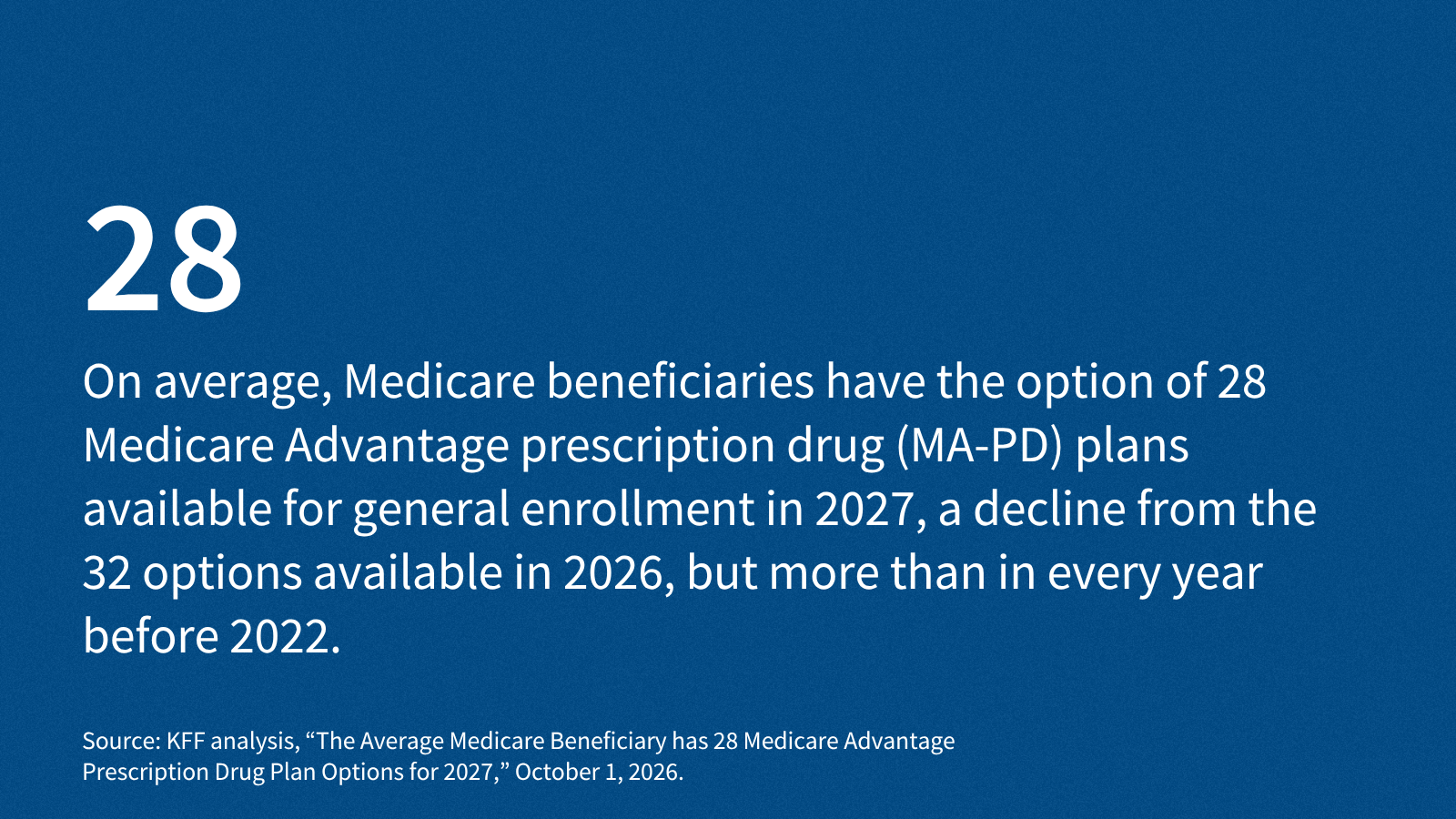
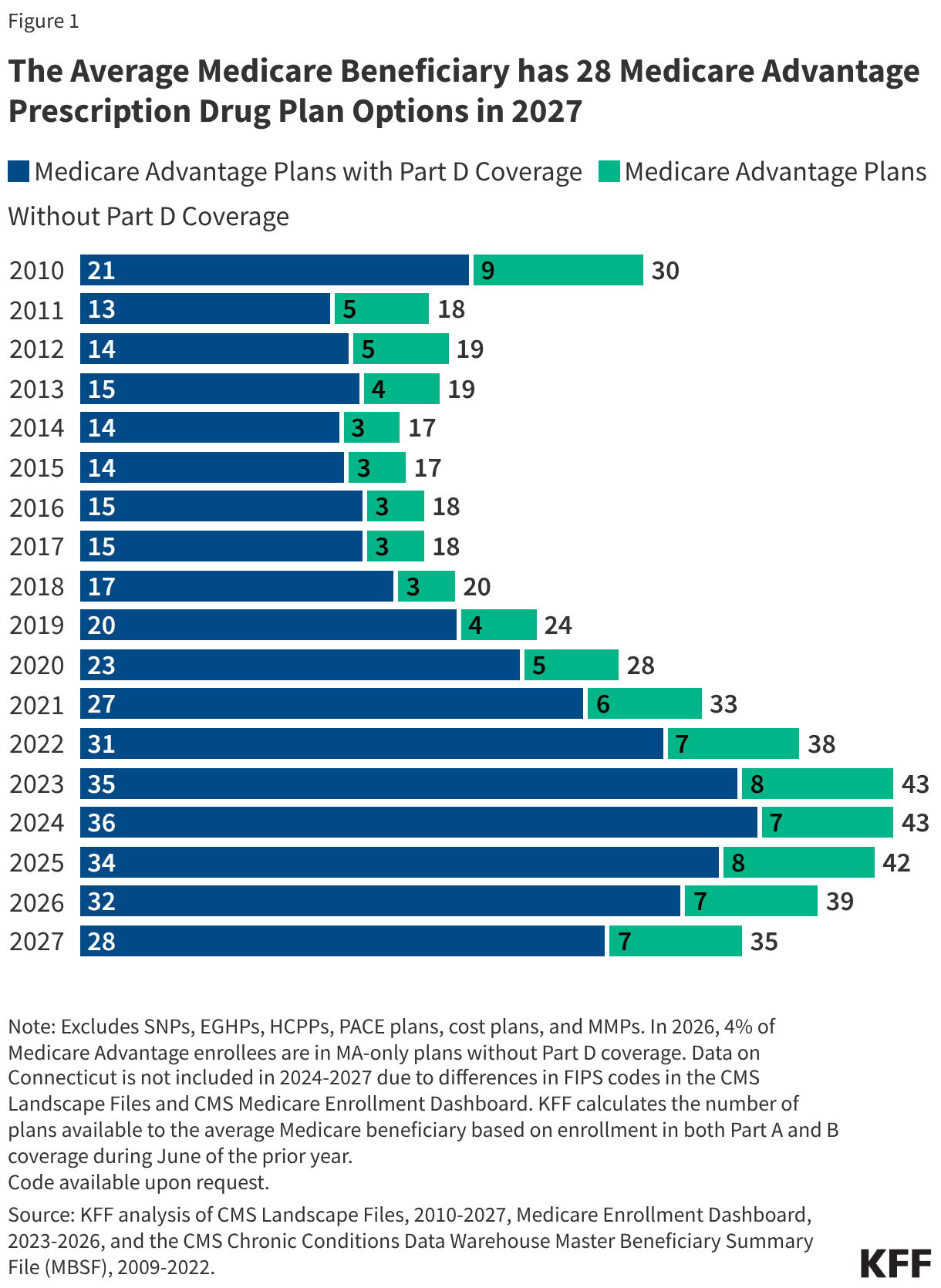
Data compiled from recent analyses of plan offerings show that, on average, Medicare beneficiaries will have the option of 28 Medicare Advantage prescription drug (MA-PD) plans in 2027. This figure represents a decline from the 32 options that were available to the average beneficiary in 2026, a calculation that excludes employer-sponsored plans and special needs plans that are not accessible to the general public.
To contextualize this movement, the sheer volume of MA-PD options grew at a steady pace over a decade, climbing consistently between 2010 and 2024. This extended growth trajectory ultimately reached a historical peak of 36 available options for the average Medicare beneficiary in 2024. Despite the subsequent contraction leading into 2027, the volume of available choices remains higher than the figures recorded in 2021, when the average beneficiary faced 27 options, as well as every year preceding it.
When expanding the scope to encompass all Medicare Advantage plans cleared for general enrollment—accounting for plans both with and without integrated prescription drug coverage—the average Medicare beneficiary can choose from roughly 35 plans in 2027. This compares to an average of 39 plans available during the preceding 2026 plan year.
Mirroring the trajectory observed exclusively within MA-PD offerings, the broader total of Medicare Advantage plans available to the average beneficiary remains elevated compared to any single year recorded between 2010 and 2021.
Structural Realities of Integrated Prescription Drug Coverage
By statutory requirement, all Medicare Advantage plans must cover the entirety of traditional Medicare Part A and Part B benefits. However, individual plan administrators retain the discretion to determine whether they will incorporate Part D prescription drug coverage directly into their core benefit packages.
Depending on the specific plan structure, enrollees may find themselves paying a distinct, separate premium designated exclusively for Part D coverage. Alternatively, insurance providers may utilize the rebate portion of their direct payments from the federal government to subsidize or entirely cover these administrative and pharmaceutical costs.
Statistical tracking indicates that the vast majority of Medicare Advantage enrollees are currently housed within plans that successfully bundle prescription drug coverage into their overarching frameworks. Furthermore, the majority of these participants pay no additional premium beyond the standard Part B premium required of Medicare beneficiaries.
The modest reduction in total plan availability means that a distinct subset of beneficiaries will discover that their current healthcare coverage arrangements are no longer operational or offered for the upcoming year. In the vast majority of instances, these affected individuals reside in counties where they will retain access to robust, alternative Medicare Advantage choices for 2027, alongside traditional Medicare options.
For certain beneficiaries whose specific plans have exited the regional market, continuity may be found through alternative plans offered by the same insurance carrier. In many routine circumstances, enrollees may be transitioned automatically into a newly designated plan managed by the same insurer, provided the underlying contract incorporates another plan of an identical operational type—such as an Health Maintenance Organization (HMO) or Preferred Provider Organization (PPO)—within the same geographic county.
Conversely, other impacted individuals will be forced to navigate an active choice regarding their healthcare trajectory should they wish to secure a new Medicare Advantage policy, or they will be transitioned into traditional Medicare by default.
Geographic Disparities and State-Level Variations
The abundance of Medicare Advantage plans featuring integrated prescription drug coverage is far from uniform, exhibiting wide-ranging disparities when examined across state lines.
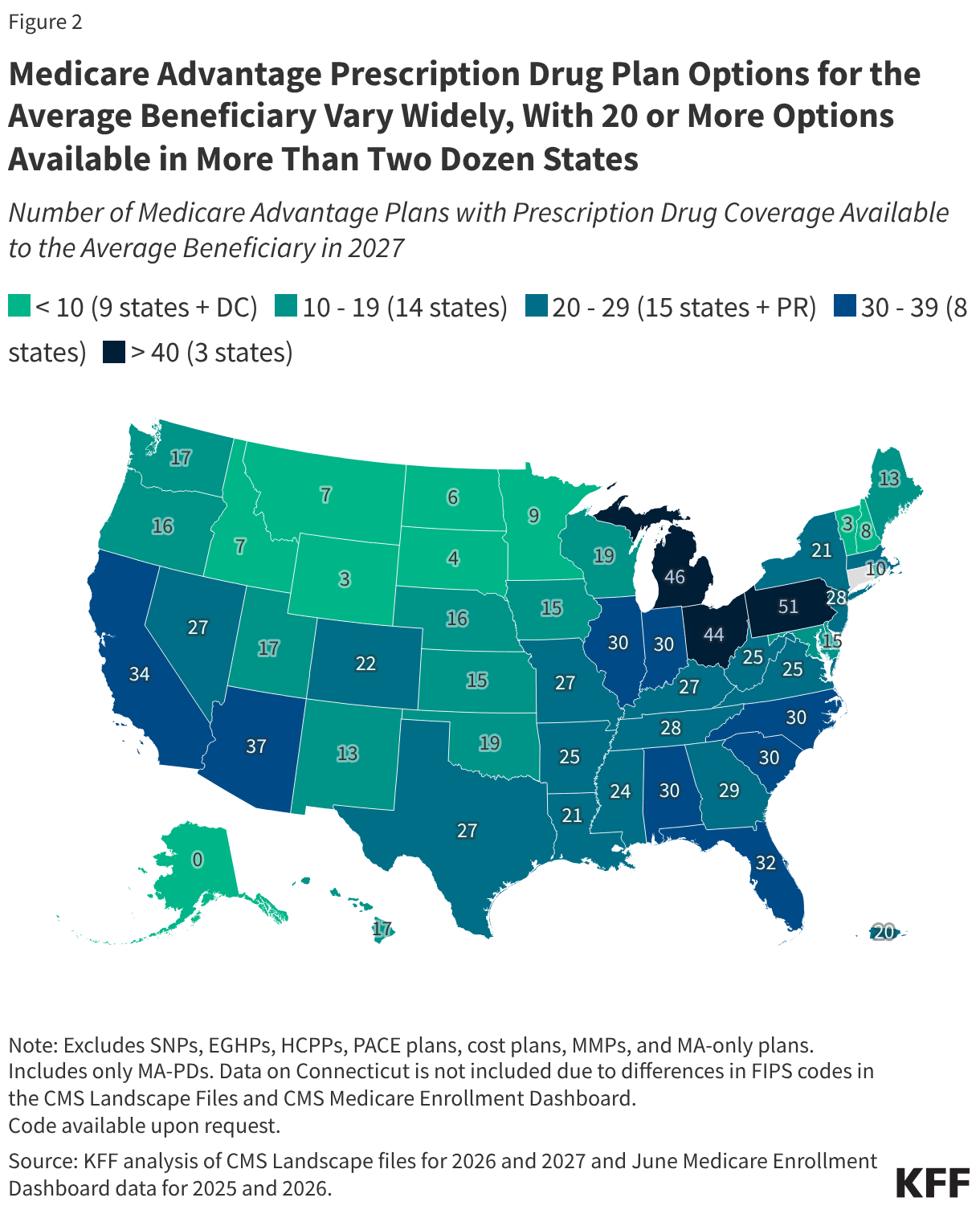
In 26 individual states and Puerto Rico, the average Medicare beneficiary retains access to at least 20 distinct MA-PD options for the 2027 plan year. This upper tier includes three states—Pennsylvania, Michigan, and Ohio—where the average beneficiary benefits from an expansive field of at least 40 MA-PD options.
At the opposite end of the spectrum, the landscape looks remarkably constrained. In nine states and the District of Columbia, the average Medicare beneficiary can choose from fewer than 10 MA-PD options in 2027. This restricted group includes Alaska, which records no available plans for general enrollment in 2027, maintaining a historical pattern where the state has featured few or zero Medicare Advantage options. Connecticut is systematically excluded from these calculations due to structural reporting discrepancies regarding how counties are tracked across federal CMS enrollment and plan documentation files.
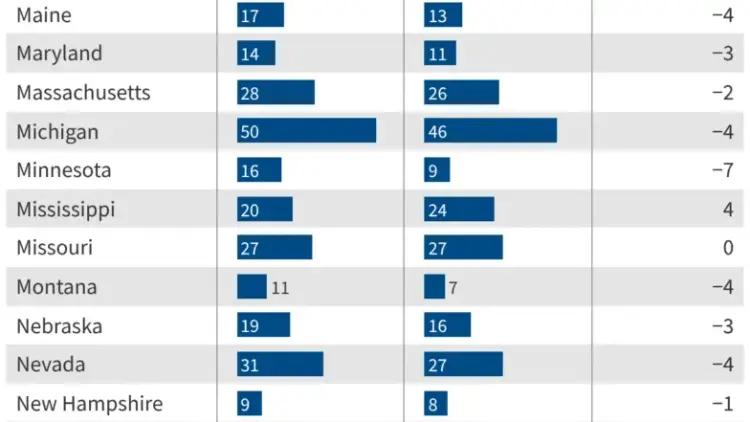
Comparing year-over-year metrics reveals that across a majority of states, the average beneficiary will navigate a reduced field of Medicare Advantage plan options in 2027 relative to 2026. The states sustaining the most pronounced reductions in available general enrollment MA-PDs include Texas, which dropped by nine options, followed by Illinois and Ohio with declines of eight options each. Minnesota, New Mexico, and Washington each experienced a reduction of seven available plans.
Stability and stagnation characterized other regions: nine states will maintain an identical number of MA-PD options in 2027 compared to 2026, while only four states will experience an increase in available plan choices.
The Persistent Challenge of Consumer Decision-Making
Navigating the architecture of American healthcare and deciding how best to receive Medicare benefits remains an intricate hurdle for aging populations. Beyond the sheer volume of plans available on paper, each calendar year brings structural alterations to Medicare Advantage plan benefits and fiscal obligations. These modifications frequently encompass shifts in the scope and generosity of supplemental benefits, adjustments to cost-sharing requirements for standard Medicare-covered services, alterations to out-of-pocket spending limits, and revised protocols for utilizing covered medical services. These latter rules often involve tightening or altering referral mandates and prior authorization frameworks, alongside shifting drug formularies and localized provider networks.
Detailed datasets reflecting these specific operational changes are typically published separately by federal regulators, often followed by exhaustive analytical breakdowns from healthcare research organizations.
Despite the high-stakes nature of these annual variations, historical data indicates that nearly seven in ten Medicare beneficiaries do not actively compare or evaluate competing coverage options during the designated open enrollment windows. Prior qualitative research involving Medicare focus groups underscores that enrollees are frequently overwhelmed by the sheer volume of choices and report substantial difficulties sorting through the myriad plan options.
With more than two dozen MA-PD alternatives available on average in 2027, coupled with continuous year-to-year shifts in benefits, formularies, and cost structures, fully comprehending how individual plans differ—and how those differences directly impact personal out-of-pocket expenses and medical access—remains a formidable challenge for the nation’s beneficiaries.



