
Paid family, medical, and sick leave remain vital tools for workers striving to balance personal and family health care needs with demanding work responsibilities. Access to paid leave is a particularly salient concern for women, who comprise nearly half of the nation’s workforce and often shoulder the bulk of caregiving duties. While the federal Family and Medical Leave Act (FMLA) requires eligible employers to provide certain workers with unpaid family leave, the United States stands apart from nearly all other industrialized nations by lacking a national mandate for paid family or sick leave.
This absence of a federal standard has created a fragmented patchwork of policies determined by a mix of state and local laws, individual employer benefits, and labor contracts. Although advocates have pushed for a national paid leave standard for decades, federal legislative action has remained limited. Consequently, many workers must rely on voluntary employer policies that vary significantly in scope and compensation, or on state-level legislation where available.
Federal, State, and Local Policies on Sick, Family, and Medical Leave
The landscape of leave policies across the United States is divided between short-term sick leave and extended family and medical leave, with distinct rules governing each category at the federal, state, and local levels.
Sick Leave
Paid sick leave allows workers to take short durations of time off to recover from short-term injuries or illnesses, such as a cold, or to attend doctor’s appointments without losing pay. It is frequently provided on an accrual basis up to a set number of hours or days per year. For example, a common structure provides one hour of leave earned for every 30 hours worked, up to a maximum of seven days per year, and replaces 100% of the worker’s regular wages. On average, private sector workers are offered seven days of paid sick leave per year, with benefits funded directly by the employer.
While there is no federal requirement that employers offer paid sick leave, many states have stepped in with mandates, and numerous employers provide the benefit voluntarily. According to data from the Bureau of Labor Statistics (BLS), 82% of workers had access to paid sick leave through their employer in 2025.
Proponents of a national paid sick leave mandate emphasize that workers should not be forced to choose between going to work while sick and losing pay or their job. They point to numerous studies highlighting the broad societal benefits of paid sick leave, including preventing the spread of infectious illnesses, increasing the use of preventive health care services, reducing on-the-job injuries, and decreasing inappropriate emergency room visits.
Conversely, opponents of a national mandate generally contend that federal intervention is unnecessary because many employers already provide these benefits voluntarily, arguing that leave should remain a matter of private employer discretion. They cite concerns over the financial implications for businesses required to provide the benefit, particularly smaller enterprises, and warn of potential wage reductions designed to offset compliance costs.
At the federal level, the Healthy Families Act has been reintroduced annually in Congress. If passed, it would require nationwide employers with 15 or more employees to provide at least seven days of paid sick leave annually, based on a 40-hour work week. Employees would be permitted to use the leave for their own illness, to care for a sick family member, to obtain medical care, or to address needs resulting from domestic violence, sexual assault, or stalking—often referred to as "safe time," "safe days," or "safe leave." Federal government employees have traditionally enjoyed access to paid sick leave through standard civil service benefits packages.
Significant traction has occurred at the state and local levels. Since San Francisco passed the nation’s first mandatory paid sick leave law via voter initiative in 2006, 18 states plus the District of Columbia, alongside 18 other localities, have enacted laws requiring covered employers to provide eligible employees with paid sick leave. Most of these policies permit the use of accrued sick leave for safe time. Additionally, three states and three localities have general paid time off laws that allow employees to use accrued leave for any reason, including illness. Furthermore, ten states and 12 localities permit the use of accrued paid sick leave for workplace closures or the closure of a worker’s child’s school or childcare facility associated with a public health emergency.
The scope and generosity of these laws vary widely. Most state and local policies include exemptions based on the size and type of employer, and many permit employers to impose worker eligibility requirements, such as a waiting period—most commonly 90 days from the start of employment—before new employees can use accrued leave. Laws generally provide for the accrual of 30 to 40 hours per year, though smaller employers often face lower accrual requirements.
Family and Medical Leave
FMLA and Unpaid Family and Medical Leave
More than 30 years have passed since the federal government enacted the Family and Medical Leave Act (FMLA), which grants eligible employees up to 12 weeks of unpaid, job-protected leave per year for their own serious health condition, to care for a seriously ill family member, for the arrival of a new child, and to address needs related to a family member’s military deployment. Eligible employees can also receive up to 26 weeks of unpaid, job-protected leave per year to care for a seriously ill or injured family service member or veteran.
The law applies to public agencies and local educational agencies of all sizes, as well as private employers with 50 or more employees. While the FMLA has provided job security to millions of workers, just over half—56%—of the workforce is actually eligible for FMLA protections. This gap exists because small employers are exempt, and even within covered worksites, many employees do not meet the law’s strict tenure and hours requirements. To bridge this gap, most states have expanded job-protected leave benefits beyond the FMLA’s minimum standards by broadening eligibility, extending the duration of leave, expanding the definition of family members, or adding qualified reasons for taking leave.
Paid Family and Medical Leave
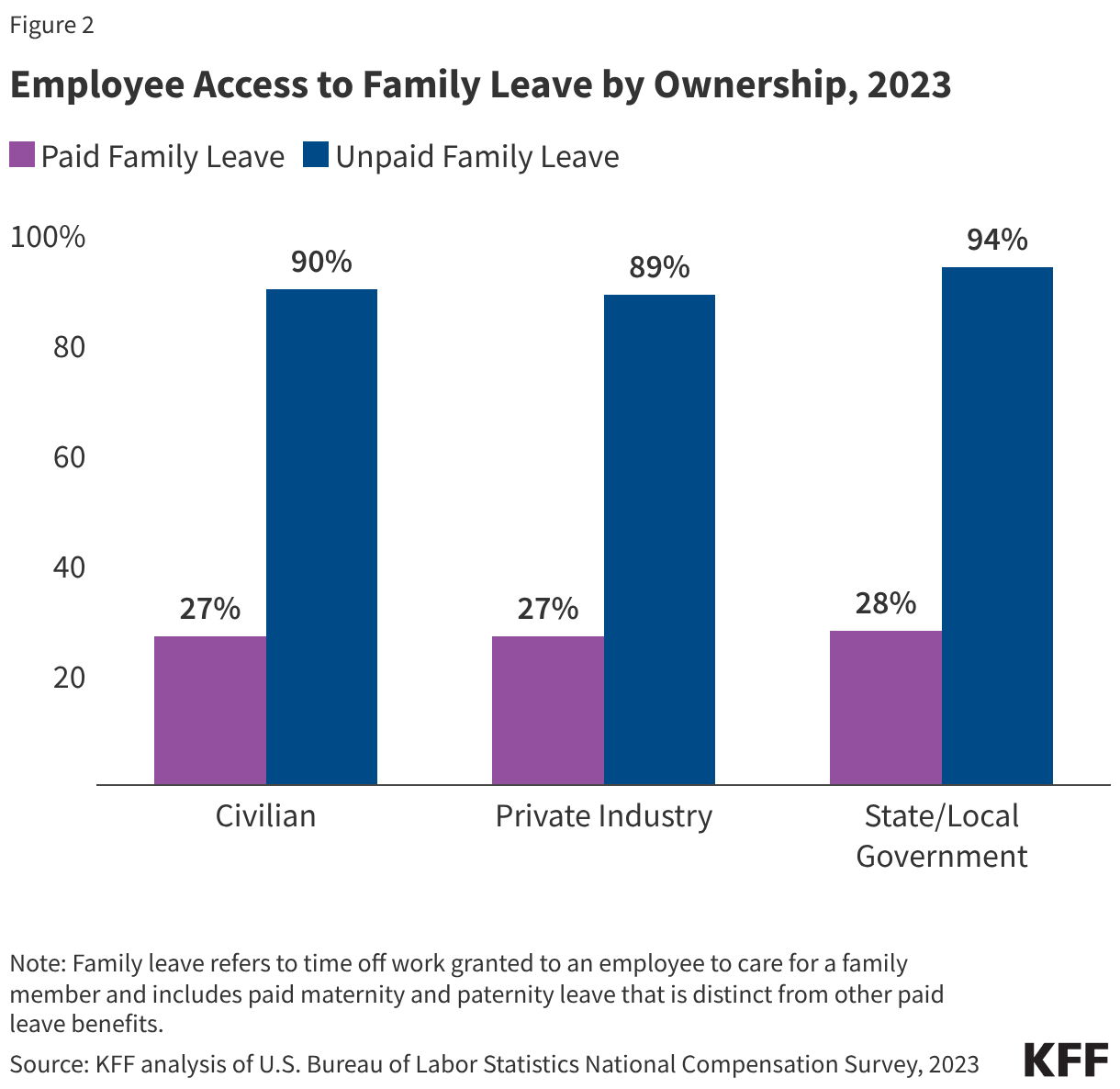
Data from the BLS reveals that just over one in four workers, or 27%, had access to paid family leave in 2023. While explicit data on access to standalone paid medical leave for longer, serious illnesses is more limited, the BLS estimates that 42% of workers had access to short-term disability insurance in 2025, which can be utilized to take paid time off for parental or medical leave.
Supporters of a national paid family and medical leave program argue it would provide essential financial security when workers must take extended leave for medical reasons, to care for an ailing family member, or to welcome a new child. Research indicates that access to paid family leave is associated with improved physical and mental health for new parents, better birth outcomes, enhanced short- and long-term financial security for caregivers, and stronger attachment to the workforce, particularly for women, who are statistically more likely to care for children and aging adults.
Opponents frequently voice concerns regarding the financial impact of new federal requirements on businesses, potential government overreach into the free market, increased tax burdens if public funding mechanisms are utilized, and the broader economic implications for wages and overall employment levels.
Despite numerous legislative attempts to enact a national paid family and medical leave policy, no permanent, broad-scale federal law has been passed. The Family and Medical Insurance Leave, or FAMILY, Act, which was re-introduced in the 119th Congress, seeks to create a national insurance program providing workers with up to 12 weeks of partial income replacement for their own serious health condition, the condition of an immediate family member, or the birth and placement of a child. The proposed program would be funded through joint employee and employer payroll contributions.
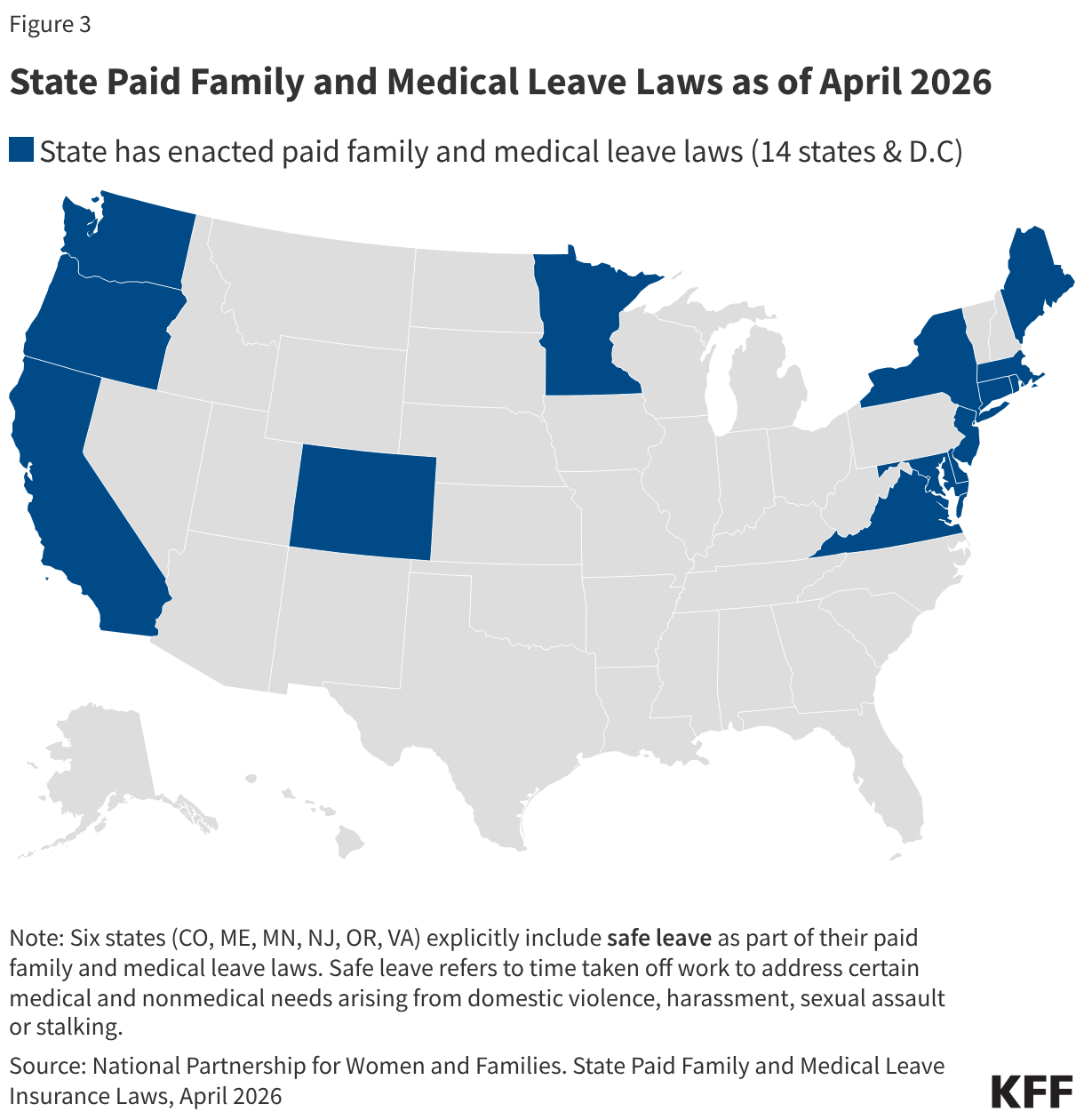
At the state level, momentum has been stronger. To date, 14 states and the District of Columbia have enacted paid family and medical leave programs. In November 2020, Colorado became the first state to establish paid family and medical leave through a ballot measure. Subsequently, Virginia became the first Southern state to pass a statewide paid family and medical leave requirement, with implementation slated for 2026.
Six states—Colorado, Maine, Minnesota, New Jersey, Oregon, and Virginia—explicitly include safe leave as part of their paid family and medical leave frameworks, while Oregon also permits leave for public health emergencies. Paid leave durations for an employee’s own serious medical condition generally range from 6 to 52 weeks per year, with 8 to 12 weeks allotted for family leave. Four states—Colorado, Connecticut, Oregon, and Washington—alongside Washington, D.C., offer an additional two to four-week extension specifically for pregnancy-related health issues.
Wage replacement under these state programs ranges from 50% to 100% of regular pay, subject to established caps, and some states utilize a sliding scale to provide higher replacement percentages for lower-income workers. All states offering paid family and medical leave enforce minimum earnings or employment length requirements to qualify, and some mandate a 7-day unpaid waiting period. These benefits are typically administered directly by the state or through employer-sponsored qualifying programs funded by payroll contributions.
Employer Provision of Paid Leave Benefits
Data from the BLS National Compensation Survey illustrates that access to paid leave benefits varies widely depending on establishment size, worker status, and wage levels. Nevertheless, overall access has trended upward in recent years. The share of workers with access to paid family leave climbed from 17% in 2018 to 27% in 2023, while access to paid sick leave rose from 78% in 2020 to 82% in 2025.
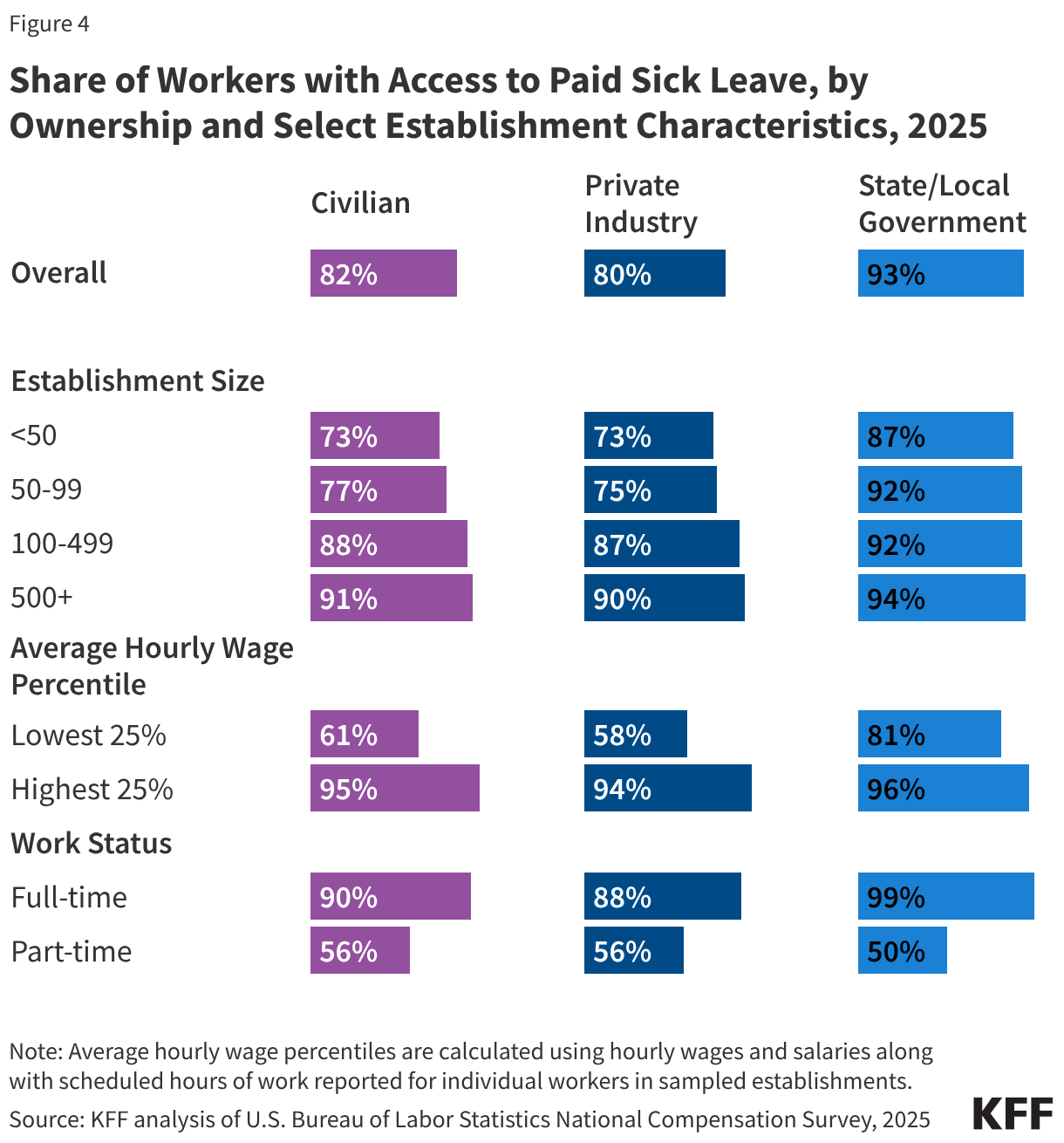
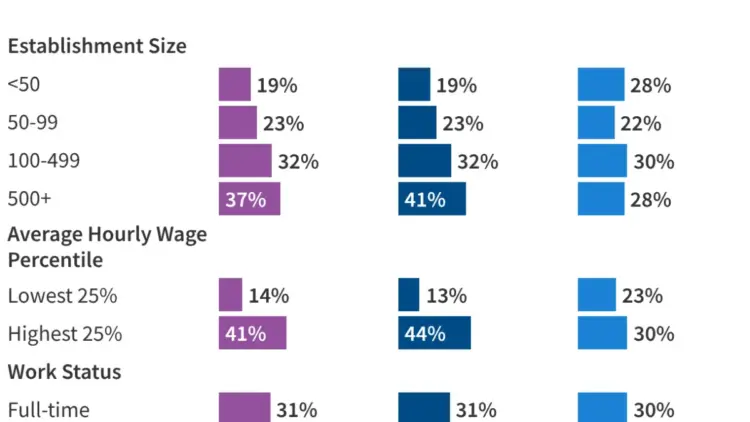
Significant disparities in access persist among different groups of workers. For paid sick leave, just over half of part-time workers, or 56%, have access, compared to 90% of full-time workers. This discrepancy disproportionately impacts women, who are more likely to hold part-time positions and bear the responsibility of caring for sick children at home. Disparities are also evident by company size: 91% of workers in establishments with 500 or more employees have access to paid sick leave, compared to 73% of workers in establishments with fewer than 50 employees.
A similar pattern is visible in paid family leave data from 2023, where 31% of full-time workers enjoyed access compared to only 14% of part-time workers. In small businesses with fewer than 50 workers, roughly one in five employees had access to paid family leave, a figure that nearly doubles to 37% in establishments with more than 500 workers.
In the absence of comprehensive federal action, the movement for paid leave will likely continue to center on state and local policy initiatives, voluntary corporate adoption, and negotiated union contracts. Because the vast majority of individuals will require time off during their working lives to address personal or family illnesses or to welcome a new child, paid leave remains a pressing and enduring concern for working families across the country.



