
As millions of Americans continue to grapple with the compounding pressures of rising health care costs, the debate over a national health plan has once again taken center stage. New data from KFF reveals that public support for "Medicare-for-all"—a system where all Americans would receive their health insurance through a single government plan—has reached an all-time high. With progressive Democratic candidates campaigning heavily on the proposal during the 2026 midterm election cycle, the evolving landscape of public opinion highlights both a deep-seated desire for systemic health care reform and the complex, often contradictory views citizens hold regarding how such a plan would impact their daily lives.
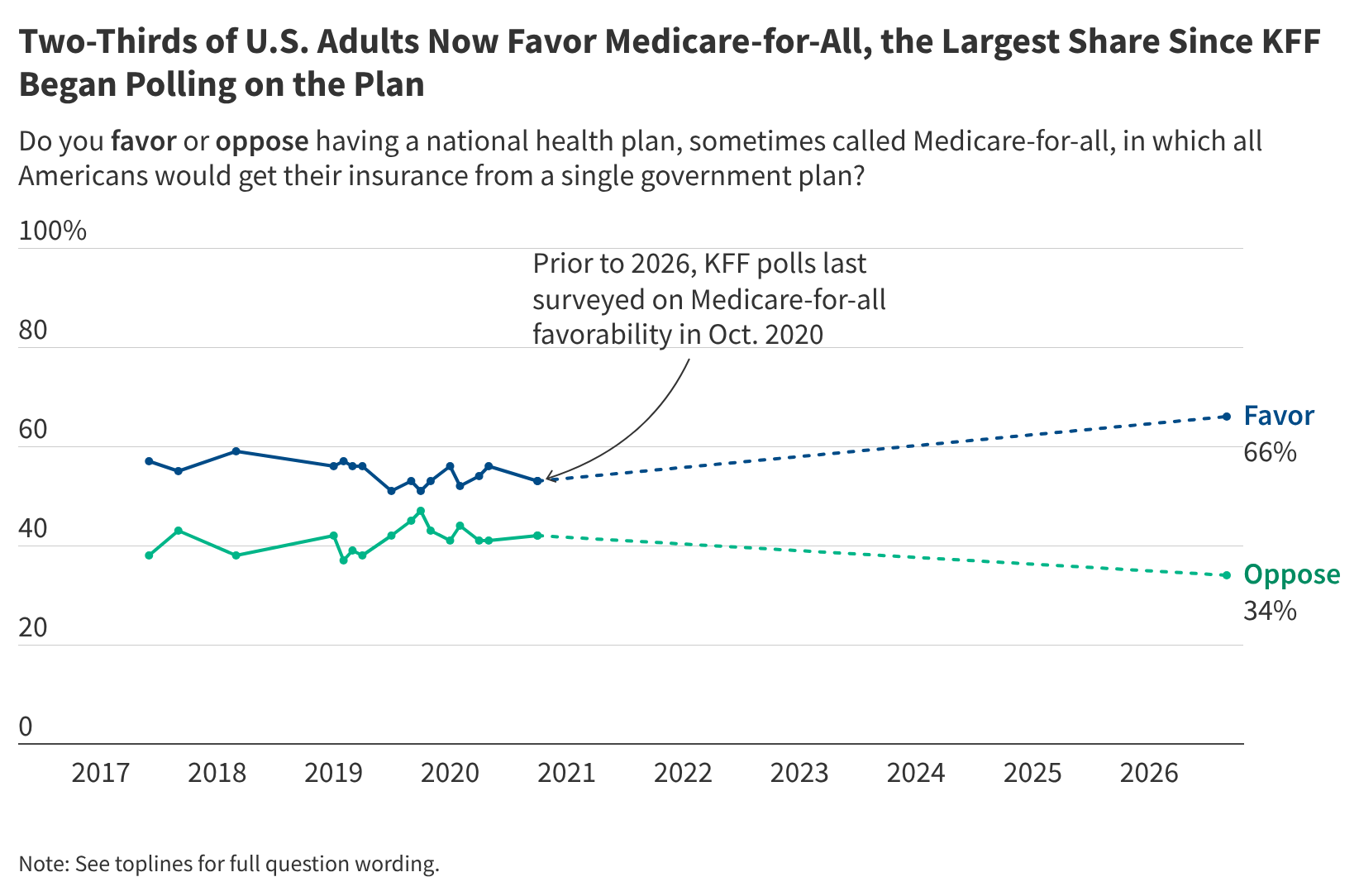
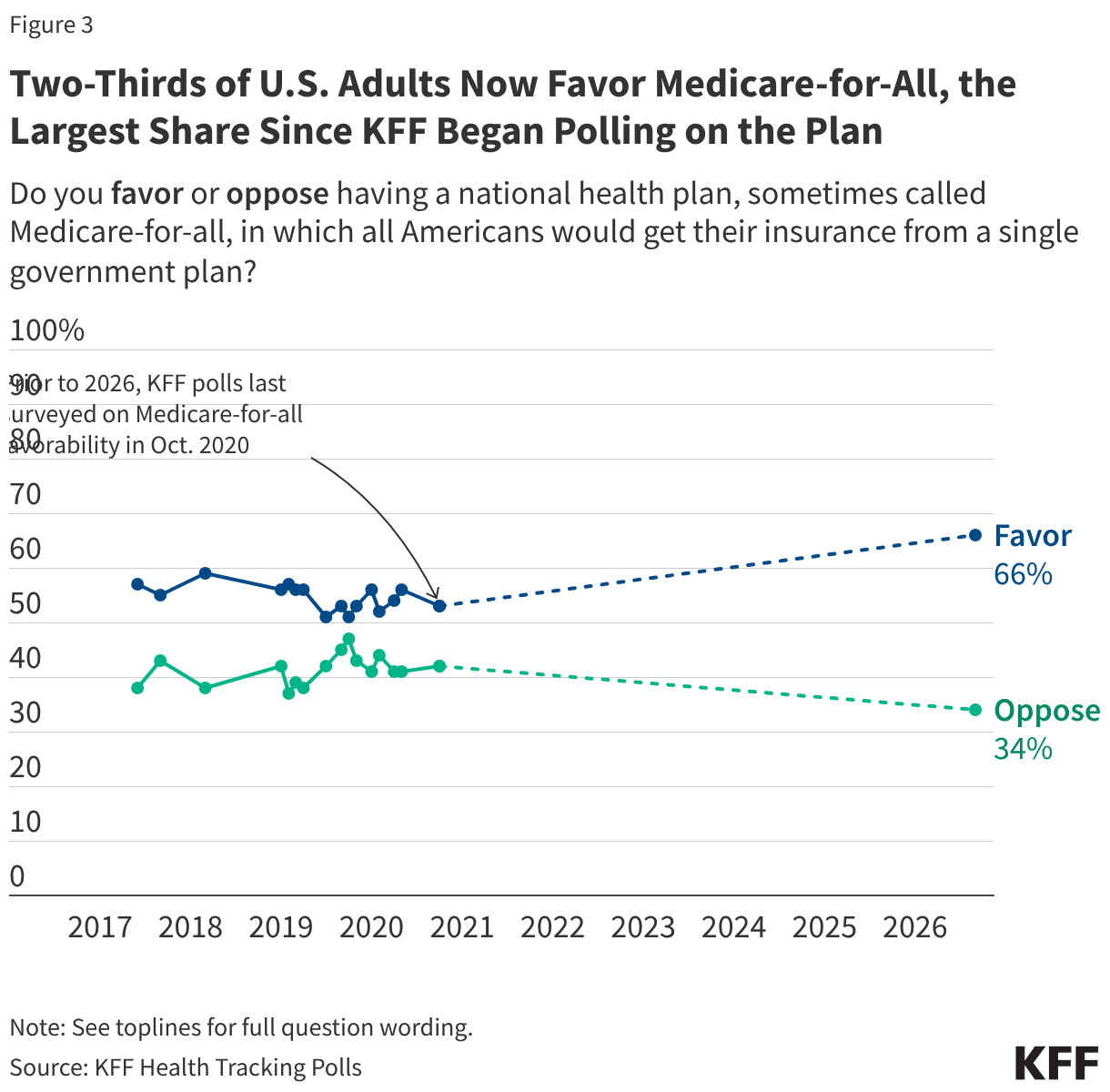
For many years, KFF has tracked public sentiment concerning national health plans, establishing specific tracking questions focused on Medicare-for-all since 2017. The September 2026 KFF Health Tracking Poll shows that two-thirds of the public, or 66%, now favor having a national health plan that consolidates insurance under a single government program. This marks a notable peak compared to historical trends, with opposition falling to roughly one-third of the population at 34%.
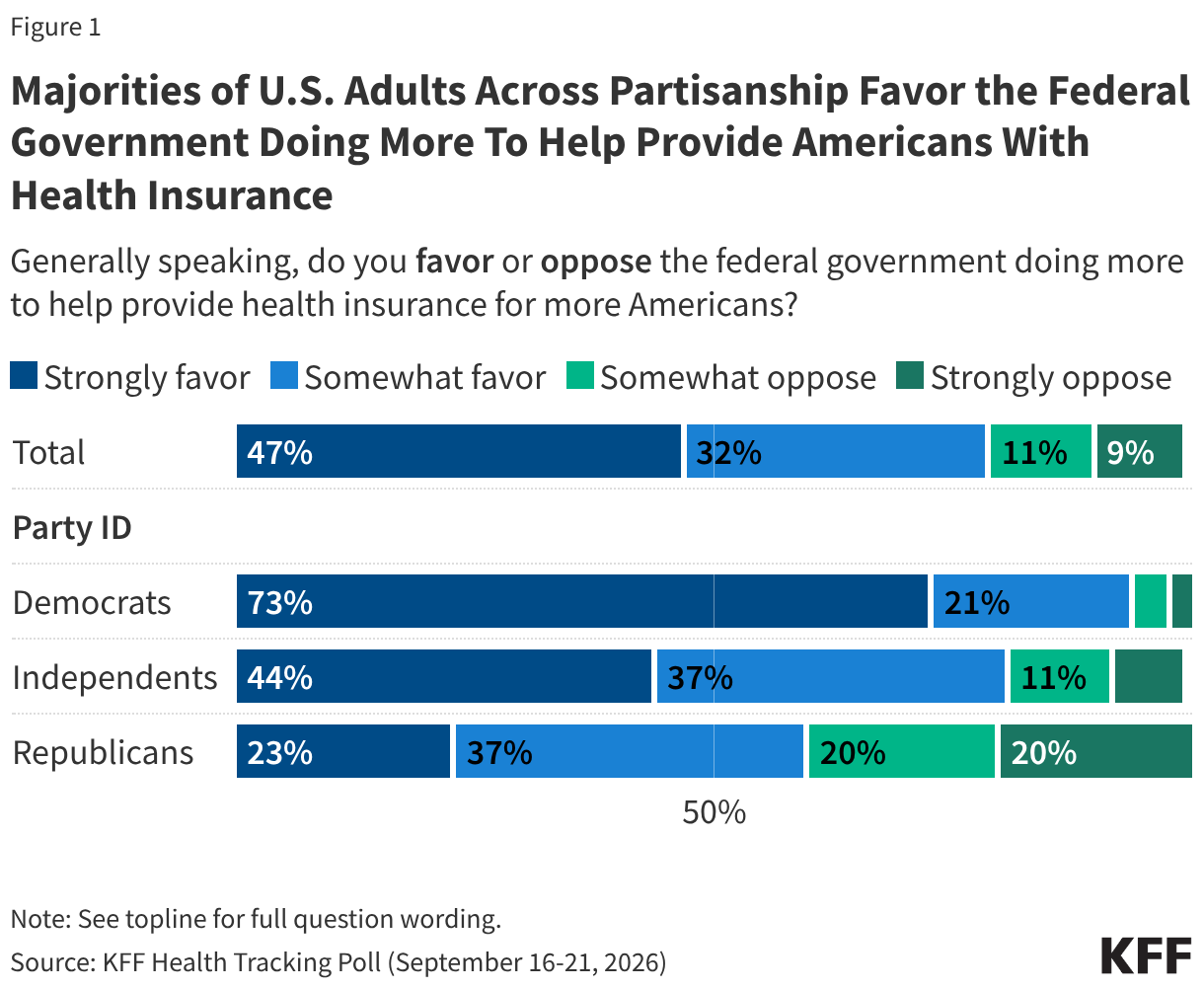
This renewed surge in popularity unfolds against a broader backdrop of persistent public support for government involvement in health insurance. When asked about the wider principle of the federal government doing more to help provide health coverage for more Americans, roughly eight in ten adults, or 79%, express approval, while only one in five oppose a larger federal footprint. This sentiment transcends strict party lines, commanding support from nearly all Democrats at 94% and roughly eight in ten independents at 82%. Even among Republicans, a majority of 61% favor a larger federal role in expanding health insurance access. This broad consensus is hardly a fleeting trend; KFF polling dating back to 2006 consistently shows that three-quarters or more of U.S. adults have favored the federal government stepping in to assist with insurance coverage over the past two decades.
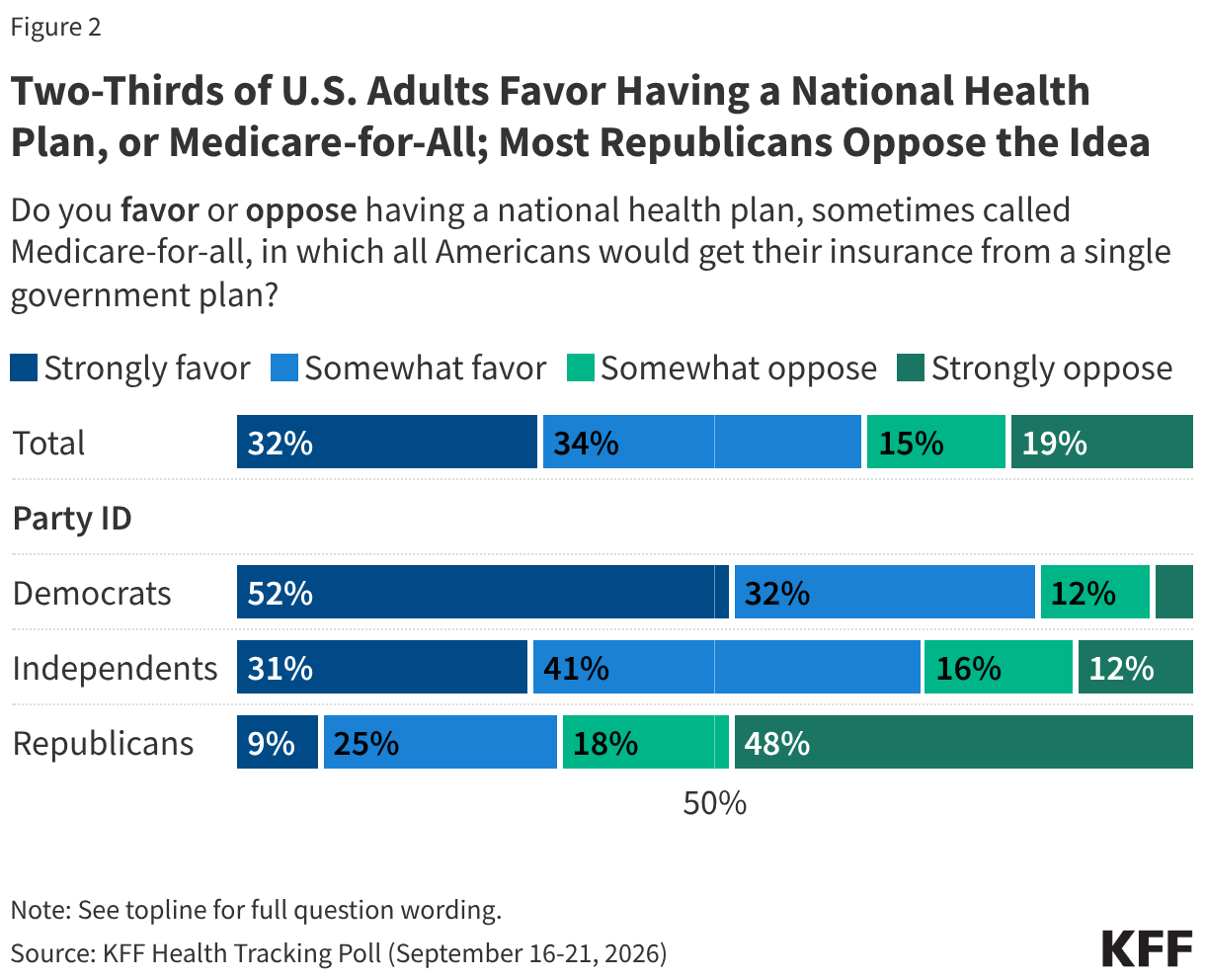
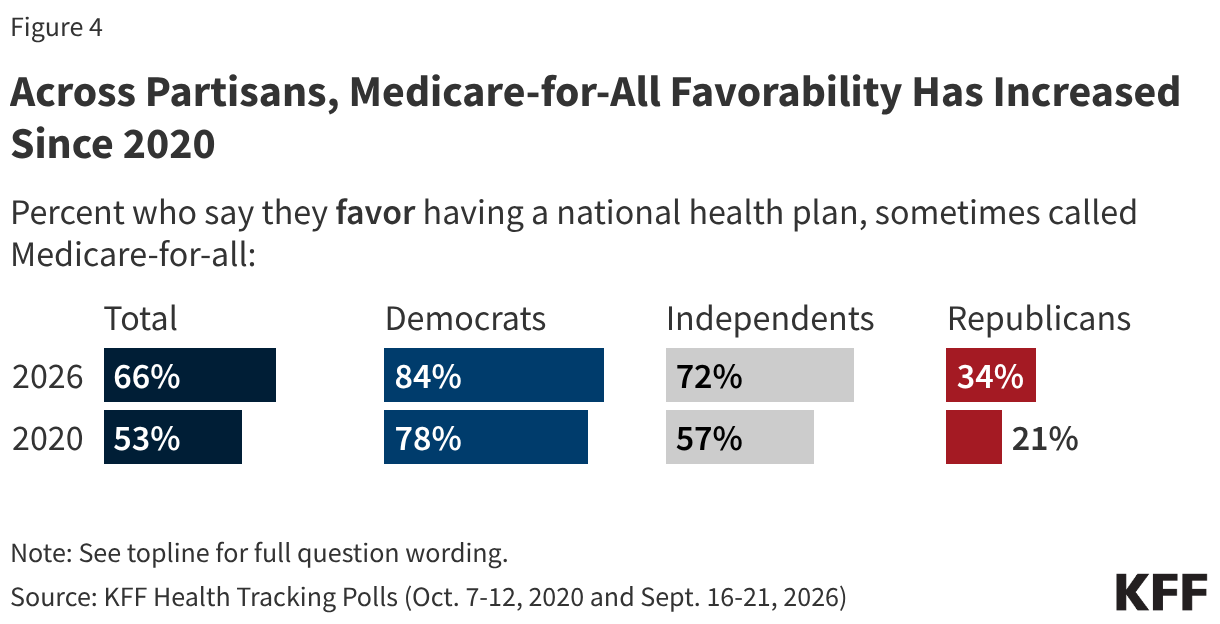
When examining the specific proposal of Medicare-for-all in the current 2026 political climate, stark partisan divisions reemerge, though support has grown across nearly every political affiliation since 2020. Among Democrats, backing remains exceptionally high at 84%, mirroring numbers from six years prior. Independents have seen a sharp increase, with about seven in ten, or 72%, now favoring the proposal, up significantly from less than six in ten at 57% in 2020. Republicans remain largely opposed, with 66% expressing disapproval—including about half who state they "strongly oppose" it. However, even within the GOP, support has crept upward, with one-third of Republicans now favoring the plan, compared to just one in five in 2020.
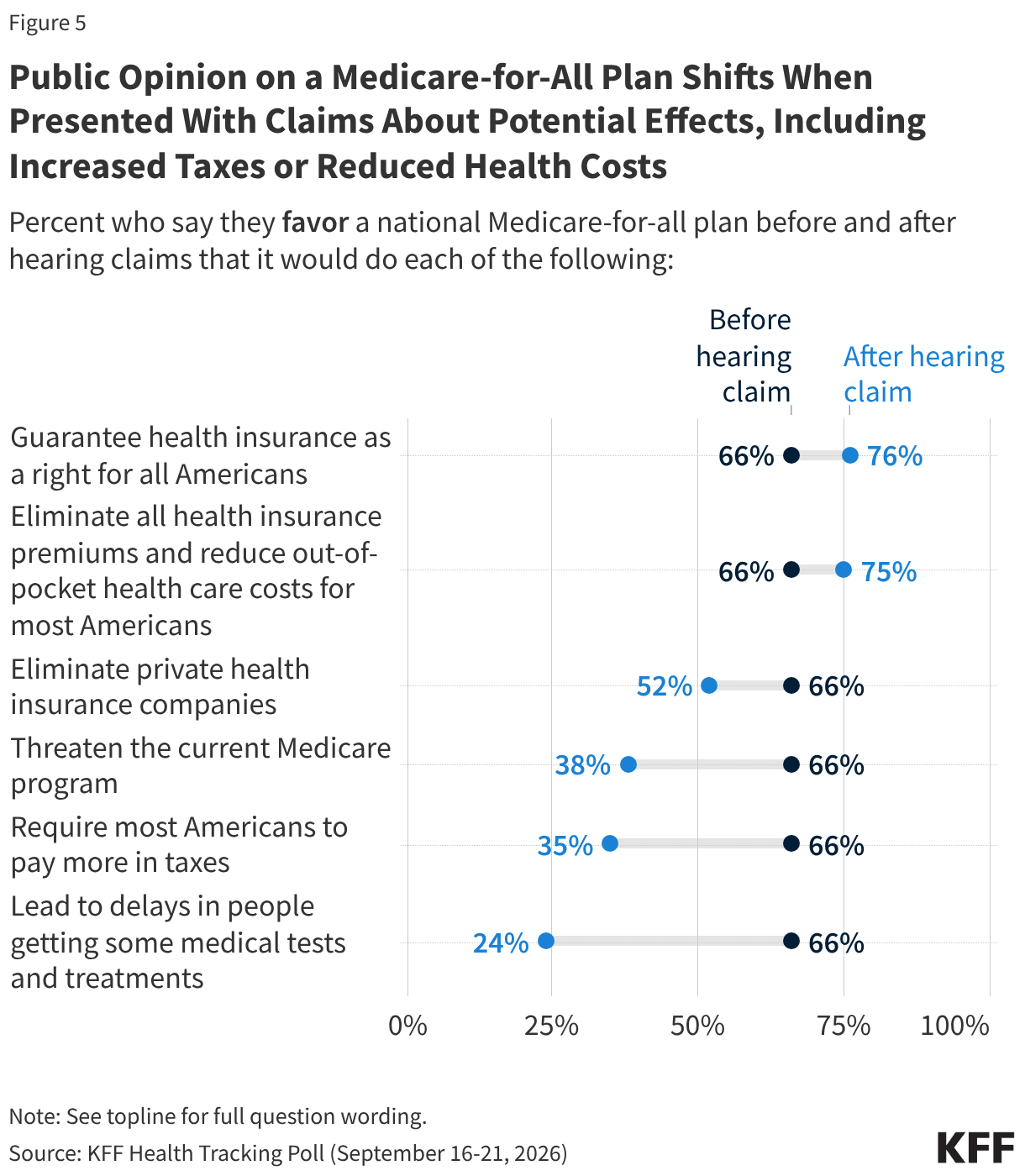
Despite this rising baseline support, KFF polling demonstrates that public opinion on Medicare-for-all remains remarkably malleable, shifting substantially when respondents are exposed to potential real-world arguments and policy consequences that typically dominate national debates. When informed that a Medicare-for-all system would guarantee health insurance as a universal right, eliminate all health insurance premiums, and significantly reduce out-of-pocket health care costs, overall favorability surges to as high as three-quarters of the public.
Conversely, enthusiasm plummets when respondents hear counter-arguments highlighting potential drawbacks. Favorability drops as low as one in four when individuals are told the system could lead to delays in receiving medical tests or treatments. It falls to roughly one-third when people learn the plan could trigger higher taxes, and to about four in ten when warned that it could threaten the viability of the traditional Medicare program.
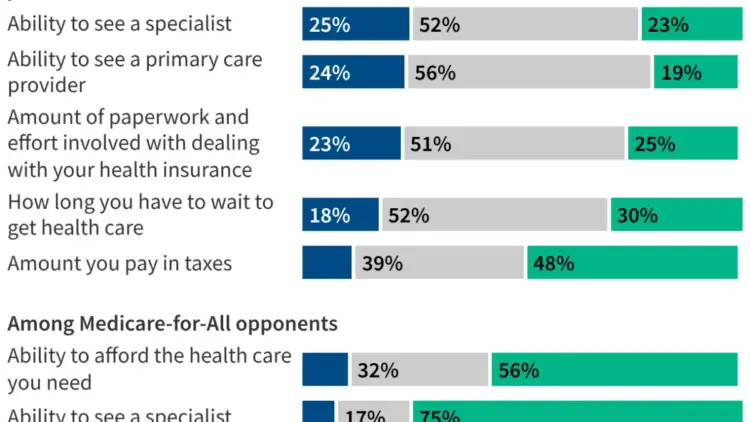
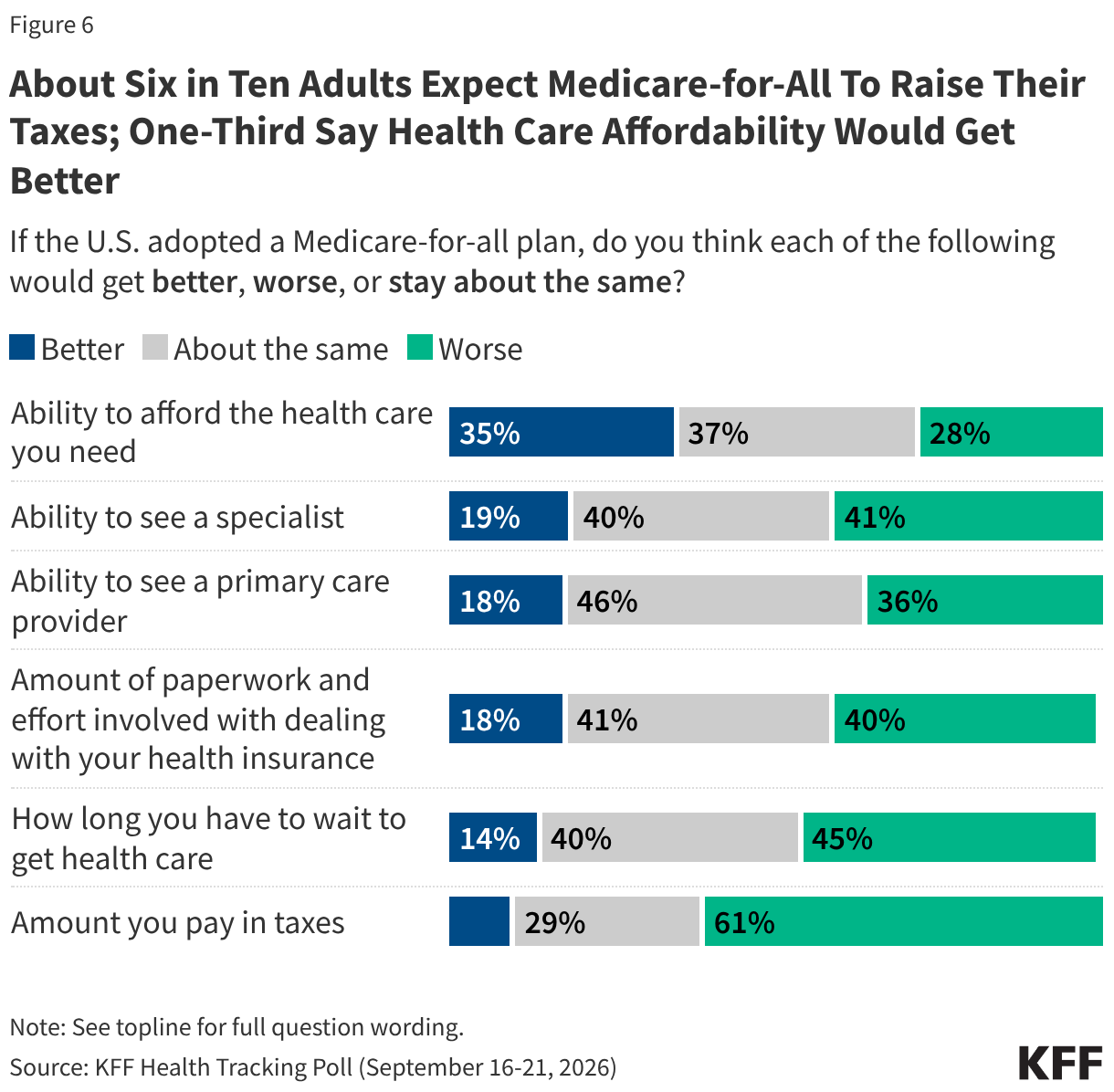
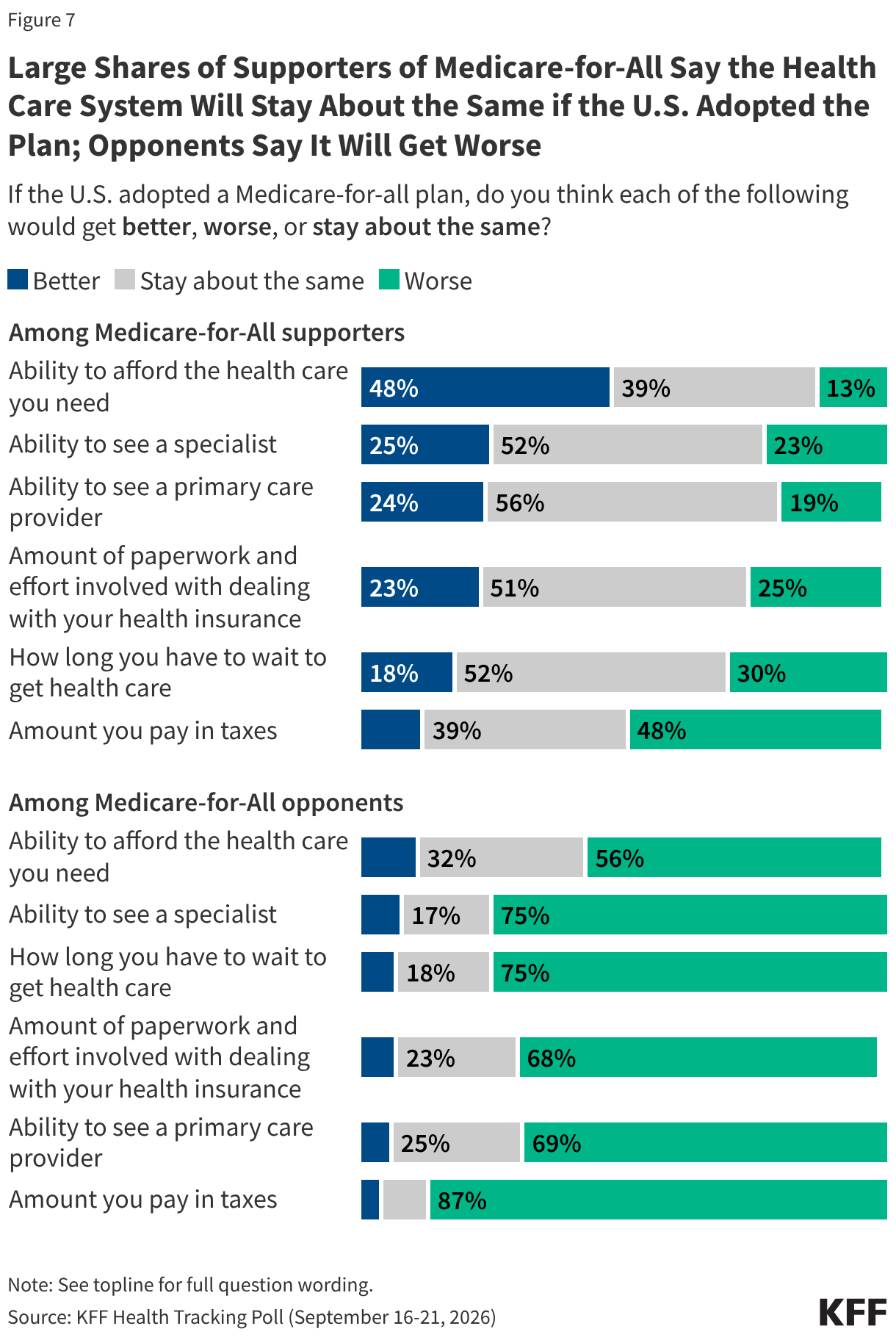
These competing narratives feed into mixed personal expectations among the American public regarding how a single-payer system would affect them individually. When asked to look inward, U.S. adults tend to lean more negative than positive on specific outcomes. Approximately one-third of adults believe their ability to afford necessary health care would improve under Medicare-for-all, while 28% predict it would worsen, and 37% expect no change.
When looking at broader systemic and financial impacts, the outlook darkens considerably in the eyes of many citizens. The vast majority of adults—about six in ten—expect their personal tax burden to worsen under a Medicare-for-all framework, compared to just one in ten who believe taxes would improve and nearly three in ten who expect them to stay about the same. For other metrics, such as provider access, wait times, and administrative paperwork, larger shares of the public expect conditions to either worsen or remain unchanged rather than improve.
Intriguingly, an analysis of those who support Medicare-for-all reveals that their advocacy persists despite holding mixed or even negative expectations about personal impacts. Among self-identified supporters of the plan, about half believe their health care affordability would improve, but an identical 48% expect their taxes to increase. Furthermore, at least half of Medicare-for-all supporters anticipate that their personal access to medical providers, wait times for treatment, and the volume of insurance paperwork will remain largely unchanged. By contrast, opponents of the plan are far more unified, with overwhelming majorities predicting that every tested metric of the health care system would deteriorate under a single-payer structure.
Another critical dynamic revealed in the polling data centers on public perceptions of private insurance. Roughly six in ten privately insured adults—including those with coverage through an employer or purchased directly—believe it is likely they would be able to keep their current health insurance if the United States adopted a Medicare-for-all system. This includes about seven in ten privately insured individuals who actively support Medicare-for-all.
This finding echoes a persistent misunderstanding documented in past KFF surveys, such as those conducted during the 2019 Democratic presidential primary debates. In reality, most prominent Medicare-for-all legislative proposals, including the landmark bills introduced by Senator Bernie Sanders beginning in 2017, are structured to replace nearly all current private health insurance with a single, comprehensive government-run plan.
A Historical Look at National Health Plan Polling
To fully understand the current trajectory of public opinion, it is helpful to examine the historical arc of national health plan polling. Long before Medicare-for-all became a central fixture of progressive campaigning in 2017, KFF polls tracked public sentiment regarding single-payer health plans as far back as 1998.
For nearly two decades leading up to the mid-2010s, fewer than half of U.S. adults consistently supported a national health plan. Throughout polls conducted between 1998 and 2004, roughly four in ten adults favored the concept, while a clear majority remained opposed. During the tumultuous national health reform debates surrounding the passage of the Affordable Care Act between 2008 and 2009, an average of KFF polls showed that just under half of the public supported a national plan at 46%, while about 49% opposed it. It was not until February 2016, amid robust policy discussions during that year’s presidential primary, that support ticked upward to reach an even split, with half of adults favoring a national health plan and roughly 43% opposed.
Phrasing the Question
Public opinion data also underscores how deeply terminology and question wording can shape survey outcomes regarding national health care reform. KFF tracking data has repeatedly shown that the specific phrasing used to describe a policy proposal heavily influences whether respondents react positively or negatively.
A KFF Health Tracking Poll revealed that majorities of adults react favorably to terms such as "universal health coverage" at 63%, "Medicare-for-all" at 63%, and a "national health plan" at 59%. However, public warmth cools considerably when other descriptors are used. Only 49% expressed a positive reaction to the term "single-payer health insurance system," with about one in five respondents declining to offer an opinion either way. Meanwhile, public sentiment was evenly divided over the phrase "socialized medicine," with 46% viewing it positively and 44% negatively.
Furthermore, the structural design and wording of survey questions themselves can dramatically alter the measured level of public support. Polls conducted in 2017 illustrate that whether a survey explicitly mentions tax financing, frames the system as a replacement for existing coverage, or provides respondents with an explicit "don’t know" option yields vastly different results. For instance, a September 2017 Politico/Harvard poll found that less than half of respondents favored replacing the current insurance system with a "single-payer system," whereas two-thirds supported replacing it with a "taxpayer-funded national plan like Medicare."
When polls explicitly introduce the reality of tax financing, measured support ranges from an even split in a 2017 NBC/Wall Street Journal survey to a solid majority in a CNN poll from the same year. Moreover, when surveys explicitly give respondents the explicit permission to state that they do not know enough about the topic—such as a November 2017 Gallup poll—the proportion of active supporters and opponents shrinks dramatically, leaving the vast majority of the public to report that they simply lack sufficient information to take a definitive stance.



