
The United States government is actively reshaping its international health footprint under a new policy framework, initiating a wave of bilateral cooperation agreements that shift a greater share of financial responsibility onto partner nations. The framework, formally introduced as the "America First Global Health Strategy" on September 18, 2025, outlines a fundamental redesign of how Washington engages in global health assistance. At the core of this strategy is the establishment of bilateral Memorandums of Understanding (MOUs) between the United States and countries that traditionally receive U.S. global health assistance. These agreements function as structured five-year roadmaps—typically spanning the 2026 to 2030 period—designed to transition foreign-supported programs toward sustainable, long-term country ownership.
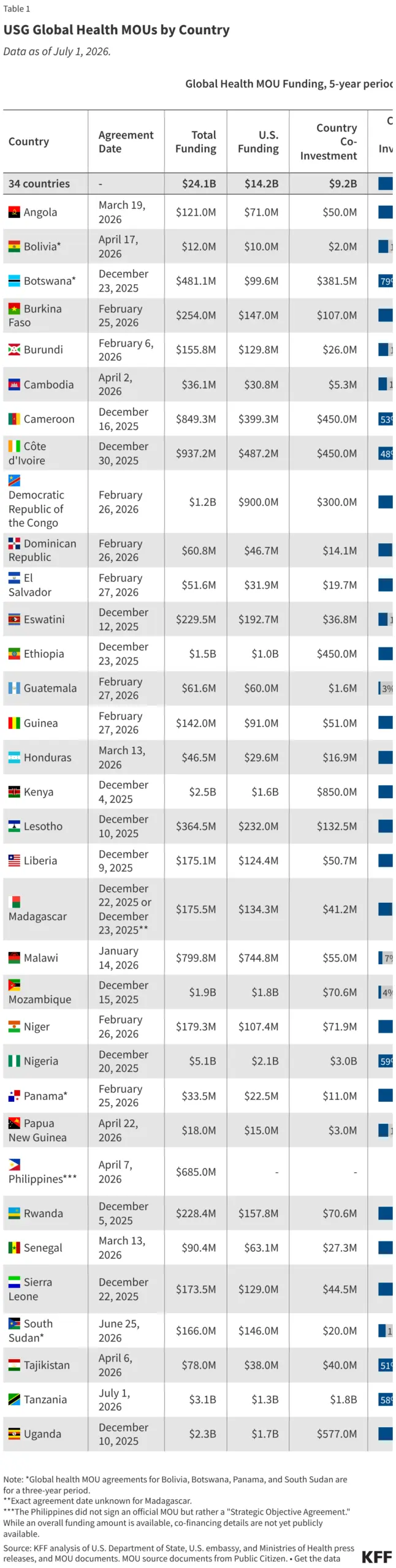
As the implementation phase gets underway, newly compiled data from tracking initiatives provide a comprehensive look at the scope, financial shifts, and programmatic priorities of these agreements. According to updates covering data gathered up to July 1, 2026, and subsequently revised through September 2026, the U.S. has successfully signed agreements with 34 countries. While the primary objective of these MOUs is to help nations build more resilient and durable domestic health systems, they also formalize a reciprocal pledge: partner governments commit to progressively increasing their domestic health spending and co-investing in their own health sectors as U.S. financial assistance scales down.
The rollout of these agreements has varied in duration and formal structure depending on the jurisdiction. While the vast majority follow the standard five-year planning cycle, global health MOU agreements for Bolivia, Botswana, Panama, and South Sudan are structured for a shorter three-year period. Meanwhile, the Philippines took a slightly different path, signing a "Strategic Objective Agreement" rather than a traditional MOU. While an overall funding amount has been established for the Philippines, specific co-financing details remain unavailable to the public at this stage of the process.

An analysis of the financial commitments embedded within the signed agreements reveals a notable contraction in total U.S. funding. Across the 34 countries with active agreements, historical funding levels—measured by appropriated and planned amounts for fiscal years 2021 through 2023, alongside requested amounts for fiscal years 2024 and 2025 within the Global Health Programs account—stand in stark contrast to the newly proposed allocations. Specifically, the data indicates a combined funding reduction of approximately $7.3 billion, representing a 34 percent decrease in U.S. global health support across these partner countries over the five-year MOU lifespan.
These comparative figures highlight the dual nature of the America First Global Health Strategy: while partner nations are stepping up their domestic co-investment shares, the absolute volume of U.S. bilateral assistance in these specific regions is experiencing a managed contraction. For Botswana and South Sudan, prior funding baselines used for comparison represent planned global health funding for the 2023 through 2025 fiscal years. Due to limitations in historical data availability, direct funding comparisons could not be generated for Bolivia and Panama.

The mechanisms driving these agreements rely heavily on public disclosures, official press releases, and available legal texts. Because the tracking of these developments depends on announcements issued by the U.S. Department of State, American embassies abroad, and partner country Ministries of Health, the depth of publicly accessible information varies significantly by nation. Complete MOU texts—which offer the most granular insights into annual financial breakdowns, specific program targets, and exact co-financing milestones—are publicly accessible for only a portion of the signatory countries. Where full MOU documents are available, overall financial totals are calculated by summing the annual figures outlined directly within the text.
Programmatic priorities within the agreements are identified primarily through targeted keyword searches of official statements and documents. Global health security, for instance, is tracked as a core focus area when country agreements explicitly cite the term or incorporate detailed descriptions of outbreak preparedness, disease response, and the containment of emerging health threats. Because many official press releases rely on high-level summaries rather than exhaustive policy breakdowns, analysts note that these public records may not fully capture every specific public health program or localized initiative targeted within an individual country’s agreement.
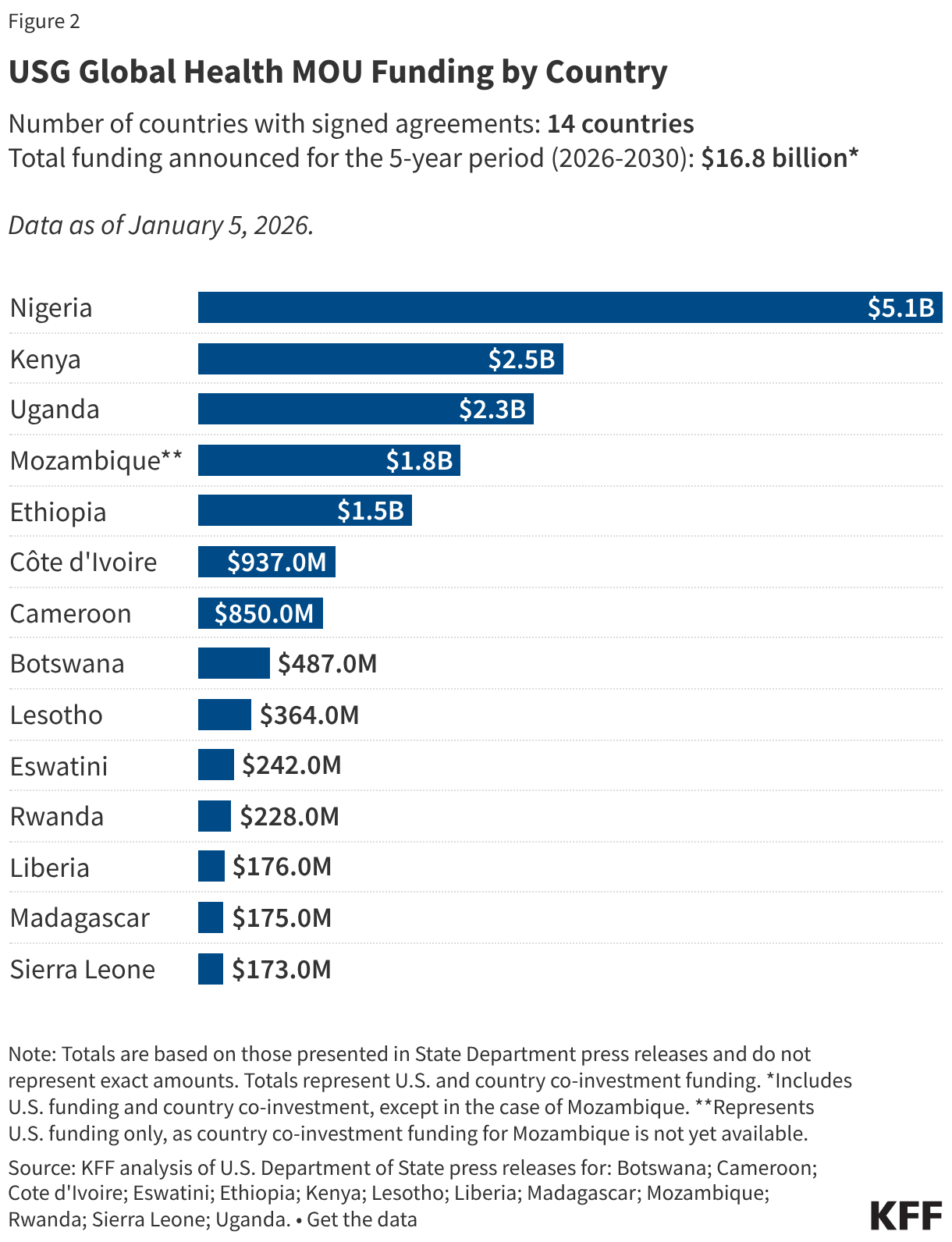
As the U.S. government and its international partners continue to process and implement these agreements throughout the year, tracking mechanisms remain active. The underlying data resource, originally launched in January 2026, continues to be updated as additional bilateral documents are finalized, newly released texts become available, and further details regarding domestic co-investment emerge from partner capitals.



