
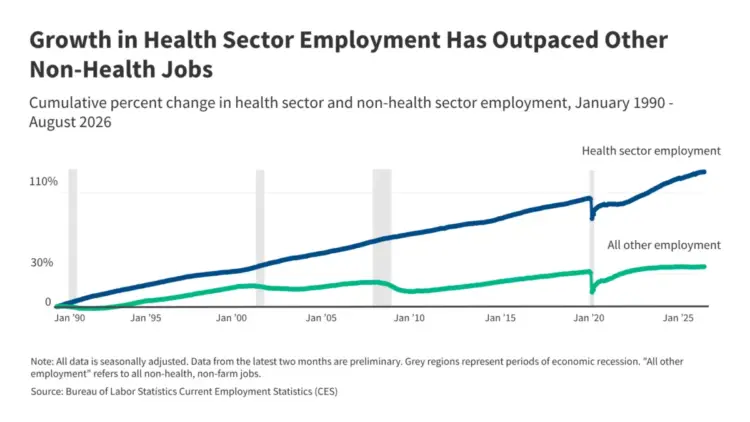
Employment within the United States health care sector continues to surge ahead of the broader economy, driven by sustained demand and shifting care delivery models, according to an updated analysis of federal labor data released by the Peterson-KFF Health System Tracker.
The newly updated chart collection, which tracks long-term trends and recent developments across the American labor market, reveals a striking divergence between health sector employment and the rest of the non-farm economy. While job growth across other non-farm sectors has largely plateaued, the health care industry has maintained a steady and robust upward trajectory. Over the past year alone, the health sector added 378,500 jobs, representing a solid 2% increase. By comparison, growth in non-health, non-farm employment crawled at a meager 0.2% over the same period, underscoring the unique economic engine that the health care industry continues to represent amid broader macroeconomic uncertainties.
This continuous expansion has elevated the health care sector’s footprint within the national workforce to historic levels. Health care jobs now account for 11.6% of all non-farm employment across the United States. This represents a noticeable climb from a decade ago, when health care positions made up 10.7% of the total non-farm job market. Looking back over a longer historical horizon, the divergence becomes even more pronounced. Since 1990, health sector employment has expanded at a rate more than three times that of all other non-health, non-farm employment sectors combined.
A closer examination of where these jobs are being created points to a significant structural evolution in how medical care is delivered to patients nationwide. The most dramatic employment increases have occurred within outpatient settings, which have seen a staggering 40% surge in jobs since August 2016. This shift reflects a broader healthcare industry transition away from traditional inpatient hospital settings toward outpatient clinics, ambulatory surgery centers, urgent care facilities, and home-based care models, driven by technological advancements, patient preferences, and payer incentives.
Despite the remarkable pace of hiring, the data also highlights shifts in compensation trends within the industry. Over the past three years, health care wage growth has cooled slightly when compared to the broader economy and other industries. This dynamic comes at a time when health systems and medical practices across the country are navigating complex financial landscapes, balancing the necessity of aggressive recruitment and retention efforts against budgetary pressures.
The comprehensive chart collection detailing these labor market dynamics is publicly available on the Peterson-KFF Health System Tracker, an online information hub dedicated to monitoring, analyzing, and assessing the performance, accessibility, and overall quality of the U.S. health system. Through ongoing analyses of federal databases and labor statistics, the platform continues to provide vital insights into the intersection of health care economics and the American workforce.



