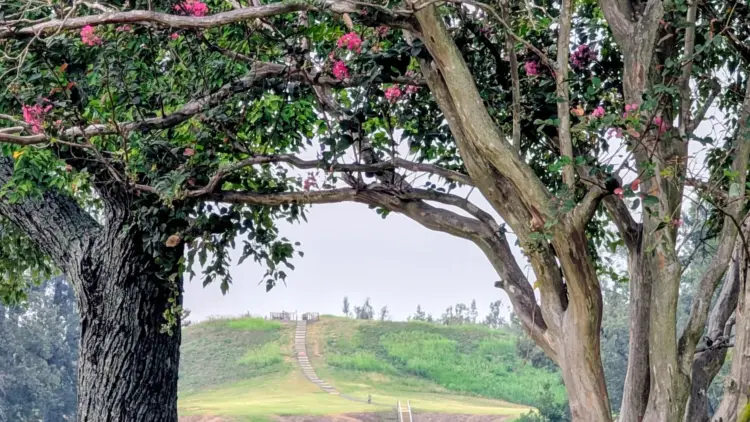
Poverty Point World Heritage Site in rural northeast Louisiana stands as one of North America’s most significant prehistoric earthen landmark complexes. For visitors who use wheelchairs or have limited mobility, an evaluation of the historic park reveals a location that delivers strong accessibility in key areas—most notably its educational museum, orientation theater, and custom-equipped guided tram tour—while presenting distinct physical challenges across its outdoor paved areas, trail networks, and dining facilities.
While the site permits visitors with physical disabilities to experience its remarkable ancient earthworks, navigating the broader grounds requires careful advance planning. The highlights of the facility include an accessible open-air tram outfitted with fold-out ramps and securement systems, a seamless museum experience featuring table-height artifact displays, and spacious restroom facilities. However, visitors must contend with deteriorating concrete paving joints that threaten small front casters, an absence of accessible hiking trails or routes to the mound summits, and a complete lack of wheelchair-accessible picnic tables.
Location, Logistics, and Visitor Planning
Located at 6859 Highway 577 in Pioneer, Louisiana, Poverty Point sits in a remote, rural stretch of West Carroll Parish. Travelers arriving via Interstate 20 are advised to take the Delhi exit and navigate north toward Epps before following the brown state park directional signs along LA-577. Travel time to the site is approximately one hour from Monroe, Louisiana, and roughly one hour and thirty minutes from Vicksburg, Mississippi. Because commercial services and amenities
in the immediate surrounding countryside are sparse, visitors should secure fuel, beverages, and meals prior to arriving in the area.
The state historic site operates daily from 9:00 a.m. to 5:00 p.m., with annual closures on Thanksgiving Day, Christmas Day, and New Year’s Day. Entry fees are structured around a modest per-person general admission charge, with reduced rates available for senior citizens and free entry granted to young children.
To experience the park’s primary accessible feature—the guided tram tour—visitors must purchase a separate, higher-priced ticket that encompasses standard park admission. Senior discounts apply to tram tickets as well, and young children ride free of charge. The tram operates on a set schedule from Wednesday through Sunday, departing at 10:00 a.m., 11:30 a.m., 1:00 p.m., and 3:00 p.m., subject to favorable weather conditions.
Because the guided tram ride offers the most direct and comfortable way to view the extensive earthwork complex without traversing miles of open turf, planning a visit between Wednesday and Sunday is strongly recommended. Prospective visitors are advised to contact park personnel in advance at 318-926-5492 or toll-free at 888-926-5492. Calling ahead allows staff to confirm operational schedules and ensure the tram’s boarding ramp is deployed and prepared prior to arrival.
On days when the tram is not running or during off-peak visits, guests retain the option to drive their personal cars or vans along the same paved loop road used by the tram, or to walk and roll along the roadway. Due to the open, unsheltered layout of the landscape, carrying water and sun protection is essential during warmer months.
Parking, Site Arrival, and Navigational Hazards
Arrival at Poverty Point is straightforward, featuring dedicated, clearly signed accessible parking stalls situated near the ranger station and restroom facility. The main parking lot features a paved asphalt surface suitable for manual and powered mobility devices.
Adjacent to the parking area, a covered outdoor gallery displays a series of informational panels detailing the history and geographical layout of the ancient mound complex, complete with site maps. The panels are mounted at an appropriate height, allowing visitors seated in wheelchairs to read the text and view graphics comfortably.
However, the ground surface beneath and surrounding these informational panels presents a notable hazard for wheelchair users. The paving consists of large, triangular concrete slabs formatted in alternating smooth and exposed-aggregate textures. Over time, the joints between these concrete sections have separated into wide cracks and deep gaps that frequently collect leaves and natural debris. Additionally, vertical displacement between adjacent panels has created uneven lips. Small front caster wheels on wheelchairs can easily drop into these gaps or catch against raised edges, causing abrupt stops. Navigating this area requires slow movement and crossing panel joints at an angle.
A similar surface issue affects the nearby mound overlook—a hexagonal concrete viewing platform bounded by low timber retaining walls that faces the site’s primary earthworks across an open field. Constructed with the same triangular concrete slab arrangement, the platform features identical wide gaps and cracked joints that require cautious rolling.
Access from the parking lot to the elevated sidewalk network is provided by a concrete curb ramp painted blue. Although the protective paint shows signs of weathering and chipping, the structural incline of the ramp remains functional and navigable.
Museum Exhibits and Film Theater Access
The park’s museum serves as the most thoroughly accessible structure on the property. A wide, gently sloped concrete walkway provides a direct pathway from the parking lot to the main entrance without intervening steps or thresholds. Entrance is made through double glass doors resting over a flat threshold mat. Because the entrance lacks an automated push-button door operator, visitors using manual chairs may require assistance when opening the heavy doors.
Once inside, the museum interior is lined with smooth, low-pile carpeting that minimizes rolling resistance. The display room is designed with wide aisles, providing ample turning clearance and allowing multiple visitors or mobility devices to pass comfortably. Artifact display cases constructed of clear glass are positioned at table height, allowing seated visitors an unobstructed view of ancient stone tools, intricate beads, and clay cooking balls recovered from the site. While display cases are positioned thoughtfully, certain large wall-mounted text panels feature smaller explanatory print positioned high on the boards, which can cause neck strain for seated viewers.
The site’s orientation theater, which screens an introductory film covering the archaeological history of Poverty Point, is fully accessible. Rather than using fixed theater seating or tiered rows, the room contains loose, movable chairs resting on a level carpeted floor. This flexible layout allows wheelchair users to park in any preferred location throughout the space or request that staff reposition chairs to accommodate companions.
Restroom Facilities and Interior Accessibility
Public restrooms are located in a standalone structure adjacent to the main parking lot. The building is accessed via a concrete ramp flanked by green metal handrails on both sides. The ramp features a gentle incline, a switchback turn, and a wide, level landing at the entrance doorway. Entry doors are marked with standard accessibility symbols. Because cleaning crews maintain the facilities frequently, floor tiles inside can become slick, a condition occasionally marked by cautionary wet-floor signage.
The single accessible stall within the restroom is spacious, offering a generous turning radius for larger power chairs or scooters and permitting side-transfer positioning. The stall is fitted with a wall-mounted toilet backed by standard grab bars along the rear and side walls.
However, the placement of the toilet paper dispenser presents an accessibility flaw: it is installed high on the wall directly above the side grab bar, requiring an extended upward and lateral reach from a seated position.
Handwashing areas feature wall-hung sinks with sufficient knee clearance beneath and smooth lever-handled faucets. A critical oversight in the restroom design is the lack of protective insulation or wrapping on the exposed hot water supply and drain pipes beneath the sink, creating a burn or contact hazard for users with sensory impairments in their lower limbs. Automatic soap and paper towel dispensers are mounted higher than standard reach zones and offset to the side of the sink basin. On recent site visits, at least one soap dispenser was observed out of service. The restroom facility also includes a wall-mounted baby changing table.
The Guided Tram Tour Experience
The guided tram tour represents the signature accessible attraction at Poverty Point, delivering an immersive tour of the prehistoric mounds for individuals unable to traverse the expansive grassy terrain on foot. The tour utilizes open-air, green-painted tram units comprising a motorized tow unit pulling roofed passenger cars with open sides. The primary value of the tour stems from the ranger-led interpretation, which provides detailed historical context that self-guided motorists miss when driving the loop road independently.
To accommodate visitors with mobility devices, one tram car features a designated wheelchair seating area identified by an exterior accessibility icon. Upon request, park personnel flip up two standard bench seats to clear floor space, open a hinged side access gate, and deploy a lightweight, two-section folding aluminum ramp directly onto the asphalt pavement. The length of the ramp produces a manageable slope, and park staff actively assist passengers during boarding. Once positioned inside, passengers remain in their own wheelchairs while enjoying an unobstructed view through the open sides of the vehicle.
For vehicle safety during travel, the tram is equipped with a dedicated Q’Straint tie-down securement kit, which is stored in a protective bag adjacent to the wheelchair space. Passengers should request that the driving ranger attach the tie-down straps prior to departure, as the tram makes frequent stops, starts, and turns along the tour route.
During the excursion, the tram stops at an observation point adjacent to the earthworks. This area features a large, covered wooden shade pavilion built over a concrete pad set nearly flush with the road edge. The shelter contains fixed wooden benches while leaving open floor space for wheelchair users to maneuver under the roof. To protect the delicate archaeological integrity of the site, state park regulations strictly require all visitors to remain on designated pathways and viewing areas; consequently, the prehistoric earthworks are viewed from this sheltered perimeter rather than climbed.
Site Grounds, Paths, and Surface Conditions
Outside of the concrete walkways connecting the parking area, museum, restroom building, and main picnic pavilion, the vast majority of Poverty Point’s historic landscape consists of natural terrain and open turf.
The site’s formal hiking network consists of a 2.6-mile trail carved through mowed grass. The trail lacks hard-packed or paved surfaces, rendering it difficult or impassable for standard manual wheelchairs and mobility scooters, particularly after rainfall. Furthermore, there are no paved or accessible pathways leading up the steep slopes of the site’s prehistoric earthen mounds.
Visitors opting to roll along the main paved tour road rather than riding the tram must account for severe sun exposure, as the surrounding grounds feature minimal tree canopy or shade cover. Utilizing the tram remains the most effective method for exploring the grounds. While Louisiana State Parks maintains specialized all-terrain track chairs for public loan at select state parks, prospective visitors should contact Poverty Point management directly prior to traveling to inquire whether such equipment is currently hosted at this specific site.
Picnic Facilities and Outdoor Amenities
The outdoor dining options at Poverty Point exhibit significant accessibility gaps. None of the picnic tables installed across the park grounds are wheelchair accessible. The site utilizes standard metal-frame picnic tables featuring integrated benches attached along both sides without extended tabletop ends, preventing a wheelchair user from pulling under the table surface.
The park’s primary covered picnic pavilion is built upon a concrete slab adjacent to the museum walkway. While the edge of the concrete pad sits nearly flush with the adjoining sidewalk, encroaching grass, soil, and organic debris have accumulated along the seams. Internally, the pavilion layout is constricted; tables are positioned close together around structural wooden support posts, leaving narrow pathways that impede maneuvering. A secondary, larger pavilion nearby features identical standard seating configurations.
Additional open-air picnic tables are scattered beneath crape myrtle trees throughout the park. These tables sit directly on open lawn surfaces without connecting paved paths, concrete pads, or hardground access. Visitors planning to dine on site are advised to utilize personal lap trays or position their wheelchairs alongside the outer edges of the pavilion tables.
Detailed Summary of Site Accessibility Features
An overview of the site’s physical infrastructure highlights clear distinctions between accessible and restricted zones across the property:
- Guided Tram Tour: Fully accessible. Equipped with a two-section fold-out aluminum ramp, flip-up interior seating, dedicated floor space, and a Q’Straint tie-down system. Operates Wednesday through Sunday.
- Museum Facility: Fully accessible. Features level concrete approach paths, a flat threshold, low-pile indoor carpet, wide display aisles, and table-height glass artifact cases. Entrance doors are manual.
- Orientation Theater: Fully accessible. Utilizes an open, carpeted floor layout with loose, movable seating rather than fixed rows.
- Restroom Building: Accessible approach via a concrete ramp equipped with double handrails and a level landing. Interior stall offers a wide turning radius and side/rear grab bars, though the toilet paper dispenser is mounted high above the bar. Roll-under sinks feature lever handles, though plumbing pipes remain uninsulated.
- Site Overlook and Info Panels: Partially accessible. Informational panels are mounted at comfortable seated viewing heights, but surrounding triangular concrete paving features wide gaps, cracked joints, and uneven edges that present caster hazards.
- Tour Road Loop: Fully paved and accessible for personal cars, vans, walking, or rolling alongside tram traffic.
- Hiking Trails and Mounds: Inaccessible. The 2.6-mile trail system consists entirely of mowed grass, and no paved or accessible routes lead to the top of the earthwork mounds.
- Picnic Infrastructure: Inaccessible. All tables feature fixed side benches lacking open tabletop extensions, and open-air tables sit directly on grass without paved access routes.
Ultimately, Poverty Point World Heritage Site offers a worthwhile educational experience for visitors with mobility impairments, provided trips are scheduled between Wednesday and Sunday to take advantage of the museum film and accessible tram tour. Visitors should plan around the park’s outdoor physical limitations by exercising caution on cracked concrete walkways and making alternative arrangements for outdoor dining.